Calculating Time Difference and Length Contraction in Train Overtaking Scenario

  • Thread starter Thread starter Amrator
  • Start date Start date
  • Tags Tags
    Train
Click For Summary

Homework Help Overview

The discussion revolves around a scenario involving two trains, A and B, where train A has a proper length L and train B moves past A at a relative speed of 4c/5. The problem involves calculating the time difference between the moments when the fronts of the trains coincide and when their rears coincide, using concepts such as length contraction and the rear-clock-ahead effect.

Discussion Character

  • Mixed

Approaches and Questions Raised

  • Participants explore different methods to calculate the time difference, including length contraction and the rear-clock-ahead effect. Some express uncertainty about the correct interpretation of the problem and the calculations involved. There are discussions about the need for a more formulaic approach and the use of coordinates.

Discussion Status

Participants are actively engaging with the problem, questioning assumptions and interpretations. Some have offered guidance on using specific formulas and concepts, while others express confusion about the calculations and seek clarification on certain points.

Contextual Notes

There are indications of differing interpretations of the problem's requirements, particularly regarding the time it takes for the trains to completely pass each other. Participants also mention the importance of synchronisation of clocks in different frames and the relativity of simultaneity.

Amrator
Messages
246
Reaction score
83
Homework Statement
Train A has proper length ##L##. Train B moves past A (on a parallel track, facing the same direction) with relative speed ##\frac{4c}{5}## (as measured by either train; so each one sees the other move at ##\frac{4c}{5}##). The length of B is such that A says that the fronts of the trains coincide with at exactly the same time as backs coincide. What is the time difference between the fronts coinciding and the backs coinciding, as measured by B? Solve this in two ways: (a) by using length contraction, and (b) by using the rear-clock-ahead effect (among other things).
Relevant Equations
$$t_{observed} = \gamma t_{proper}$$
$$L_{observed} = \frac{L_{proper}} {\gamma}$$
$$t_R - t_L = \frac{Lv}{c^2}$$
$$V = \frac{u+v}{1+\frac{uv}{c^2}}$$
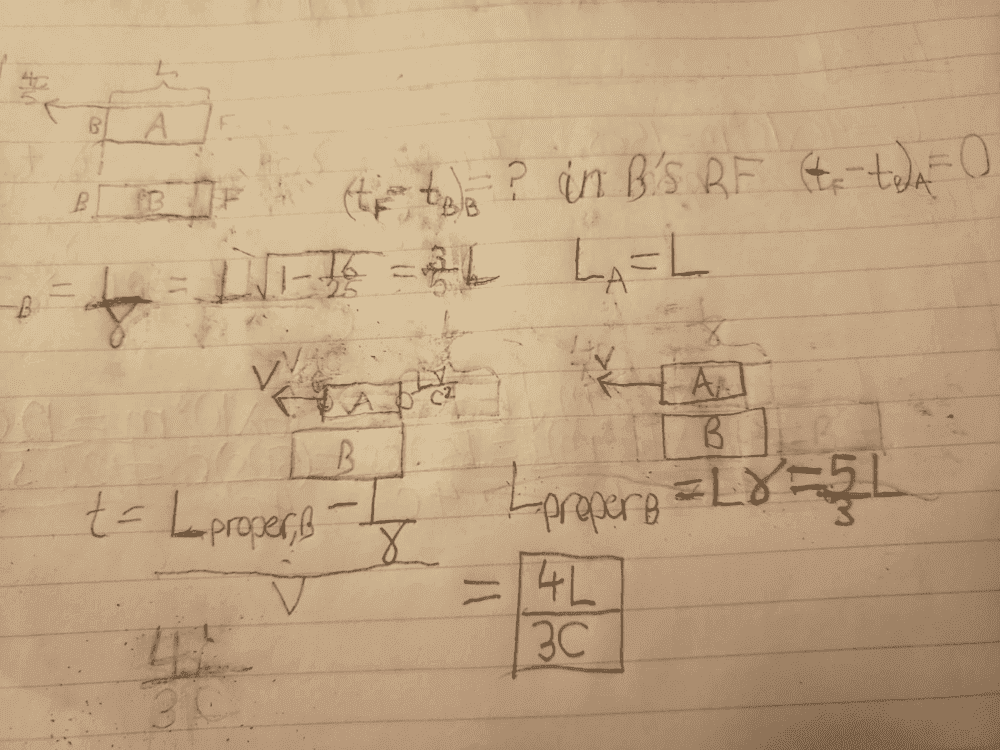
a) So I think I solved a. "The length of B is such that A says that the fronts of the trains coincide with at exactly the same time as backs coincide." This tells us that in A's frame, B has the same length as A. So ##L_{observed}## in A's frame is simply ##L##. To obtain the proper length of B, you would then simply multiply ##L## by ##\gamma##. In B's frame, the length of A is contracted by ##\frac{3}{5}##. Now, to obtain the time difference, we subtract the length contraction of A from the proper length of B, and we divide that result by the speed of A. Doing so gives us ##\frac{4L}{3c}##.

b) We have to use the rear-clock-ahead effect which is ##t_R - t_L = \frac{Lv}{c^2}##. The rear-clock-ahead effect basically states that if a train with length ##L## moves with speed##v## relative to you, then you observe the rear clock reading ##\frac{Lv}{c^2}## more than the front clock, at any given instant. So we have to add it to some other time to obtain the time difference. The issue I don't know how to get that time. At the initial time, the front clock will read ##-\frac{Lv}{c^2}##.
1599701459860.png
 
Last edited:
Physics news on Phys.org
Amrator said:
Homework Statement:: Train A has proper length ##L##. Train B moves past A (on a parallel track, facing the same direction) with relative speed ##\frac{4c}{5}## (as measured by either train; so each one sees the other move at ##\frac{4c}{5}##). The length of B is such that A says that the fronts of the trains coincide with at exactly the same time as backs coincide. What is the time difference between the fronts coinciding and the backs coinciding, as measured by B? Solve this in two ways: (a) by using length contraction, and (b) by using the rear-clock-ahead effect (among other things).
Relevant Equations:: $$t_{observed} = \gamma t_{proper}$$
$$L_{observed} = \frac{L_{proper}} {\gamma}$$
$$t_R - t_L = \frac{Lv}{c^2}$$
$$V = \frac{u+v}{1+\frac{uv}{c^2}}$$

a) So I think I solved a. "The length of B is such that A says that the fronts of the trains coincide with at exactly the same time as backs coincide." This tells us that in A's frame, B has the same length as A. So ##L_{observed}## in A's frame is simply ##L##. To obtain the proper length of B, you would then simply multiply ##L## by ##\gamma##. In B's frame, the length of A is contracted by ##\frac{3}{5}##. Now, to obtain the time difference, we subtract the length contraction of A from the proper length of B, and we divide that result by the speed of A. Doing so gives us ##\frac{4L}{3c}##.
`

I think you have calculated the wrong thing here. I think the question asks how long it takes the trains to completely pass each other: from when their fronts coincide until their rears coincide.

To do this using method b) you need to use coordinates and generally be more formulaic in your calculations.
 
PeroK said:
`

I think you have calculated the wrong thing here. I think the question asks how long it takes the trains to completely pass each other: from when their fronts coincide until their rears coincide.

To do this using method b) you need to use coordinates and generally be more formulaic in your calculations.
But they're facing the same direction.
 
Amrator said:
But they're facing the same direction.
Ah, yes. Sorry.
 
  • Like
Likes   Reactions: Amrator
Amrator said:
b) We have to use the rear-clock-ahead effect which is ##t_R - t_L = \frac{Lv}{c^2}##. The rear-clock-ahead effect basically states that if a train with length ##L## moves with speed##v## relative to you, then you observe the rear clock reading ##\frac{Lv}{c^2}## more than the front clock, at any given instant. So we have to add it to some other time to obtain the time difference. The issue I don't know how to get that time. At the initial time, the front clock will read ##-\frac{Lv}{c^2}##.

The idea is this. The ends being adjacent are simulatenous events in frame A. If there are two synchronised (in frame B) clocks at either end of train B, then these are not synchronised in frame ##A##. But, they do show the time in frame B of the two events (fronts adjacent and rears adjacent).

The difference in frame B is, therefore, equal to the lack of synchronisation as measured in frame A.

You need to check the particular formula for the rear-clock-ahead. And be careful about what length to use.

It's also worth using the Lorentz Transformation to solve this problem.
 
PeroK said:
`

I think you have calculated the wrong thing here. I think the question asks how long it takes the trains to completely pass each other: from when their fronts coincide until their rears coincide.

To do this using method b) you need to use coordinates and generally be more formulaic in your calculations.
I apologize @PeroK, but could you elaborate for part b?
 
Amrator said:
I apologize @PeroK, but could you elaborate for part b?
I just beat you to it.
 
  • Like
Likes   Reactions: Amrator
PeroK said:
The idea is this. The ends being adjacent are simulatenous events in frame A. If there are two synchronised (in frame B) clocks at either end of train B, then these are not synchronised in frame ##A##. But, they do show the time in frame B of the two events (fronts adjacent and rears adjacent).

The difference in frame B is, therefore, equal to the lack of synchronisation as measured in frame A.

You need to check the particular formula for the rear-clock-ahead. And be careful about what length to use.

It's also worth using the Lorentz Transformation to solve this problem.
Why is that?
 
Amrator said:
Why is that?
That's the relativity of simultaneity. If I were teaching SR I would teach that first so the students would never forget it!
 
  • #10
PeroK said:
The idea is this. The ends being adjacent are simulatenous events in frame A. If there are two synchronised (in frame B) clocks at either end of train B, then these are not synchronised in frame ##A##. But, they do show the time in frame B of the two events (fronts adjacent and rears adjacent).

The difference in frame B is, therefore, equal to the lack of synchronisation as measured in frame A.

You need to check the particular formula for the rear-clock-ahead. And be careful about what length to use.

It's also worth using the Lorentz Transformation to solve this problem.
I don't know. I'm lost. I tried doing ##\frac{Lv}{c^2} + \frac{L}{\gamma^{2}v}## But that didn't give me the same answer as a...
 
  • #12
Your answer to (a) looks good.

Amrator said:
b) We have to use the rear-clock-ahead effect which is ##t_R - t_L = \frac{Lv}{c^2}##. The rear-clock-ahead effect basically states that if a train with length ##L## moves with speed##v## relative to you, then you observe the rear clock reading ##\frac{Lv}{c^2}## more than the front clock, at any given instant.
Yes

So we have to add it to some other time to obtain the time difference.
Why do you say this? Doesn't ##\frac{Lv}{c^2}## (with the appropriate L) already give you the answer?
 

Similar threads

  • · Replies 6 ·
Replies
6
Views
5K
  • · Replies 14 ·
Replies
14
Views
3K
  • · Replies 7 ·
Replies
7
Views
1K
  • · Replies 54 ·
2
Replies
54
Views
5K
  • · Replies 13 ·
Replies
13
Views
2K
Replies
2
Views
2K
  • · Replies 67 ·
3
Replies
67
Views
5K
  • · Replies 1 ·
Replies
1
Views
2K
  • · Replies 13 ·
Replies
13
Views
3K
  • · Replies 12 ·
Replies
12
Views
3K