Calculating Torque for Steel Fixture at 90 Degrees

  • Thread starter Thread starter SevenToFive
  • Start date Start date
  • Tags Tags
    Torque
Click For Summary
SUMMARY

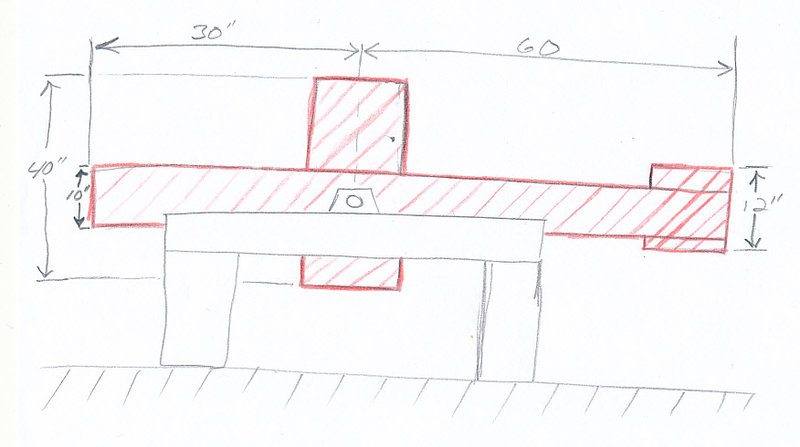
The discussion focuses on calculating the torque required to rotate a 3600lbs steel fixture made from 10-inch steel channel, which rotates 90 degrees around a pivot point located at its center. The user initially estimates the torque by multiplying the force of 30lbs applied at the end of the fixture (12 inches from the edge) by the distance to the pivot point (60 inches), resulting in 1800 in-lbs. However, participants emphasize the need to account for static friction (stiction), suggesting that the actual torque requirement may be at least double this estimate due to the influence of bearings and lubrication conditions.

PREREQUISITES
  • Understanding of torque calculations and units (in-lbs)
  • Familiarity with static friction and its impact on mechanical systems
  • Knowledge of mechanical design principles, particularly regarding pivot points
  • Experience with steel material properties and their implications in structural design
NEXT STEPS
  • Research the effects of static friction on torque calculations in mechanical systems
  • Learn about gearbox selection and its impact on torque transmission
  • Explore the principles of pivot mechanics and their applications in engineering design
  • Investigate lubrication techniques and their effects on reducing stiction in mechanical assemblies
USEFUL FOR

Mechanical engineers, designers of rotating fixtures, and anyone involved in the calculation of torque for heavy machinery applications will benefit from this discussion.

SevenToFive
Messages
56
Reaction score
3
The red section of this fixture rotates 90 degrees it weighs 3600lbs, and is 130 inches wide. It is made out of 10 inch steel channel. On the left of the drawing is the dimension of 40" and the pivot point is actually in the center.
We can rotate it by hand if you grab onto the end that is 12" and it takes approximately 30lbs force applied to the end. If we want to add a gearbox to drive this fixture would it simply be multiplying the 30lbs by 60 inches that is the end of the fixture to the pivot point? Giving me 1800 in-lbs? It doesn't seem like enough. Or am I just greatly over simplifying this? Any help is greatly appreciated.
IMG_0001.jpg
 
Engineering news on Phys.org
You say the red section rotates 90 degrees, but you do not say what axis it rotates about. The whole question really need clarification.
 
Dr.D said:
You say the red section rotates 90 degrees, but you do not say what axis it rotates about. The whole question really need clarification.

The red section rotates around the circle which runs through the fixture where the intersection of the red section running left and right and the red portion running up and down.
 
To be sure we understand, you are actually rotating the arm vertically around the table pivot shaft, correct?
 
Hopefully this drawing will help clear things up. Thanks to everyone who replies.

IMG.jpg
 
Due to stiction (static friction), you wil probably need at least twice that torque to get it started; depends entirely on the bearings and lubricant. I still remember a textbook example from half a century ago that stated: "It takes 10 men to start a loaded railroad boxcar moving but one man can keep it moving."
 

Similar threads

  • · Replies 10 ·
Replies
10
Views
13K
Replies
5
Views
5K
  • · Replies 14 ·
Replies
14
Views
2K
  • · Replies 7 ·
Replies
7
Views
6K
  • · Replies 19 ·
Replies
19
Views
4K
  • · Replies 1 ·
Replies
1
Views
2K
Replies
13
Views
3K
  • · Replies 8 ·
Replies
8
Views
3K
  • · Replies 7 ·
Replies
7
Views
3K
Replies
1
Views
1K