Calculating Volume of a Solid by Subtracting Volumes of Basic Shapes

  • Topic:
  • Thread starter Thread starter mathlearn
  • Start date Start date
  • Tags Tags
    Cylinder Volume
Join the discussion
Registration is free. Start your own thread to ask a follow-up.
3 replies · 2K views
mathlearn
Messages
331
Reaction score
0
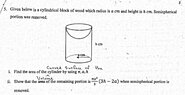
Please solve this problem

View attachment 5776

:)
 

Attachments

  • New Document 217-Page 2.jpg
    New Document 217-Page 2.jpg
    112.8 KB · Views: 171
Last edited by a moderator:
Mathematics news on Phys.org
mathlearn said:
Please solve this problem

:)

Good evening and welcome to MHB! :D

We ask that our users show their progress (work thus far or thoughts on how to begin) when posting questions. This way our helpers can see where you are stuck or may be going astray and will be able to post the best help possible without potentially making a suggestion which you have already tried, which would waste your time and that of the helper.

It is also MHB policy to not answer questions which are for credit or for exams.

Can you post what you have done so far?
 
Thank you super Sonic

So far

I calculated the volume of the cyclinder by taking "a" as the radius π(pie)a^2h

and I calculated the volume of the hemisphere (4/3πr^3)

and that was so far
 
Okay, using your formulas, we have the volume of a cylinder having radius $a$ as:

$$V_C=\pi a^2h$$

And the volume of a hemisphere of radius $a$ as:

$$V_H=\frac{2}{3}\pi a^3$$

Now, in order to find the volume of the given solid, we need to take the volume of the cylinder and remove (subtract) the volume of the hemisphere:

$$V_S=V_C-V_H$$

So, plug in for $V_C$ and $V_H$, then factor...what do you get?