Calculation of the average rate of reaction

Click For Summary

Discussion Overview

The discussion revolves around the calculation of the average rate of reaction, specifically addressing the role of stoichiometric coefficients in determining this rate. Participants explore the distinction between the average reaction rate and the rate of decomposition of a reactant, as well as the implications of asking about the rate of disappearance or appearance of substances in a reaction.

Discussion Character

  • Technical explanation
  • Conceptual clarification
  • Debate/contested

Main Points Raised

  • One participant questions the calculation of the average reaction rate without using stoichiometric coefficients, suggesting that they should be considered (specifically mentioning a coefficient of 2).
  • Another participant asserts that the average rate is calculated using a specific formula, although the formula itself is not provided.
  • Some participants clarify that the question is about the rate of decomposition of the reactant, defined as the rate of change of its concentration over time, rather than the overall rate of the reaction.
  • A participant seeks clarification on the meaning of "rate of disappearance," prompting a discussion about how it relates to changes in concentration.
  • It is noted that some textbooks define the rate of disappearance with a negative sign, indicating a decrease in concentration, while the rate of appearance does not use a negative sign.

Areas of Agreement / Disagreement

Participants express differing views on the necessity of stoichiometric coefficients in calculating the average reaction rate. While some agree on the distinction between the rate of reaction and the rate of decomposition, the discussion remains unresolved regarding the proper application of stoichiometric coefficients.

Contextual Notes

There are limitations in the discussion regarding the assumptions made about the definitions of rates and the specific context of the example being referenced. The mathematical steps involved in the calculations are not fully detailed, leaving some ambiguity in the application of the concepts discussed.

mcfaker
Messages
43
Reaction score
0
Hi,

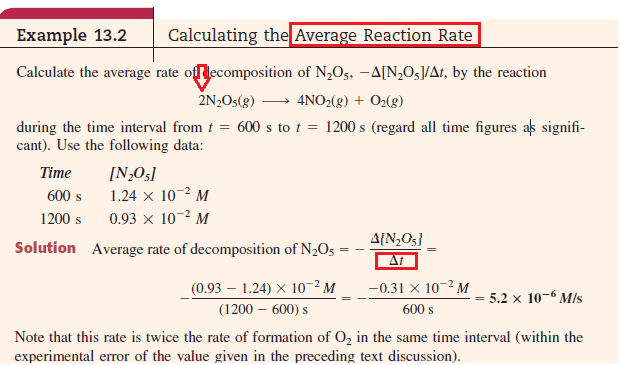
Im stuck: I found this example in which they calculate the rate of reaction: the title is "calculating the average reaction rate"

Now how the hell is this average reaction rate if they didnt use stoichiometric coefficients!? (in this case it should be 2.

Thanks in advance.
7ebaef040eb99d21f1bcb4d80106b8c7.png
 
Physics news on Phys.org
mcfaker said:
Hi,
Now how the hell is this average reaction rate if they didnt use stoichiometric coefficients!? (in this case it should be 2.

Why and how are the stoichiometric coefficients to be used?
 
because the average rate always is calculated using this formula:
8cd408da00847288fcdf9d5361f64959.png
 
True that is the rate of the reaction.

The question asks, instead, for rate of decomposition of the reactant. Which is simply the rate of change of its concentration with time.
 
Sunil Simha said:
True that is the rate of the reaction.

The question asks, instead, for rate of decomposition of the reactant. Which is simply the rate of change of its concentration with time.

Thanks, So u mean that it is not the rate of the reaction that is calculated in this example?
 
mcfaker said:
Thanks, So u mean that it is not the rate of the reaction that is calculated in this example?

Yes, that is correct. They have merely found the rate of change of concentration of the reactant (which in this case is because of decomposition. Note that if they had asked the rate of formation of one of the products, it would simply again be rate of change in its concentration with respect to time)
 
And what if they would ask "the rate of disappearance"? Do u have any idea what that might mean? Thanks!
 
Disappearance or appearance would simply mean change in concentration (in the first case, the conc. is decreasing and in the second it is increasing). So you just have to find rate of change of concentration.


Note: Some textbooks use the convention that rate of disappearance is -\frac{dC}{dt}
where C is the concentration. For appearance the expression is similar but with the absence of the minus sign.
 

Similar threads

  • · Replies 12 ·
Replies
12
Views
4K
  • · Replies 3 ·
Replies
3
Views
2K
  • · Replies 6 ·
Replies
6
Views
3K
  • · Replies 4 ·
Replies
4
Views
4K
  • · Replies 3 ·
Replies
3
Views
3K
  • · Replies 8 ·
Replies
8
Views
3K
  • · Replies 5 ·
Replies
5
Views
3K
Replies
10
Views
5K
  • · Replies 1 ·
Replies
1
Views
4K
  • · Replies 5 ·
Replies
5
Views
2K