Calculus: Optimization Problem

Click For Summary
SUMMARY

The forum discussion focuses on solving optimization problems in calculus, specifically finding the area of the largest rectangle inscribed in an ellipse and minimizing the length of a fold in a piece of paper. The use of Lagrange multipliers is suggested as a method for the ellipse problem, while the second problem involves applying the Pythagorean theorem and understanding the relationship between variables. Key insights include the parametric form of an ellipse and the necessity of deriving a function for 'y' based on 'x' in the folding problem.

PREREQUISITES
  • Understanding of optimization techniques in calculus
  • Familiarity with Lagrange multipliers
  • Knowledge of the parametric equations of an ellipse
  • Basic proficiency in using the Pythagorean theorem
NEXT STEPS
  • Learn how to apply Lagrange multipliers for constrained optimization problems
  • Study the parametric equations of ellipses and their applications
  • Explore methods for minimizing functions involving multiple variables
  • Investigate geometric interpretations of optimization problems in calculus
USEFUL FOR

Students studying calculus, particularly those focusing on optimization problems, as well as educators looking for examples of practical applications of calculus concepts.

RedBarchetta
Messages
49
Reaction score
1
Calculus: Optimization Problems

Homework Statement


Find the area of the largest rectangle that can be inscribed in the ellipse below.

I'm not quite sure where to start...first of all, how would you even enter this into a calculator to graph? On the TI-83, I only see one variable 'x' that you can enter...

I was reading a similar problem that said this was a lagrange multiplier problem. I was never taught this method. Is there any other way to do this?

________________________________________________________________________________________________________
2. The upper right-hand corner of a piece of paper, 14 in. by 10 in., as in the figure, is folded over to the bottom edge. How would you fold it so as to minimize the length of the fold? In other words, how would you choose x to minimize y?
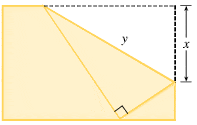
4-7-65.gif

Heres what I tried to do:

First I used the pythagorean theorem. a^2+b^2=y^2
We're trying to minimize y, so I set up the distance for each side.
(14-b)=top
(10-x)=side

Plug:
(14-b)^2+(10-x)^2=y^2

Since we can't solve for two variables, solve for one. Now what would I do? or would both variables be just "x"? like:
(14-x)=top
(10-x)=side

Thanks for the help!
 
Last edited by a moderator:
Physics news on Phys.org
RedBarchetta said:

Homework Statement


Find the area of the largest rectangle that can be inscribed in the ellipse below.
http://www.webassign.net/www29/symImages/6/8/fbe8ac50ef95dfc0c03ab89315a6dc.gif

I'm not quite sure where to start...first of all, how would you even enter this into a calculator to graph? On the TI-83, I only see one variable 'x' that you can enter...

I was reading a similar problem that said this was a lagrange multiplier problem. I was never taught this method. Is there any other way to do this?


How abt assuming four points(a cos\theta , b sin \theta), (a cos\theta ,-b sin \theta),(-a cos\theta , b sin \theta),(-a cos\theta ,-b sin \theta)

to be the vertices of that rectangle...then area =4absin\theta cos\theta=2absin 2\theta

and then maximizing the area ? So 2ab ?
 
Last edited by a moderator:
Your idea of starting a problem is to enter it into a calculator? Surely you should be able to graph an ellipse on paper and draw a rectangle in it?

The hard part would be using symmetry to show that the largest rectangle must have its sides parallel to the axes of the ellipse and that the rectangle is symmetric about both axes but you probably are expected to assume that. Assuming that, The coordinates of the vertices of the rectangle are (x0,y0), (-x0,y0), (-x0,-y0), and (x0,-y0) ( have subscripted to distinguish from the "variables" x and y). What is the area of such a rectangle, as a function of x0 and y0? Of course, x0 and y0 must also satisfy
\frac{x_0^2}{a^2}+ \frac{y_0^2}{b^2}= 1[/itex]<br /> Yes, &quot;Lagrange multiplier&quot; would be the simplest way to solve that but you can also use the equation of the ellipse to reduce to one variable.<br /> (Simple answer, by the way.)
 
RedBarchetta said:
Plug:
(14-b)^2+(10-x)^2=y^2

This seems to be a pretty wrong equation to me. Which triangle are we concerned about here? (14-b) means, length-breadth. This can hardly mean any side of a triangle.

What you need to note for the 2nd problem is that, for a given 'x', only a particular value of 'y' is possible i.e. 'y' is a function of 'x' and 'x' alone. Try to arrive at 'y(x)'.
 
Another approach:
My mathematics handbook gives the parametric form of an ellipse as:
x(t) = a cos t;
y(t) = b sin t;
The area of the inscribed rectangle is
area(t) = 4 x(t) y(t);
Solving the differential equation d/dt area(t)=0 gives the value of t at at the maximum
area. Using this value gives the area(t)=2 a b as shown in a previous reply.
 
RedBarchetta said:
1. [URL]http://www.webassign.net/www29/symImages/6/8/fbe8ac50ef95dfc0c03ab89315a6dc.gif[/URL]2. The upper right-hand corner of a piece of paper, 14 in. by 10 in., as in the figure, is folded over to the bottom edge. How would you fold it so as to minimize the length of the fold? In other words, how would you choose x to minimize y?
[URL]http://www.webassign.net/scalcet/4-7-65.gif[/URL]
Heres what I tried to do:

First I used the pythagorean theorem. a^2+b^2=y^2
We're trying to minimize y, so I set up the distance for each side.
(14-b)=top
(10-x)=side

Plug:
(14-b)^2+(10-x)^2=y^2

Since we can't solve for two variables, solve for one. Now what would I do? or would both variables be just "x"? like:
(14-x)=top
(10-x)=side

Thanks for the help!
1.
Can't see 1st image (inaccessible) :(2.
Hint:
Hypotenuse in right-angled triangle - minimum - isoscles.
=>
Solution:
x=
10
y=
14.1421356
Explanation:

If done practically, the solution presents itself instantaneously.
http://goo.gl/Cirv3

Theoretically:
The triangle formed by the folded paper is a right-angled triangle (diag).
The minimum hypotenuse in a right-angled triangle is when both the sides are equal (isoscles).
so y is minimum when 10-x=0 i.e. when x=
10

so
y2 = x2 + x2
y2= 2 . x2
y= x . \sqrt[]{}2
y = 10 (1.41421356)
y=14.14
 
Last edited by a moderator:
Aruna is (respectfully) wrong.
The real minimum occurs when x=7.5, which gives y=12.99
This can be found legitimately (as opposed to aruna's hand-wavy argument) using similar triangles.
 

Similar threads

Replies
4
Views
2K
  • · Replies 4 ·
Replies
4
Views
2K
  • · Replies 5 ·
Replies
5
Views
2K
  • · Replies 6 ·
Replies
6
Views
3K
Replies
2
Views
1K
  • · Replies 5 ·
Replies
5
Views
1K
  • · Replies 3 ·
Replies
3
Views
2K
  • · Replies 8 ·
Replies
8
Views
2K
Replies
14
Views
1K
  • · Replies 13 ·
Replies
13
Views
1K