Can a Cantilever Beam with a 20 lb Mass Hold Up without Failing?

Click For Summary

Discussion Overview

The discussion revolves around the structural integrity of a cantilever beam designed to support a 20 lb mass at its end. Participants explore the calculations related to bending stress, potential twisting stresses, and the overall design considerations for the beam, including material choice and bracing options. The conversation includes both theoretical and practical aspects of the beam's application.

Discussion Character

  • Technical explanation
  • Debate/contested
  • Experimental/applied

Main Points Raised

  • One participant questions whether their calculations regarding bending stress and yield stress are correct, suggesting that as long as the bending stress is lower than the yield stress, the beam should be adequate.
  • Another participant emphasizes the importance of applying a safety factor when checking stress against yield stress, noting that the beam is theoretically adequate based on initial calculations.
  • Concerns are raised about the additional forces acting on the beam, particularly twisting stresses due to a mass being bolted to the side of the beam and pulled out of the page.
  • Participants discuss the potential need for bracing to counteract the 'out of page' load and suggest considering a stronger beam shape, such as steel tubing, instead of a flat plate.
  • One participant mentions the absence of a wall for support and proposes installing a vertical column directly below the device to provide additional stability.
  • There is a suggestion to use 45-degree braces at the bottom of the vertical tube for enhanced support.

Areas of Agreement / Disagreement

Participants generally agree on the need for additional considerations regarding twisting stresses and bracing, but there are multiple competing views on the best design approach and structural requirements. The discussion remains unresolved regarding the optimal configuration for the cantilever beam.

Contextual Notes

Participants note various factors that could affect the design, including fixed end connection design, bolt design, and the specific loads applied to the beam. There is uncertainty regarding the exact forces acting on the beam and how they influence the overall design.

NewEngineer
Messages
21
Reaction score
2
What's happening Form,
It's been a while since I've done a FBD, but I wanted to get someone's input here and tell me if my math/logic is correct. I want to install a cantilever steel beam with a 20 lb mass at the end of it. I'm using carbon steel ASTM A108 (cheapest steel on McMaster-carr). I plan on the cross section being 0.5" x 2". According to the math below, the beam should not fail correct? As long as the bending stress is lower than the yield stress we should be ok, correct? Is there something else I should take into consideration here?

Also, the mass on the end of the beam may be pull in direction coming out from the page. Would adding a truss feature help negate the stress in the beam, or is best option to use a thicker piece of material?
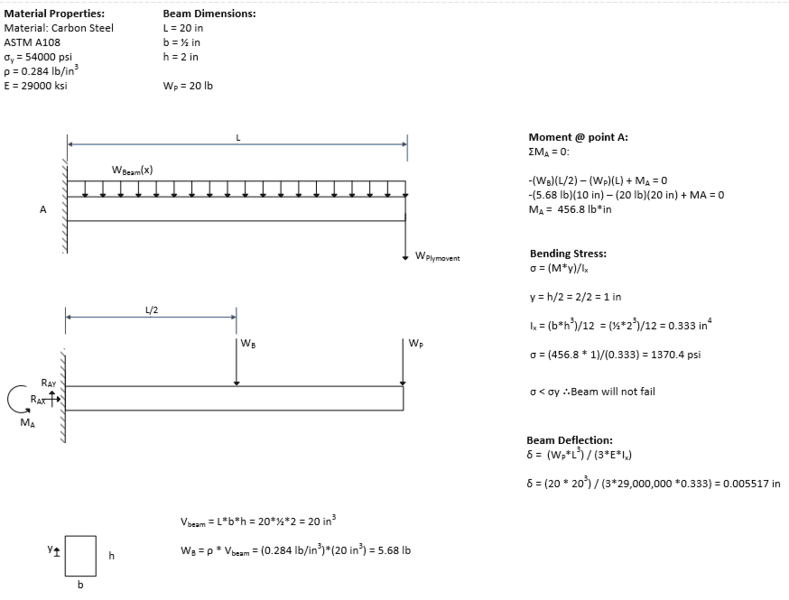
upload_2017-4-25_8-19-41.png
 
Engineering news on Phys.org
NewEngineer said:
What's happening Form,
It's been a while since I've done a FBD, but I wanted to get someone's input here and tell me if my math/logic is correct. I want to install a cantilever steel beam with a 20 lb mass at the end of it. I'm using carbon steel ASTM A108 (cheapest steel on McMaster-carr). I plan on the cross section being 0.5" x 2". According to the math below, the beam should not fail correct? As long as the bending stress is lower than the yield stress we should be ok, correct? Is there something else I should take into consideration here?

Also, the mass on the end of the beam may be pull in direction coming out from the page. Would adding a truss feature help negate the stress in the beam, or is best option to use a thicker piece of material?

View attachment 196882
Don't forget to apply a safety factor when checking the actual stress against the yield stress, but your stress is very low according to your calculation which is correct, so the beam is theoretically more than adequate. In the other direction which is much weaker, the bending stress ,and deflection into the plane of the page, depends on what force into the plane of the page at the free end is applied. You don't give that info and calculation.
 
PhanthomJay said:
Don't forget to apply a safety factor when checking the actual stress against the yield stress, but your stress is very low according to your calculation which is correct, so the beam is theoretically more than adequate. In the other direction which is much weaker, the bending stress ,and deflection into the plane of the page, depends on what force into the plane of the page at the free end is applied. You don't give that info and calculation.

Thanks for your reply. As far as the force that will be applied (coming out of the page) I can't really provide too much info here. In reality I will be bolting a 20 Lb mass on the h side of this beam (at the end), so I perhaps need to take twisting stress into consideration as well. The mass will have an arm that can be extended so the operator will pull the arm (out of the page). Is there a better set up that I can design for this?
 
NewEngineer said:
Thanks for your reply. As far as the force that will be applied (coming out of the page) I can't really provide too much info here. In reality I will be bolting a 20 Lb mass on the h side of this beam (at the end), so I perhaps need to take twisting stress into consideration as well. The mass will have an arm that can be extended so the operator will pull the arm (out of the page). Is there a better set up that I can design for this?
If this is an actual project, I hesitate to reply because there are other factors to consider like fixed end connection design, bolt design, steel plate details, possible twisting, unknown sidewards load, etc. The plate is considerably weaker under the 'out of page' load than it is under the mass weight load, and will likely control the design. You may want to consider bracing it to the wall in that direction, and/or using a beam shape other than a plate.
 
PhanthomJay said:
If this is an actual project, I hesitate to reply because there are other factors to consider like fixed end connection design, bolt design, steel plate details, possible twisting, unknown sidewards load, etc. The plate is considerably weaker under the 'out of page' load than it is under the mass weight load, and will likely control the design. You may want to consider bracing it to the wall in that direction, and/or using a beam shape other than a plate.

I agree. There is no wall around the installation. I was hoping to bolt the cantilever beam to a vertical building support column (20 inches to the left) but, what I may now do is install a vertical column directly below my device, and brace that to the support column.
 
NewEngineer said:
I agree. There is no wall around the installation. I was hoping to bolt the cantilever beam to a vertical building support column (20 inches to the left) but, what I may now do is install a vertical column directly below my device, and brace that to the support column.
but the beam should be braced the other way due to the 'out
of page' unspecified load,.you might want to consider a stronger shape, like a piece of steel tubing
 
PhanthomJay said:
but the beam should be braced the other way due to the 'out
of page' unspecified load,.you might want to consider a stronger shape, like a piece of steel tubing

Yes we would use some type of tubing for the vertical section, not the 1/2 x 2" piece of steel. If needed, we could install 45o braces at the bottom of the vertical tube.
 

Similar threads

  • · Replies 7 ·
Replies
7
Views
5K
Replies
4
Views
20K
Replies
2
Views
4K
Replies
8
Views
15K
  • · Replies 11 ·
Replies
11
Views
3K
Replies
3
Views
5K
Replies
4
Views
3K
Replies
4
Views
4K
  • · Replies 82 ·
3
Replies
82
Views
29K
  • · Replies 8 ·
Replies
8
Views
5K