Can anyone check my answers for these equilibrium problems?

Click For Summary
SUMMARY

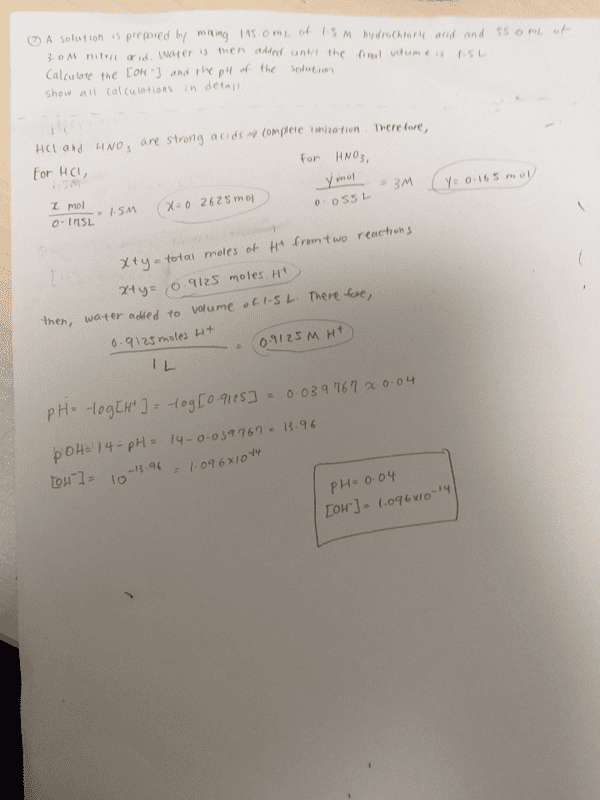
The discussion centers on verifying answers to equilibrium problems, specifically focusing on the calculations for molar quantities and concentrations. A participant confirms agreement with the method used for problem (2) but identifies a numerical error in the value of y, suggesting it should be 0.165 mol instead of 0.65 mol. Additionally, the correct volume for concentration calculations should be 1.5 L rather than 1 L, which is crucial for accurate results.

PREREQUISITES
  • Understanding of chemical equilibrium concepts
  • Familiarity with molarity calculations
  • Proficiency in using calculators for scientific computations
  • Knowledge of stoichiometry
NEXT STEPS
  • Review the principles of chemical equilibrium
  • Practice molarity calculations with varying volumes
  • Study common stoichiometric errors in chemical equations
  • Learn how to use calculators effectively for chemistry problems
USEFUL FOR

Chemistry students, educators, and anyone involved in solving equilibrium problems in chemical reactions.

Sunwoo Bae
Messages
60
Reaction score
4
Homework Statement
2.A solution is prepared by mixing 175.0mL of a 1.5 M hydrochloric acid and 55.0 mL of a 3,0 M nitric acid. Water is then added until the final volume is 1.50L. Calculate the [OH-] and the pH of the final solution.
Show all calculations in detail.

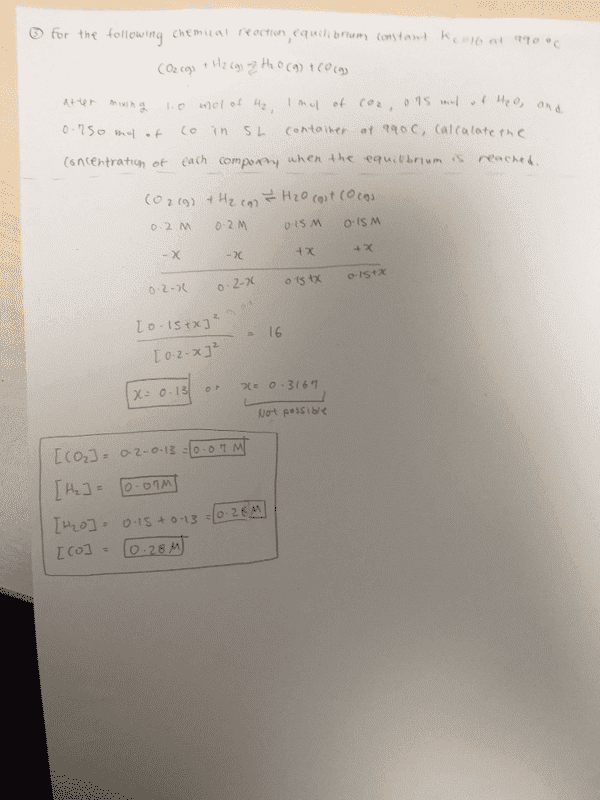
3. For the following chemical reaction equilibrium constant (Kc) is 16 at 990C.
CO2(g) + H2(g) --> H2O(g) + CO(g)

After the mixing of 1.00 mol of H2, 1.00 mol of CO2, 0.750 mol of H2O, and 0.750 mol of CO in 5.00L container at 990 C, calculate the concentrations of each component when the equilibrium is reached.
Show all calculations in detail.
Relevant Equations
ICE setup

pH + pOH = 14
pH = -log(H+)
pOH = -log(OH-)
The following are my works for the problems:
I put squares on my final answers!
1597769934518.png


1597769961792.png


Thank you!
 
Physics news on Phys.org
I definitely agree with your answer to (3); I also agree with your method for (2), though I suspect there might have been a numerical error. Specifically, shouldn't it be ##x + y = 0.4275 \text{ mol}##? It could be that you entered ##y = 0.65 \text{ mol}## into your calculator instead of ##y = 0.165 \text{ mol}##
 
  • Like
Likes   Reactions: Sunwoo Bae
Also, when calculating the concentration, you should divide by 1.5 L, not 1 L.
 
  • Like
Likes   Reactions: etotheipi

Similar threads

  • · Replies 7 ·
Replies
7
Views
2K
  • · Replies 2 ·
Replies
2
Views
1K
  • · Replies 2 ·
Replies
2
Views
2K
  • · Replies 8 ·
Replies
8
Views
2K
  • · Replies 2 ·
Replies
2
Views
2K
  • · Replies 1 ·
Replies
1
Views
3K
  • · Replies 4 ·
Replies
4
Views
2K
  • · Replies 2 ·
Replies
2
Views
2K
  • · Replies 1 ·
Replies
1
Views
3K
  • · Replies 3 ·
Replies
3
Views
2K