Can anyone simplify any of these questions?
- Context: MHB
- Thread starter hmhmherath
- Start date
-
- Tags
- Simplify
Click For Summary
Discussion Overview
The discussion revolves around simplifying a series of mathematical problems, particularly focusing on trigonometric identities and quadratic equations. Participants are addressing specific equations and exploring methods to solve them, with an emphasis on algebraic manipulation and the application of known formulas.
Discussion Character
- Homework-related
- Mathematical reasoning
Main Points Raised
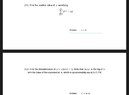
- One participant asks if anyone can simplify a set of mathematical questions, presenting a series of equations involving trigonometric functions.
- Another participant welcomes the original poster and suggests addressing the problems one at a time, specifically referencing the sum of a geometric series.
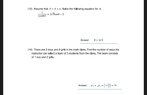
- A participant presents a series of equations derived from a trigonometric identity and proposes solving a resulting quadratic equation.
- Another participant reformulates one of the equations into a quadratic form and asks if the original poster can solve it for the tangent function.
Areas of Agreement / Disagreement
The discussion does not appear to have a consensus, as participants are presenting different approaches to the problems without resolving which method is preferable or correct.
Contextual Notes
Participants have not explicitly stated all assumptions or provided complete context for the equations, and there may be dependencies on definitions of trigonometric functions that are not fully explored.
Similar threads
Graduate
Simplifying a double summation
- · Replies 3 ·
- · Replies 1 ·
- · Replies 6 ·
- · Replies 2 ·
- · Replies 1 ·
- · Replies 7 ·
- · Replies 2 ·
- · Replies 3 ·
- · Replies 27 ·
- · Replies 4 ·