Can bounded quantification define divisibility and primality?

  • Context: MHB 
  • Thread starter Thread starter Mafaz
  • Start date Start date
  • Tags Tags
    Primitive
Click For Summary
SUMMARY

The discussion centers on the application of bounded quantification in defining divisibility and primality within the framework of primitive recursive (PR) functions. It establishes that if the characteristic function of a relation \( R(x) \) is PR, then the bounded search function \( \min_{x\le n}R(x,y_1,\ldots,y_p) \) is also PR. The forum participants emphasize the importance of understanding PR functions, including operations like addition, multiplication, and the definitions of divisibility and primality, as outlined in "Computability and Logic" by G. Boolos, J. Burgess, and R. Jeffrey.

PREREQUISITES
  • Understanding of primitive recursive (PR) functions
  • Familiarity with bounded quantification in mathematical logic
  • Knowledge of characteristic functions and their properties
  • Basic concepts of divisibility and primality in number theory
NEXT STEPS
  • Study the definitions and properties of primitive recursive functions
  • Learn about bounded existential quantification and its applications
  • Read "Computability and Logic" by G. Boolos, J. Burgess, and R. Jeffrey, focusing on chapters 6 and 7
  • Explore the construction of intermediate PR functions for proving divisibility
USEFUL FOR

Mathematicians, computer scientists, and students studying computability theory, particularly those interested in the foundations of number theory and recursive function theory.

Mafaz
Messages
4
Reaction score
0

Attachments

  • 3Q.png
    3Q.png
    35.8 KB · Views: 148
Physics news on Phys.org
Hi, and welcome to the forum!

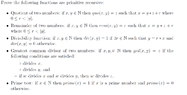
Its easiest to prove first that bounded search on a primitive recursive (PR) condition produces a PR function. I means that if the characteristic function of a relation $R(x)$ is PR, then the function that, given $n$, returns the smallest $k\le n$ such that $R(k)$ holds or $n+1$ if no such $k$ exists is PR. More generally $R$ may have parameters $y_1,\ldots,y_p$. Let's denote the bounded search function by $\min_{x\le n}R(x,y_1,\ldots,y_p)$. Then quotient, remainder and greatest common divisor can be obtained in this way because they return a number that is smaller than one of the arguments. It is also possible to show that bounded quantifications $\exists x\le n\,R(x,y_1,\ldots,y_p)$ and $\forall x\le n\,R(x,y_1,\ldots,y_p)$ on a PR relation $R$ are PR. This allows expressing divisibility and primality. For example,
\[
\text{Prime}(x)\iff 1<x\land \forall u\le x-1\;\forall v\le x-1\,uv\ne x.
\]

Several of your examples are described in the book "Computability and Logic" by G. Boolos, J. Burgess and R. Jeffrey, fifth edition, chapters 6 and 7. It requires some reading, but it has a lot of detailed examples.

If you have further questions, please post them here.
 
Evgeny.Makarov said:
Hi, and welcome to the forum!

Its easiest to prove first that bounded search on a primitive recursive (PR) condition produces a PR function. I means that if the characteristic function of a relation $R(x)$ is PR, then the function that, given $n$, returns the smallest $k\le n$ such that $R(k)$ holds or $n+1$ if no such $k$ exists is PR. More generally $R$ may have parameters $y_1,\ldots,y_p$. Let's denote the bounded search function by $\min_{x\le n}R(x,y_1,\ldots,y_p)$. Then quotient, remainder and greatest common divisor can be obtained in this way because they return a number that is smaller than one of the arguments. It is also possible to show that bounded quantifications $\exists x\le n\,R(x,y_1,\ldots,y_p)$ and $\forall x\le n\,R(x,y_1,\ldots,y_p)$ on a PR relation $R$ are PR. This allows expressing divisibility and primality. For example,
\[
\text{Prime}(x)\iff 1<x\land \forall u\le x-1\;\forall v\le x-1\,uv\ne x.
\]

Several of your examples are described in the book "Computability and Logic" by G. Boolos, J. Burgess and R. Jeffrey, fifth edition, chapters 6 and 7. It requires some reading, but it has a lot of detailed examples.

If you have further questions, please post them here.
thanks but I have difficulty to prove especially prime and divisibility . Actually I need to follow the question and to have base and inductive case.

Would please help me.
 
Mafaz said:
Actually I need to follow the question and to have base and inductive case.
The usual way of proving that divisibility is PR goes through defining several intermediate PR functions. Perhaps you expect me to write the precise definition of $\mathit{div}(x,y)$ right away, but I'd rather not for two reasons: as I said, this requires intermediate definitions, and you need to show some work, too (see https://mathhelpboards.com/rules/ 11).

First you need to get a textbook that discusses PR functions and study why some some usual functions such as addition, multiplication, factorial, predecessor and subtraction are PR. Also read what PR relations are and why their class is closed under conjunction, disjunction and negation. Next we need to prove that finite sums and bounded existential quantifier on a PR condition is again PR. Perhaps this is also discussed in your textbook. For example, if $$g(n,y)=\sum_{x=0}^n f(x,y)$$ where $f(x,y)$ is PR, then $g(n,y)$ is also PR because
\begin{align*}
g(0,y)&=f(0,y)\\
g(n+1,y)&=g(n,y)+f(n+1,y)
\end{align*}
Now try proving that if $R(x,y)$ is a PR relation, then $P(n,y)=\exists x\le n\,R(x,y)$ is also a PR relation.
 
Thanks for your reply.
So what is this example ?
Is it for qoueint or reminder ?
 
Evgeny.Makarov said:
The usual way of proving that divisibility is PR goes through defining several intermediate PR functions. Perhaps you expect me to write the precise definition of $\mathit{div}(x,y)$ right away, but I'd rather not for two reasons: as I said, this requires intermediate definitions, and you need to show some work, too (see https://mathhelpboards.com/rules/ 11).

First you need to get a textbook that discusses PR functions and study why some some usual functions such as addition, multiplication, factorial, predecessor and subtraction are PR. Also read what PR relations are and why their class is closed under conjunction, disjunction and negation. Next we need to prove that finite sums and bounded existential quantifier on a PR condition is again PR. Perhaps this is also discussed in your textbook. For example, if $$g(n,y)=\sum_{x=0}^n f(x,y)$$ where $f(x,y)$ is PR, then $g(n,y)$ is also PR because
\begin{align*}
g(0,y)&=f(0,y)\\
g(n+1,y)&=g(n,y)+f(n+1,y)
\end{align*}
Now try proving that if $R(x,y)$ is a PR relation, then $P(n,y)=\exists x\le n\,R(x,y)$ is also a PR relation.
Thanks but what is this function for?
 
Bounded existential quantification can be used to define divisibility and primality, and bounded minimization from post #2, which is similar, can be used to define the rest of the functions in post #1.
 

Similar threads

  • · Replies 1 ·
Replies
1
Views
5K
  • · Replies 5 ·
Replies
5
Views
3K
  • · Replies 5 ·
Replies
5
Views
2K
  • · Replies 7 ·
Replies
7
Views
1K
  • · Replies 3 ·
Replies
3
Views
5K
Replies
1
Views
1K
  • · Replies 5 ·
Replies
5
Views
2K
  • · Replies 7 ·
Replies
7
Views
1K
  • · Replies 1 ·
Replies
1
Views
2K
  • · Replies 4 ·
Replies
4
Views
2K