TopiRinkinen
- 8
- 0
Hi All,
I try to understand the outcome of following setup:
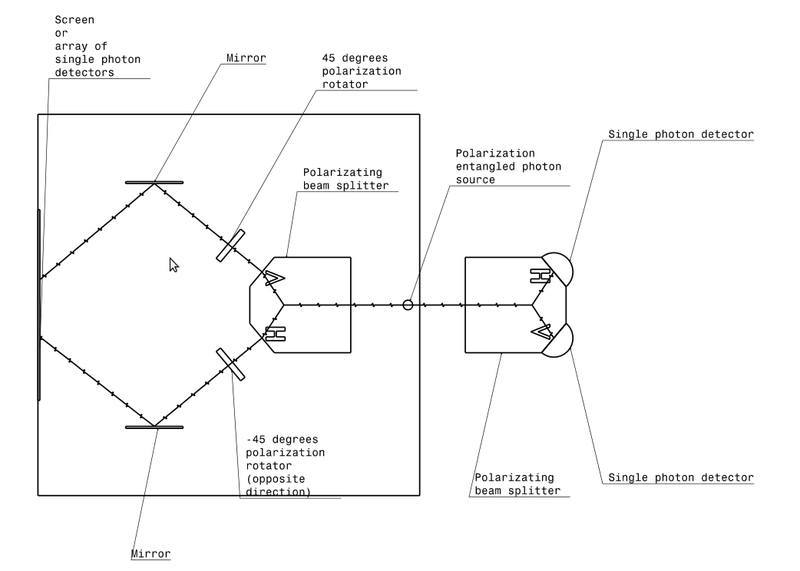
The idea is that in the middle, a pair of polarization entangled photons are generated (so that the polarization of right-going and left-going are opposites of each other).
The setup on left side is deviced so that if the polarization is "pure horizontal" or "pure vertical", no interference is generated on the screen.
But if the polarization on left side is circular, or 45 degrees, then interference pattern will be generated.
The device on the right can be rotated on the axis of the photon.
When the right-side device is at 0 degrees (as in the picture above), it will record either "horizontal click" or "vertical click", and thus "enforcing" the polarization of left photon to opposite of said click (vertical or horizontal), with 100% certainty. In this case we know the "which way" information, which prevents the interference pattern to form.
But if the right-side device is rotated 45 degrees around optical path, then it will measure "+45 degrees click" or "-45 degrees click", which corresponds a pure state on left-side ("-45 degrees" or "+45 degrees").
In this case, the photon on left side is (needs to, we don't have any "which way" detector) allowed to ride through both exits of beam-splitter, and this will generate interference pattern.
**
If the device works as I assumed above, it will allow communication using entanglement, which I do not believe.
So I am trying to find out why it does not work. And failed so far.
Any ideas ??
- Topi
I try to understand the outcome of following setup:
The idea is that in the middle, a pair of polarization entangled photons are generated (so that the polarization of right-going and left-going are opposites of each other).
The setup on left side is deviced so that if the polarization is "pure horizontal" or "pure vertical", no interference is generated on the screen.
But if the polarization on left side is circular, or 45 degrees, then interference pattern will be generated.
The device on the right can be rotated on the axis of the photon.
When the right-side device is at 0 degrees (as in the picture above), it will record either "horizontal click" or "vertical click", and thus "enforcing" the polarization of left photon to opposite of said click (vertical or horizontal), with 100% certainty. In this case we know the "which way" information, which prevents the interference pattern to form.
But if the right-side device is rotated 45 degrees around optical path, then it will measure "+45 degrees click" or "-45 degrees click", which corresponds a pure state on left-side ("-45 degrees" or "+45 degrees").
In this case, the photon on left side is (needs to, we don't have any "which way" detector) allowed to ride through both exits of beam-splitter, and this will generate interference pattern.
**
If the device works as I assumed above, it will allow communication using entanglement, which I do not believe.
So I am trying to find out why it does not work. And failed so far.
Any ideas ??
- Topi
