Can Fortran 77 Code Be Used to Debug Python Code for Solving ODEs Using Radau5?

Join the discussion
Ask a follow-up here, or get your own question answered by working scientists, mathematicians and engineers — people, not an autocomplete.
Real named experts · corrections over time · the nuance an AI answer skips
64 replies · 12K views
PS:
Below the results from solving the 66 ODEs in Python using Radau5:
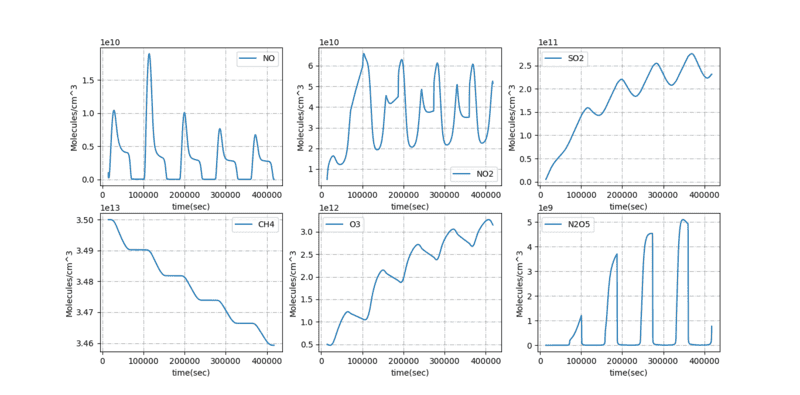
Figure_1.png
 
Reply
  • Like
Likes   Reactions: Tom.G, pbuk and FactChecker
Physics news on Phys.org
For what it's worth: I found the program that calls the routines in emep.f
The site has been moved to http://pitagora.dm.uniba.it/~testset/solvers/radau5.php
Pdf: radau5
The program is radau5d
It calls prob, init etc, and radau5
Other stuff in radaua and report

PDF http://archimede.dm.uniba.it/~testset/report/prologue.pdf has some documentation (page 16 onwards)
IV.3 Format of the problem codes
The eight subroutines that define the problem are called PROB, INIT, SETTOLERANCES, SETOUTPUT,FEVAL, JEVAL, MEVAL, and SOLUT. The following subsections describe the format of these subroutinesin full detail. An additional function PIDATE ...

Vick's emep.f from https://archimede.uniba.it/~testset/problems/emep.php

[edit]
@Vick: no fortran needed so far. I see that report.f has some utility to generate a
MATLAB and a SCILAB function to print the plots of the solution

just in case I can get a fortran compiler to run on this ancient PC: can you post a link to the .py source used for post #61 ?

##\ ##
 
Last edited:
BvU said:
For what it's worth: I found the program that calls the routines in emep.f
The site has been moved to http://pitagora.dm.uniba.it/~testset/solvers/radau5.php
Pdf: radau5
The program is radau5d
It calls prob, init etc, and radau5
Other stuff in radaua and report

PDF http://archimede.dm.uniba.it/~testset/report/prologue.pdf has some documentation (page 16 onwards)


Vick's emep.f from https://archimede.uniba.it/~testset/problems/emep.php

[edit]
@Vick: no fortran needed so far. I see that report.f has some utility to generate a
MATLAB and a SCILAB function to print the plots of the solution

just in case I can get a fortran compiler to run on this ancient PC: can you post a link to the .py source used for post #61 ?

##\ ##
The testset emep.f is Fortran coding. As I am using Python, I needed a translation of the emep.f into Python. I succeeded and post 61 is the result of my own code using my own Radau5 code. Thanks
 
Reply
  • Like
Likes   Reactions: BvU
I will just say that in my experience the biggest hazard in translating numerical computations from one language to another may have to do with differences in how the two languages store and organize arrays internally. I don't know what Python does but there is a good chance it is different from what Fortran does.
 
harborsparrow said:
I will just say that in my experience the biggest hazard in translating numerical computations from one language to another may have to do with differences in how the two languages store and organize arrays internally. I don't know what Python does but there is a good chance it is different from what Fortran does.
This is a hazard in at least two ways: indexing (is the initial index one or zero), and ordering (row major vs column major). Fortran and MATLAB use one-based indexing and column major order. C, C++, and several other languages use zero-based indexing and row major order. The zero vs one based indexing can be overcome. The order issue is harder to overcome.

As an example, the initial versions of the book "Numerical Recipes in C" were a direct transliteration of the original FORTRAN code (not Fortran, but FORTRAN. FORTRAN was the original name, which means very old code). They used some clever (or perhaps not clever) hacks to get around the indexing issue. They did not do anything with regard to multidimensional arrays, which meant that the memory-efficient FORTRAN algorithms became memory-inefficient in C. Recoding algorithms that use multidimensional arrays is non-trivial. Transliteration oftentimes results in poor performing code.

As far as Python goes, numpy does offer an "order=C" (the default) and "order=F" option on creating and populating a multidimensional array, which might offer some improvements. However, the slowness of Python vs C, C++, Fortran, and Julia typically removes all of those improvements.
 
Reply
  • Informative
  • Like
Likes   Reactions: FactChecker and harborsparrow