Can I Solve for c by Replacing b with a Value Greater Than 0?

  • Topic:
  • Thread starter Thread starter mathland
  • Start date Start date
  • Tags Tags
    Value
Join the discussion
Registration is free. Ask a follow-up in this thread, or start your own.
5 replies · 2K views
mathland
Messages
33
Reaction score
0
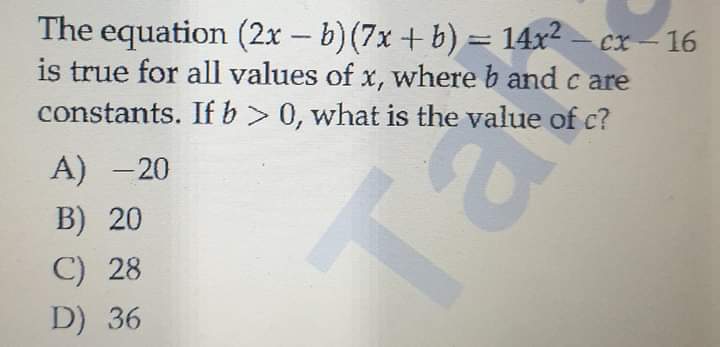
I replace b with any value greater than 0 and then solve for c. Right?
FB_IMG_1612321193999.jpg
 
Mathematics news on Phys.org
What do you get when you expand the LHS and equate the resulting terms with the corresponding terms in the RHS of the given equation
 
Greg said:
What do you get when you expand the LHS and equate the resulting terms with the corresponding terms in the RHS of the given equation

Ok. I will do as you suggested and be back.
 
It's been 7 months now! Are you still working on it?

For those who were wondering, there are two solutions.
(2x- b)(7x+ b)= 14x^2+ 2bx- 7bx- b^2= 14x^3- 5bx- b^2. That is to be equal to 14x^2- cx- 16.

So we must have -5b= -c and -b^2= -16. b^2= 16 so b= 4 or b= -4.
If b= 4, -5b= -20= -c so c= 20.
If b= -4, -5b= 20= -c so c= -20.

Check:
(2x- 4)(7x+ 4)= 14x^2+ 8x- 28x- 16= 14x^2- 20x- 16.
(2x+ 4)(7x- 4)= 14x^2- 8x+ 28x- 16= 14x^2+ 20x- 16.
 
Beer soaked comment follows.
Country Boy said:
It's been 7 months now! Are you still working on it?
...
He's been banned permanently.