Can Quantum Tunneling Cause Objects to Instantly Swap Places?

Click For Summary
SUMMARY

The discussion centers on quantum tunneling and its implications for object placement and wave function collapse. Participants explore why barriers do not collapse wave functions, contrasting them with measurement screens in the double-slit experiment. The conversation also addresses the theoretical possibility of an object instantaneously appearing in another location and the implications of spatial overlap with existing objects. Key interpretations of quantum mechanics, including the Copenhagen interpretation and the role of the Hamiltonian, are highlighted as essential to understanding these phenomena.

PREREQUISITES
  • Quantum mechanics fundamentals
  • Copenhagen interpretation of quantum mechanics
  • Schrödinger's equation
  • Hamiltonian operator in quantum mechanics
NEXT STEPS
  • Study the implications of quantum tunneling in quantum mechanics
  • Explore the differences between classical and quantum measurements
  • Investigate the role of the Hamiltonian in quantum systems
  • Review the Insights article on tunneling and its limitations
USEFUL FOR

Physicists, quantum mechanics students, and anyone interested in the theoretical aspects of quantum tunneling and wave function behavior.

durant35
Messages
292
Reaction score
11
Hello guys,

I have few questions about the well-known quantum tunneling.

I'll start off with the animation from wikipedia
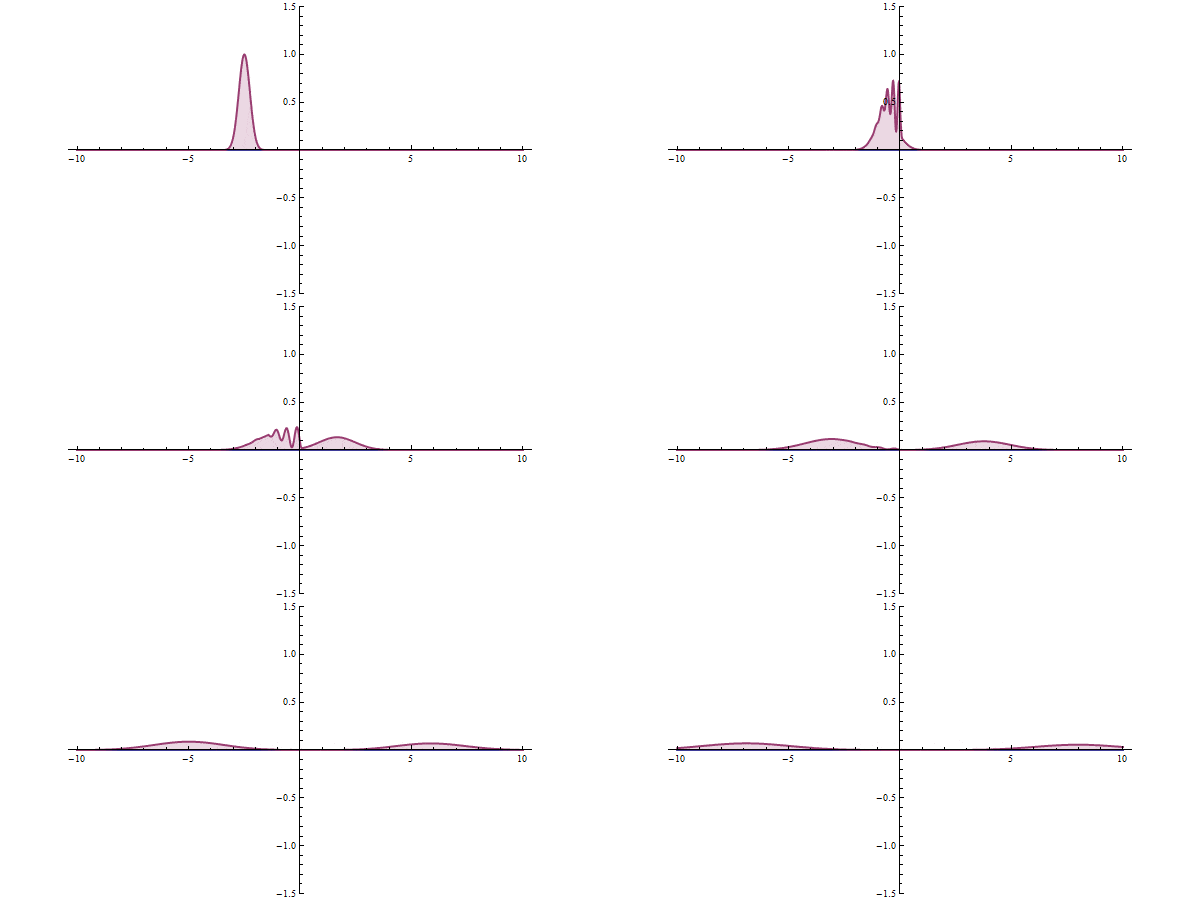
Quantum_Tunnelling_animation.gif


So question #1 why doesn't the barrier collapse the wave function, is that even possible? What's the difference between the barrier and the measurement screen in double slit experiment which collapses it when the behavior of the particle is clearly similar (moving towards the object)

Question #2: the wavefunction of any object has a small component on the other side of a barrier that it classically cannot pass. So for instance, theoretically, there's a non zero chance that some object from my room instantenously appears in the other room. What would happen with some object on the other side which before the tunneling act was in a location x which the tunneling objecg would occupy during the act of tunelling, how would the "spatial overlap" of those 2 objects be avoided?

Thanks in advance.
 
Last edited:
Physics news on Phys.org
durant35 said:
So question #1 why doesn't the barrier collapse the wave function, is that even possible? What's the difference between the barrier and the measurement screen in double slit experiment which collapses it when the behavior of the particle is clearly similar (moving towards the object)?
The explanation depends on which interpretation you choose. The easiest approach, by far, is to select an interpretation in which there is no collapse so then there's nothing to explain. However, if you do want to use a Copenhagen-like interpretation that includes collapse, the explanation is that screen is a classical object so the von Neumann cut goes below it. (If you don't like that explanation, that's OK. There's something not to like about every interpretation).
Question #2: the wavefunction of any object has a small component on the other side of a barrier that it classically cannot pass. So for instance, theoretically, there's a non zero chance that some object from my room instantaneously appears in the other room.
Kinda sorta... But there's also a non-zero chance that all the randomly moving air molecules underneath my chair will, by random chance, happen to all be moving upwards at the same time. This would blast me and the chair through the roof like a rocket. That's not going to happen... and it's enormously less improbable than what you're describing. Also take a look at this Insights article: https://www.physicsforums.com/insights/you-will-not-tunnel-through-a-wall/
What would happen with some object on the other side which before the tunneling act was in a location x which the tunneling object would occupy during the act of tunneling, how would the "spatial overlap" of those 2 objects be avoided?
If there's an object present on the far side of the barrier, it will contribute to the Hamltonian in ways that may either increase or decrease the probability of the tunnelling particle being found in the vicinity of the object. You'd have to specify the exact conditions and then solve Schrödinger's equation for those boundary conditions - the wikipedia animation you posted will no longer describe the situation.
 
Nugatory said:
If there's an object present on the far side of the barrier, it will contribute to the Hamltonian in ways that may either increase or decrease the probability of the tunnelling particle being found in the vicinity of the object. You'd have to specify the exact conditions and then solve Schrödinger's equation for those boundary conditions - the wikipedia animation you posted will no longer describe the situation.

That sounds logical and intuitive. My question was directed to the hypotethical case where the concept of instanteneous tunelling would actually occur and the object in question would tunnel to a location where it would necessary have to push out another object because it would, in a lack of better phrase, took its spot. So considering that, would the pushing out of the mentioned object and tunneling of our original object happen instanteneously and not in order original object tunnels to location x (cause)
-> object that was at location x gets pushed out (effect).
I hope I am being clear regarding the problem. Any suggestions are welcome.
 

Similar threads

  • · Replies 14 ·
Replies
14
Views
2K
  • · Replies 4 ·
Replies
4
Views
1K
  • · Replies 13 ·
Replies
13
Views
3K
  • · Replies 2 ·
Replies
2
Views
2K
  • · Replies 4 ·
Replies
4
Views
3K
  • · Replies 5 ·
Replies
5
Views
2K
  • · Replies 33 ·
2
Replies
33
Views
4K
  • · Replies 1 ·
Replies
1
Views
2K
  • · Replies 24 ·
Replies
24
Views
4K
  • · Replies 2 ·
Replies
2
Views
2K