Can Riemann integrable be defined using the epsilon delta non method?

Join the discussion
Ask a follow-up here, or get your own question answered by working scientists, mathematicians and engineers — people, not an autocomplete.
Real named experts · corrections over time · the nuance an AI answer skips
5 replies · 3K views
hongseok
Messages
20
Reaction score
3
TL;DR
Is it correct to define Riemann integrability as follows: 'For any ϵ>0, there exists a δ>0 such that if the maximum interval length of the partition is less than δ, then the difference between the upper and lower Riemann sums is less than or equal to ϵ'? I wanted to define Riemann integrability using the idea of the epsilon-delta method.
 
Last edited:
Physics news on Phys.org
hongseok said:
I wanted to define Riemann integrability using the idea of the epsilon delta argument.
Hi, @hongseok. We call ##f## Riemann integrable on ##[a,b]## if there exists ##L\in{\mathbb R}## so that for every ##\epsilon>0## there exists some ##\delta>0## such that

$$|S(f\,\dot{P})-L|<\epsilon,\qquad\forall{P}.\quad{||P||<\delta}$$

for any tag ##\dot{P}## on ##P##.

Did I help you? Best wishes!
 
Reply
  • Like
Likes   Reactions: bhobba and hongseok
hongseok said:
TL;DR Summary: Is it correct to define Riemann integrability as follows: 'For any ϵ>0, there exists a δ>0 such that if the maximum interval length of the partition is less than δ, then the difference between the upper and lower Riemann sums is less than or equal to ϵ'? I wanted to define Riemann integrability using the idea of the epsilon-delta method.

Is it correct to define Riemann integrability as follows: 'For any ϵ>0, there exists a δ>0 such that if the maximum interval length of the partition is less than δ, then the difference between the upper and lower Riemann sums is less than or equal to ϵ'? I wanted to define Riemann integrability using the idea of the epsilon-delta method.
Intuitively, this seems good for finite integrals. For a formal proof, you would need to work through all the details using the precise definitions that you are given. I don't think that your approach will work for infinite integrals, but your official definitions may not allow those anyway, or there might be some way around those.
 
Reply
  • Like
Likes   Reactions: hongseok, bhobba and mcastillo356
FactChecker said:
Intuitively, this seems good for finite integrals. For a formal proof, you would need to work through all the details using the precise definitions that you are given. I don't think that your approach will work for infinite integrals, but your official definitions may not allow those anyway, or there might be some way around those.
For improper integrals to and/or from ##\pm \infty##, the integral is defined as a limit of proper integrals (with finite bounds). This is not part of the basic definition of a Riemann integral itself.
 
Reply
  • Like
Likes   Reactions: hongseok, bhobba, FactChecker and 1 other person
hongseok said:
TL;DR Summary: Is it correct to define Riemann integrability as follows: 'For any ϵ>0, there exists a δ>0 such that if the maximum interval length of the partition is less than δ, then the difference between the upper and lower Riemann sums is less than or equal to ϵ'? I wanted to define Riemann integrability using the idea of the epsilon-delta method.

Almost.

A function is Darboux integrable iff its lower integral (the supremum of the lower sums, [itex]\sup_{P} L(f,P)[/itex]), is equal to its upper integral (the infimum of the upper sums, [itex]\inf_P U(f,P)[/itex]). This is equivalent to the condition [tex]\forall \epsilon > 0 : \exists \mbox{a partition $P$} : U(f,P) - L(f,P) < \epsilon.[/tex] It is not necessary to put any upper bound on the norm of [itex]P[/itex]. Although this criterion tells you if a function is integrable, it doesn't tell you what the value of the integral is.

Darboux integrability is equivalent to Riemann integrability.
 
Reply
  • Like
  • Informative
Likes   Reactions: hongseok, mcastillo356 and bhobba
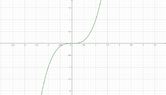
Hi, @hongseok, note that, for example, the unbounded function ##y=x^3## is Riemann integrable, since the definition holds for some closed interval ##[a,b]##; but at the same time I can argue it is an improper integral: unboudedness is the reason.

geogebra-export (23).png

Best whises!
 
Reply
  • Like
Likes   Reactions: hongseok