Can Scalar Fields Be Decomposed into Symmetric and Antisymmetric Parts?

Click For Summary
SUMMARY

A scalar field can indeed be decomposed into symmetric and antisymmetric parts, similar to vector fields. The decomposition is expressed mathematically as $$\phi (q) = \frac{\phi(q) + \phi(-q)}{2} + \frac{\phi(q) - \phi(-q)}{2}$$. This method utilizes the properties of scalar fields as 0-forms on smooth manifolds. The discussion references the Hodge decomposition, which provides a foundational understanding of such decompositions in differential geometry.

PREREQUISITES
  • Understanding of scalar fields and their mathematical properties
  • Familiarity with differential geometry concepts, particularly smooth manifolds
  • Knowledge of Hodge decomposition and its implications
  • Basic proficiency in mathematical notation and operations involving forms
NEXT STEPS
  • Study the Hodge decomposition in detail to understand its applications in differential geometry
  • Explore the properties of 0-forms and their role in scalar field theory
  • Learn about the decomposition of vector fields into conservative, solenoidal, and harmonic components
  • Investigate the implications of symmetric and antisymmetric decompositions in physics and engineering
USEFUL FOR

Mathematicians, physicists, and students of differential geometry who are interested in the decomposition of scalar fields and their applications in theoretical frameworks.

Jhenrique
Messages
676
Reaction score
4
If a vector field can be decomposed how a sum of a conservative + solenoidal + harmonic field...
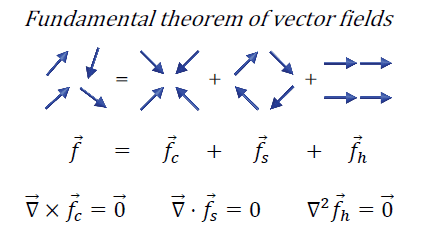
imagem.png


so, BTW, a scalar field can be decomposed in anothers scalar fields too?
 
Physics news on Phys.org
What types of scalar fields are there?
 
How about
$$\phi (q) = \frac{\phi(q) + \lvert \phi(q)\rvert}{2} +\frac{\phi(q) - \lvert \phi(q)\rvert}{2}$$
for a point ##q \in Q## on a smooth manifold and a section ##\phi \in C^{\infty}(Q, Q \times \mathbb R)## of the trivial vector bundle?
This is a decomposition into positive and negative parts.
If the operation ##q \to - q## makes sense, then you can also take
$$\phi (q) = \frac{\phi(q) + \phi(-q)}{2} +\frac{\phi(q) - \phi(-q)}{2}$$
using the same trick. This is a decomposition into symmetric and anti-symmetric parts.
EDIT: You might be interested in this: http://en.wikipedia.org/wiki/Hodge_decomposition
Note that a "scalar field" is a ##0##-form since ##\bigwedge^0 T^*Q \simeq Q \times \mathbb R##.
 
Last edited:

Similar threads

  • · Replies 1 ·
Replies
1
Views
2K
  • · Replies 7 ·
Replies
7
Views
5K
  • · Replies 1 ·
Replies
1
Views
1K
  • · Replies 4 ·
Replies
4
Views
2K
  • · Replies 5 ·
Replies
5
Views
3K
  • · Replies 20 ·
Replies
20
Views
2K
  • · Replies 3 ·
Replies
3
Views
4K
  • · Replies 23 ·
Replies
23
Views
4K
  • · Replies 5 ·
Replies
5
Views
2K
  • · Replies 1 ·
Replies
1
Views
4K