Can this Basic Math Olympiad Problem be Solved without Calculus?

Join the discussion
Ask a follow-up here, or get your own question answered by working scientists, mathematicians and engineers — people, not an autocomplete.
Real named experts · corrections over time · the nuance an AI answer skips
28 replies · 5K views
timetraveller123
Messages
620
Reaction score
45
<Moderator's note: moved from a technical forum, so homework template missing.>
upload_2017-5-6_22-11-44.png

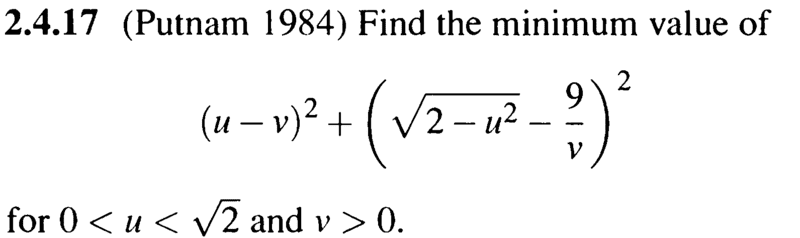
so this is the question.
i want to know if there is a solution without using calculus maybe trig substitution maybe other methods?
i tried trig substitition
i let u = √2 cosx
and v be sinx
am i on the right track
 
Last edited by a moderator:
  • Like
Likes   Reactions: Buffu
Physics news on Phys.org
ok fine let
v be siny
but this only makes the problem complicated how am i supposed to minimum value of function with different variables
 
It has to be a minimum with respect to both variables. While that is technically not sufficient to have a global minimum, it will do the job here.
 
so terms containing x should be minimum themselves and terms containing y must be local minimum too?
 
Yes, or the same with u and v without substitution. If a point is not a minimum with respect to these variables, there is a point nearby which has a lower value.
 
@mfb
i am just realizing i got back to using calculus and partial derivative i know that method already is there any other
 
Sometimes there are other options. You have the sum of two squares. Both squares are not negative, so if there is a point where both squares are zero, or at least at a global minimum within the allowed parameter range, you found a global minimum. Then you just have to check if it is within the given range of the coordinates.
There is no such point in this problem (unless you allow imaginary arguments).
 
so is the calculus the only method? without imaginary numbers only real because i have it done the calculus way already
 
vishnu 73 said:
so is the calculus the only method? without imaginary numbers only real because i have it done the calculus way already
Did you try AM-GM ?
 
One thing that makes it hard is having both variables in both terms. If you were to make a substitution to two new variables, x and y, so that one term only contains x then you can concentrate first on minimising the other term wrt y.
The downside is that checking the given bounds gets awkward.

Another possible start is to consider what happens on the boundaries.
 
Last edited:
sorry for the late reply

@Buffu
how to apply am-gm here

@haruspex
yup i am finally seeing that calculus is the most straight forward approach here
 
vishnu 73 said:
sorry for the late reply

@Buffu
how to apply am-gm here

@haruspex
yup i am finally seeing that calculus is the most straight forward approach here
Standard differential calculus approach will lead to quartics to solve.
I think I have the answer, using my first suggestion. Write x+u for v and find the min wrt u. That should give you an expression for v in terms of u. It is rather nasty, but see if you can spot a fairly simple pair of values satisfying it.
Showing that produces the minimum is easier than finding it from calculus.
 
  • Like
Likes   Reactions: timetraveller123
##\displaystyle (u - v)^2 + \left(\sqrt{2- u^2} - {9\over v}\right)^2 \ge 2(u-v)\left(\sqrt{2- u^2} - {9\over v}\right)##

Maybe do ##v = ku## now.

I don't think it simplifies the equation much but better than nothing, right ?
 
  • Like
Likes   Reactions: timetraveller123
okay i will give that a try too give me some time i am now doing another problem
 
vishnu 73 said:
no calculus approach does not lead to quartics if you take partial derivatives it is much simpler
anyways i will give your method a try too give me some time

using calculus is quite simple link to answer
https://mks.mff.cuni.cz/kalva/putnam/psoln/psol848.html
Very neat, and yes, that is the answer I got.
The method at that link does produce quartics - see the expression with both y and 1/y3 - but it turns out to factorise nicely.
 
oh if that's what you meant by quartics then yes but anyways i will give your method a try too
 
0


@haruspex

is this correct is this the method

would the method if i let u = x + v?

@Buffu
i am not really too sure how to prceed with am gm i get stuck once after i make the substituion please help me thanks
 
thanks i am getting the exact same equation as before it works

but why does this method work?
 
vishnu 73 said:
thanks i am getting the exact same equation as before it works

but why does this method work?
It is really the same as just differentiating the original equation partially wrt u and v, but by a change of axes it makes the algebra a bit easier.
 
hi i have just one minor question here can you help me verify thanks ?

so this is the question
find all integer solutions to n4 +2n3 + 2n2 + 2n + 1 = m2
i factored it to become
(n+1)2(n2 +1) = m2
aren't the solution just (n,m) = (0,1) (-1 , 0)
is this correct?
 
wait no there is more solutions and no i mean n= -1 and m= 0
(n,m) :
when n is -1 the whole expression becomes zero giving m = 0

when n = 0 m = 1 or -1

so (n,m) : (0,1) , ( 0,-1) , (-1, 0)

my argument is that either n2 + 1 = perfect square or the whole expression must equal zero

the former is satisfied when n = 0 and m = ±1
the latter is satisfied when n = -1 and m =0 correspondingly
 
vishnu 73 said:
i mean n= -1 and m= 0
Ah, yes, silly me.
vishnu 73 said:
my argument is that either n2 + 1 = perfect square or the whole expression must equal zero

the former is satisfied when n = 0 and m = ±1
the latter is satisfied when n = -1 and m =0 correspondingly
I'm convinced.
 
  • Like
Likes   Reactions: timetraveller123
ok thanks just a quick clarification