Can this be solved without trial and error?

  • Thread starter Thread starter Darkmisc
  • Start date Start date
  • Tags Tags
    Error trial
Click For Summary
SUMMARY

The discussion centers on solving the equation 11^2 - 8^2 = 57 using algebraic methods rather than trial and error. Participants emphasize the importance of factoring and applying the difference of squares identity, x^2 - y^2 = (x+y)(x-y), to simplify the problem. By considering integer solutions and the constraints of the problem, they derive valid pairs (x, y) that satisfy the equation. The final conclusion is that systematic algebraic approaches can yield solutions more efficiently than trial and error.

PREREQUISITES
  • Understanding of algebraic identities, specifically the difference of squares.
  • Familiarity with factoring techniques in integer equations.
  • Basic knowledge of solving systems of equations.
  • Ability to work with inequalities and constraints in mathematical problems.
NEXT STEPS
  • Study the difference of squares identity in depth.
  • Learn advanced factoring techniques for polynomial equations.
  • Explore integer programming methods for solving equations with constraints.
  • Practice solving systems of equations using substitution and elimination methods.
USEFUL FOR

Mathematics students, educators, and anyone interested in improving their problem-solving skills in algebra and number theory.

Darkmisc
Messages
222
Reaction score
31
Homework Statement
One square subtracted from another square gives an area of 57. Both squares have side lengths less than 25. What is the area of the larger square?
Relevant Equations
x^2 - Y^2 = 57
Hi everyone

The following problem looks like it needs to be solved by trial and error. Is there a quicker way to do it?

I had the answers (but not solutions), so I simply worked backwards to get 11^2-8^2=57.

If I had to solve it, I would have made a list of the final digits you'd get if you squared numbers ending in 0 - 9, i.e.

0 --> 0
9 --> 1
8 --> 4
7 --> 9
6 --> 6
5 --> 5
4 --> 6
3 --> 9
2 --> 4
1 --> 1

You could also just list the squares of 1 to 25, but I'm not sure if calculators are allowed for this problem.

I'd then look at the which final digits subtracted from each other gives a final digit of 7. Here, it'd be be 1 minus 4 gives a final digit of 7.

Then, I'd use trial and error and eventually arrive at 11^2 - 8^2.

Can it be done in less steps than this?

Thanks
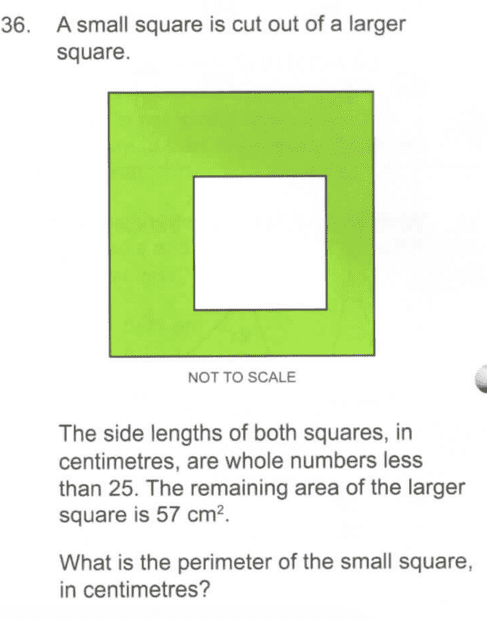
image_2022-07-09_170900314.png
 
  • Like
Likes   Reactions: Delta2
Physics news on Phys.org
Factor 57 as 1*3*19
and then wlog: x≥y set x = y + z where z≥ 0 for some integer z

This will give you
x2 - y2 = 57
(y+z)2-y2 = 58´7
y2 + 2yz + z2 - y2 = 57
2yz + z2 = 57
factorize:
z(2y + z) = 57 = 1*3*19

Now you have only a few cases to consider

case 1: z = 1 gives you 2y + 1 = 57 thus y = 28 not eligible
case 2: z = 3 gives you 2y + 3 = 19 thus y = 8 and x = 11 your solution
case 3: z = 19 gives you 2y + 19 = 3 thus y < 0 not eligible
case 4: z = 57 willl also give y< 0

When you work with integer equations, it is a good idea to factorize
 
  • Like
Likes   Reactions: phinds, Delta2 and Darkmisc
Whenever you have a difference between squares, you should start with the identity x^2 - y^2 = (x+y)(x-y). Then we have <br /> (x + y)(x - y) = 57. There are now two possibilities: <br /> \begin{split} x + y &amp;= \mbox{$57$ or $19$}, \\<br /> x - y &amp;= \mbox{$1$ or $3$}.\end{split} This system is easliy solved to find (x,y) = (29, 28) or (11,8). The first violates the constraint that both x and y are less than 25.

EDIT: An improvement is to note that the conditions of the problem require <br /> 0 &lt; x - y &lt; x + y &lt; 50 so x + y = 57 is plainly impossible.
 
Last edited:
  • Like
Likes   Reactions: SammyS, fresh_42, Delta2 and 2 others
Yeah that was a much better solution than mine :) but my strategy can be used when not havin difference of squares too
 
  • Like
Likes   Reactions: Delta2
pasmith said:
Whenever you have a difference between squares, you should start with the identity x^2 - y^2 = (x+y)(x-y). Then we have <br /> (x + y)(x - y) = 57. There are now two possibilities: <br /> \begin{split} x + y &amp;= \mbox{$57$ or $19$}, \\<br /> x - y &amp;= \mbox{$1$ or $3$}.\end{split} This system is easliy solved to find (x,y) = (29, 28) or (11,8). The first violates the constraint that both x and y are less than 25.
 
drmalawi said:
Factor 57 as 1*3*19
No need to include 1 as a factor.
drmalawi said:
This will give you
x2 - y2 = 57
(y+z)2-y2 = 58´7
58'7 is a typo and should be 57, right?
drmalawi said:
factorize:
z(2y + z) = 57 = 1*3*19
Again, no need to include 1.
 
Mark44 said:
No need to include 1 as a factor.
I know but it is sometimes illustrative and helpful

Mark44 said:
58'7 is a typo and should be 57, right?

yes it is
 

Similar threads

Replies
10
Views
3K
  • · Replies 21 ·
Replies
21
Views
3K
Replies
4
Views
3K
Replies
6
Views
2K
Replies
7
Views
2K
  • · Replies 3 ·
Replies
3
Views
1K
Replies
3
Views
2K
Replies
9
Views
2K
  • · Replies 3 ·
Replies
3
Views
2K
  • · Replies 1 ·
Replies
1
Views
2K