Solve the given problem involving probability without replacement

Join the discussion
Ask a follow-up here, or get your own question answered by working scientists, mathematicians and engineers — people, not an autocomplete.
Real named experts · corrections over time · the nuance an AI answer skips
10 replies · 4K views
chwala
Gold Member
Messages
2,843
Reaction score
428
Homework Statement
This is apast paper question. Allow me to post it as it is.
Relevant Equations
Probability
1728080305462.png


Okay, i was able to solve it by trial and error, i am seeking for a more concrete approach. Can combination work here? or a more solid approach using sequences? or probability itself?

My trial and error,
##P_{green} = \dfrac{9}{12}×\dfrac{8}{11} ×\dfrac{7}{10}×\dfrac{6}{9}×\dfrac{3}{8} = \dfrac{21}{220}##

##n=5##.

and why 2 marks? or there is a shorter method.
 
Reply
  • Like
Likes   Reactions: Gavran
Physics news on Phys.org
chwala said:
and why 2 marks?
And how should we know how many marks there are supposed to be? Is 2 not a perfect score for this question?
 
Reply
  • Like
Likes   Reactions: chwala and SammyS
chwala said:
a more concrete approach
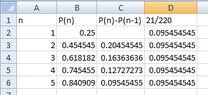
Excel:
1728096424538.png


The calculated value in C6 equals the target value in D6 when n=5.
 

Attachments

  • 1728096320696.png
    1728096320696.png
    2.9 KB · Views: 123
Reply
  • Like
Likes   Reactions: chwala
Hill said:
Excel:
View attachment 351877

The calculated value in C6 equals the target value in D6 when n=5.
ok @Hill, I can see that you're still using the same approach as I am, but you're doing it differently. For instance, following your method,

##P(2) = \dfrac{9}{12}×\dfrac{3}{11}=0.204525##

and so on.

Cheers man!
 
chwala said:
ok @Hill, I can see that you're still using the same approach as I am, but you're doing it differently. For instance, following your method,

##P(2) = \dfrac{9}{12}×\dfrac{3}{11}=0.204525##

and so on.

Cheers man!
These formulas are behind my numbers:
1728108388293.png


I.e., ##P(n)=\frac {3}{13-n}+\frac{10-n}{13-n}*P(n-1)##

In my approach, ##P(2) = 0.454545##, but rather ##P(2)-P(1)=0.204545##.
 
Last edited:
Reply
  • Like
Likes   Reactions: chwala
## \begin{align}
P(n)&=\frac{9!}{(10-n)!}\cdot \frac{(12-n)!}{12!}\cdot3\nonumber\\
&=\frac{(12-n) \cdot (11-n)}{12\cdot 11\cdot 10}\cdot 3\nonumber\\
&=\frac{n^2-23n+132}{440}\nonumber
\end{align} ##

where ## P(n) ## is the probability that Marie picks a green ball on pick ## n ##.
 
Reply
  • Informative
Likes   Reactions: chwala
I forgot to say that in my posts 3 and 5, ##P(n)## is the probability of picking a green ball on picks ##1## - ##n##. Thus, ##P(n)-P(n-1)## is the probability of picking a green ball on pick ##n##.
 
Reply
  • Like
Likes   Reactions: chwala and Gavran
chwala said:
Homework Statement: This is apast paper question. Allow me to post it as it is.
Relevant Equations: Probability

View attachment 351870

Okay, i was able to solve it by trial and error, i am seeking for a more concrete approach. Can combination work here? or a more solid approach using sequences? or probability itself?

My trial and error,
##P_{green} = \dfrac{9}{12}×\dfrac{8}{11} ×\dfrac{7}{10}×\dfrac{6}{9}×\dfrac{3}{8} = \dfrac{21}{220}##

##n=5##.

and why 2 marks? or there is a shorter method.
I would do it this way.
 
Reply
  • Like
Likes   Reactions: chwala
We can work backwards from [itex]\frac{21}{220}[/itex] until we get something we can recognise as [itex]P(n)[/itex] for some [itex]n[/itex]. We have a factor of 7 and a factor of 3 in the numerator, so we need at least factors of 9 and 8, which we get by multiplying by 9/9 = 1 and 8/8 = 1. We don't hae a factor of 12 in the denominator, but we can get that by mupltiying by 6/6 = 1 and combining the 6 with a factor of 2. Hence
[tex]\begin{split}<br /> \frac{21}{220} &= \frac{7 \times 3}{2 \times 10 \times 11} \\<br /> &= \frac{9}{9} \times \frac88 \times \frac{6}{6} \times \frac{7 \times 3}{2 \times 10 \times 11} \\<br /> &= \frac{9}{6 \times 2} \times \frac{8}{11} \times \frac{7}{10} \times \frac{6}{9} \times \frac{3}{8} \\<br /> &= P(5).\end{split}[/tex]
 
Last edited:
Reply
  • Informative
Likes   Reactions: chwala
phinds said:
And how should we know how many marks there are supposed to be? Is 2 not a perfect score for this question?
I agree that 2 marks is sufficient. Question requires logical thinking.
 
chwala said:
I agree that 2 marks is sufficient. Question requires logical thinking.
As I understand it, there can be three cases.

The first case is a complete solution. That means there is a correct trial for n=5 (the fifth ball is green). In this case a student scores the mark 2.
The second case is an incomplete solution. That means there is a correct trial for n=4 (the fourth ball is green) or n=3 (the third ball is green) or n=2 (the second ball is green). In this case a student scores the mark 1.
The third case is an incomplete solution too. But in this case that means there is only 1 correct trial for n=1 (the first ball is green) or there is not a correct trial. In this case a student does not score a mark.
 
Reply
  • Like
Likes   Reactions: WWGD and chwala