Can this version of pneumatic piston sustain a certain load on its own?

Click For Summary
SUMMARY

The discussion centers on the functionality of a micro pneumatic piston designed by a freshman design student. The piston is intended to maintain its position when both chambers are pressurized and connected. Key insights reveal that the piston behaves similarly to a spring and adheres to the Ideal Gas Law, which governs the movement of the piston based on pressure differences. The concept presented is akin to a regenerative hydraulic circuit, indicating a foundational understanding of pneumatic systems.

PREREQUISITES
  • Understanding of pneumatic systems and their components
  • Familiarity with the Ideal Gas Law
  • Basic principles of pressure and force in fluid mechanics
  • Knowledge of regenerative hydraulic circuits
NEXT STEPS
  • Research the Ideal Gas Law and its applications in pneumatic systems
  • Explore the design and functionality of regenerative hydraulic circuits
  • Learn about the mechanics of pneumatic pistons and their load-bearing capabilities
  • Investigate pressure equalization techniques in pneumatic systems
USEFUL FOR

This discussion is beneficial for design students, mechanical engineers, and anyone interested in the principles of pneumatic systems and their applications in engineering projects.
Polar24
Messages
1
Reaction score
1
TL;DR
I designed a micro pneumatic piston that can stay in a position as long as no extra force is applied
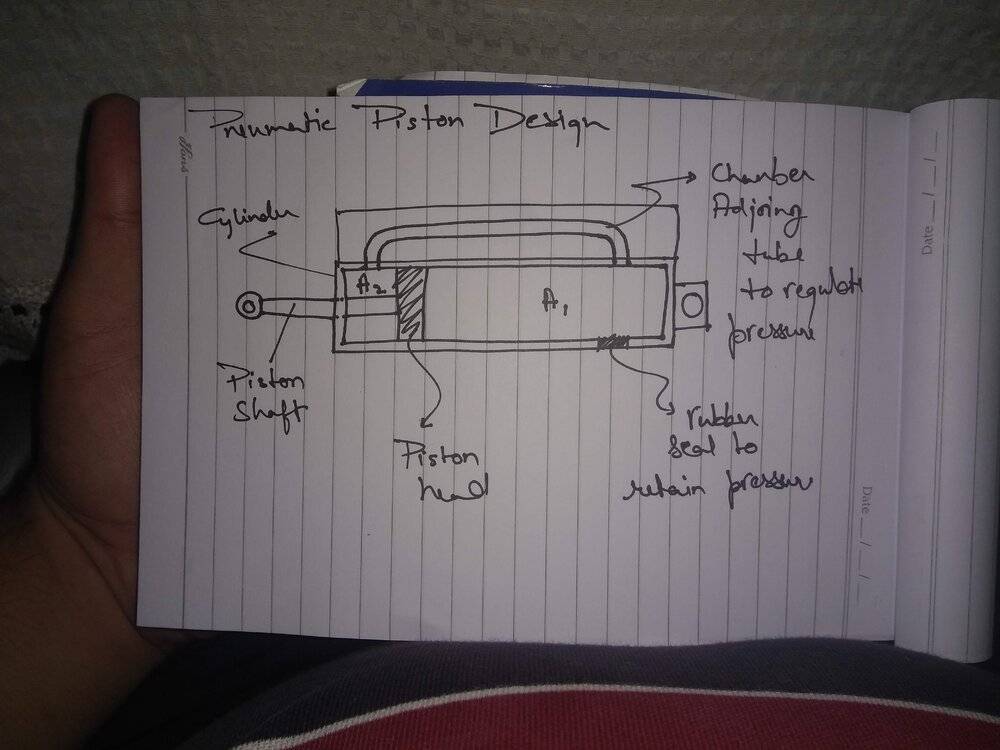
Hey guys I am a freshman design student and I have been doing a project in which I am using a pneumatic piston that I designed, I don't have depth knowledge about pneumatics but I tried something. I am using simple concept for this if the cylinder is already pressurized and I am able to join both chambers, do piston is going to sustain its position?
IMG_20200625_223711355.jpg
I need help in this I am sharing my design with this
 
  • Like
Likes   Reactions: Joe591
Engineering news on Phys.org
Polar24 said:
Summary:: I designed a micro pneumatic piston that can stay in a position as long as no extra force is applied

Hey guys I am a freshman design student and I have been doing a project in which I am using a pneumatic piston that I designed, I don't have depth knowledge about pneumatics but I tried something. I am using simple concept for this if the cylinder is already pressurized and I am able to join both chambers, do piston is going to sustain its position?View attachment 265290 I need help in this I am sharing my design with this
Welcome to the PF. :smile:

If ##P_1## and ##P_2## are initially different and you open the valve to equalize them, the piston should move according to the Ideal Gas Law. Are you familiar with that equation?
 
Why do you believe it will sustain its position? Could you lay out your thought process here?
 
  • Like
Likes   Reactions: berkeman
Polar24 said:
I am using simple concept for this if the cylinder is already pressurized and I am able to join both chambers, do piston is going to sustain its position?
The piston will appear to be like a spring.
As you move the piston the enclosed volume will change, because the area of the piston A1, is equal to the area of the annulus A2, plus the area of the rod.

You have rediscovered the pneumatic equivalent to half of a regenerative hydraulic circuit.
 

Similar threads

  • · Replies 6 ·
Replies
6
Views
1K
Replies
5
Views
2K
Replies
2
Views
2K
  • · Replies 6 ·
Replies
6
Views
1K
  • · Replies 33 ·
2
Replies
33
Views
4K
  • · Replies 5 ·
Replies
5
Views
4K
  • · Replies 6 ·
Replies
6
Views
18K
  • · Replies 18 ·
Replies
18
Views
671
  • · Replies 5 ·
Replies
5
Views
3K
  • · Replies 17 ·
Replies
17
Views
2K