SUMMARY
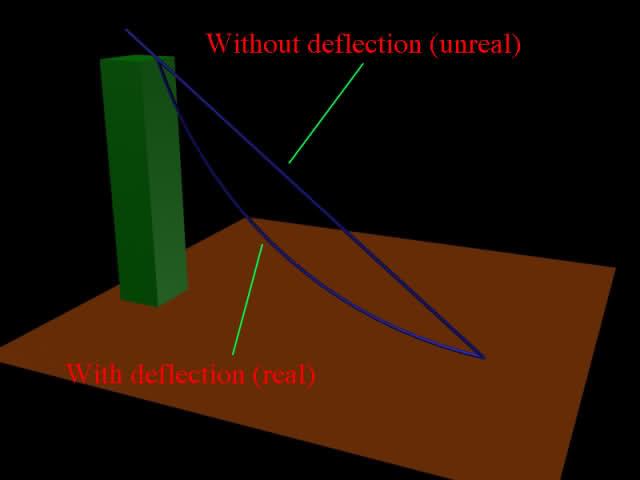
The discussion focuses on calculating the deflection of a long rod placed between the ground and a tall building, considering factors such as material properties, length, and radius. The standard deflection formula for a uniformly distributed load (UDL) on a simply supported beam, specifically [5*w*L^4]/[384*E*I], is recommended for small deflections. Young's modulus for Carbon nanotubes is noted as 1,000 GPa, and the Moment of Inertia (I) is calculated using the formula (π*r^4)/4. The conversation emphasizes the importance of approximations and the need to consider the inclination of the rod when performing calculations.
PREREQUISITES
- Understanding of beam deflection theory
- Familiarity with Young's modulus and material properties
- Knowledge of Moment of Inertia calculations
- Basic principles of structural mechanics
NEXT STEPS
- Research advanced beam deflection theories for large deflections
- Learn about finite element analysis (FEA) for complex structures
- Explore the effects of shear and axial loads on beam deflection
- Study the implications of rod inclination on deflection calculations
USEFUL FOR
Engineers, physicists, and students in structural mechanics or materials science who are interested in calculating deflection in beams and rods, particularly in applications involving tall structures and advanced materials like Carbon nanotubes.