Can we write Rolle's Theorem this way?

  • Context: Undergrad 
  • Thread starter Thread starter nil1996
  • Start date Start date
  • Tags Tags
    Theorem
Click For Summary

Discussion Overview

The discussion revolves around the formulation of Rolle's Theorem, specifically whether the conditions can be modified to include cases where the function values at the endpoints are not equal. Participants explore the implications of such a modification and whether it holds under certain conditions.

Discussion Character

  • Debate/contested

Main Points Raised

  • One participant presents a modified version of Rolle's Theorem, suggesting that the condition f(a) = f(b) could be replaced with f(c) > [f(a), f(b)] or f(c) < [f(a), f(b)].
  • Another participant agrees with the proposed modification, indicating that it can be proven using the intermediate value theorem.
  • A clarification is made regarding the application of Rolle's theorem to the interval [d,c] instead of [d,b].
  • Participants acknowledge the notation issue with f(c) being displayed incorrectly.

Areas of Agreement / Disagreement

There is some agreement on the validity of the proposed modification to Rolle's Theorem, but the discussion remains open regarding the implications and exceptions related to the new condition.

Contextual Notes

Participants do not fully resolve the implications of the modified condition, and there may be assumptions regarding the continuity and differentiability of the function that are not explicitly stated.

nil1996
Messages
301
Reaction score
7
Rolle's theorem:

Statements:
If y =f(x) is a real valued function of a real variable such that:

1) f(x) is continuous on [a,b]
2) f(x) is differentiable on (a,b)
3) f(a) = f(b)

then there exists a real number c[itex]\in[/itex](a,b) such that f'(c)=0

what if the the f(x) is like the following graph:
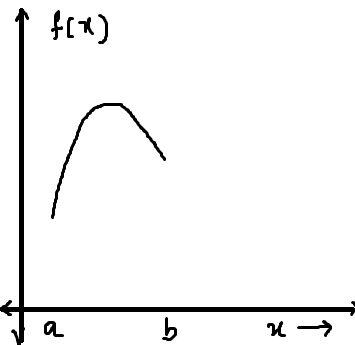
attachment.php?attachmentid=66149&stc=1&d=1391078080.png


here there is a point 'c' for which f'(c) =0 but f(a) [itex]\neq[/itex] f(b)

So to take such cases in consideration can we make a change to the last statement of Rolle's theorem as:
3)f(c) > [f(a),f(b)] Or f(c)<[f(a),f(b)]

are there any exceptions to the above statement?
 

Attachments

  • 11.png
    11.png
    1.8 KB · Views: 671
Last edited:
Physics news on Phys.org
Yes, that statement works. The easiest way to prove this is to notice that if f(c.) > f(b) > f(a) (for example), then there exists some d such that a<d<c and f(d) = f(b) by the intermediate value theorem. Then applying Rolle's theorem to the interval [d,c] completes the proof.

This computer seems to insist on writing f(c.) without the period as f©, hence the strange notation.
 
Office_Shredder said:
Then applying Rolle's theorem to the interval [d,c] completes the proof.

Do you mean interval[d,b]
 
Yeah good catch
 
Thanks :smile:
 
Last edited:

Similar threads

  • · Replies 6 ·
Replies
6
Views
3K
  • · Replies 3 ·
Replies
3
Views
2K
  • · Replies 9 ·
Replies
9
Views
3K
  • · Replies 3 ·
Replies
3
Views
4K
  • · Replies 6 ·
Replies
6
Views
4K
  • · Replies 5 ·
Replies
5
Views
3K
  • · Replies 1 ·
Replies
1
Views
3K
  • · Replies 9 ·
Replies
9
Views
3K
  • · Replies 9 ·
Replies
9
Views
3K
  • · Replies 4 ·
Replies
4
Views
2K