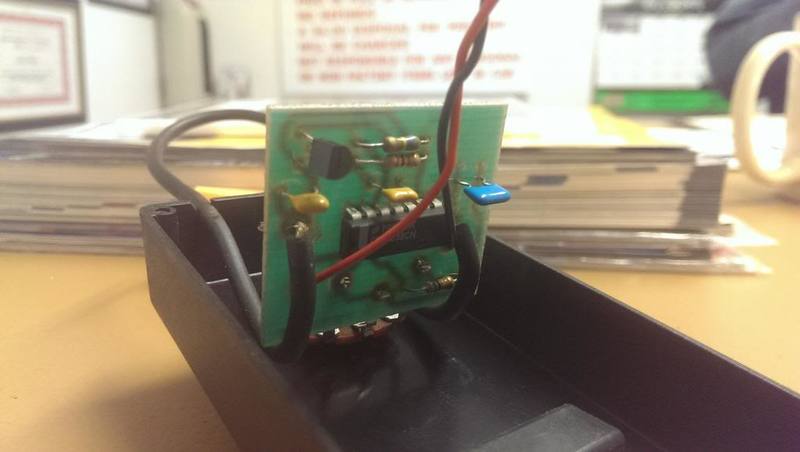
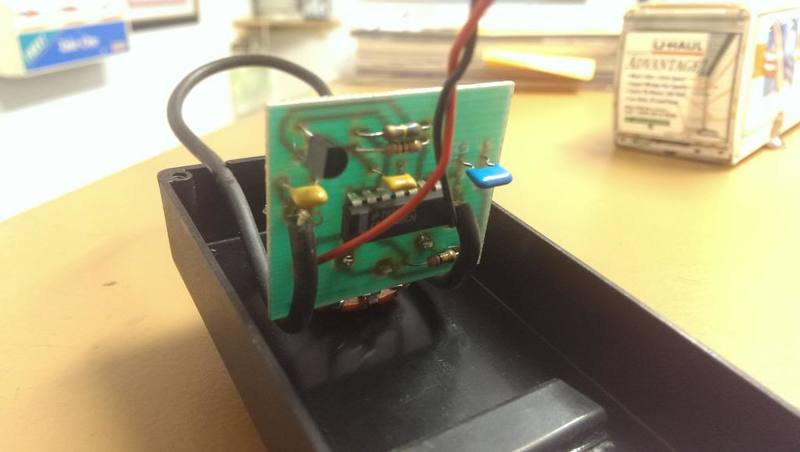
Can you help identify home-made potentiometer components?

Click For Summary

Discussion Overview

The discussion revolves around identifying components of a homemade potentiometer, including resistors, capacitors, transistors, and integrated circuits. Participants seek to determine the ratings and types of these components based on images provided, as well as to understand the overall function of the device.

Discussion Character

  • Exploratory
  • Technical explanation
  • Debate/contested

Main Points Raised

  • One participant requests help identifying components in images, mentioning a lack of knowledge about electronic components.
  • Another participant suggests that the resistors appear to be regular 1/4 W resistors and that the transistor is likely a bipolar type, advising to check for descriptions.
  • Questions arise about the yellow and blue components, with some participants proposing they are capacitors and suggesting using a multimeter to measure capacitance.
  • There are suggestions that the components could be PTC thermistors or a 3-terminal voltage regulator, with uncertainty about their exact nature.
  • One participant identifies the integrated circuit as a CD4093 quad NAND gate and inquires about the function of the device to assist in reverse engineering.
  • Another participant speculates that the black wire may serve as an antenna and discusses the possibility of the device being a crude jammer or oscillator.
  • One participant provides a detailed analysis of the resistors' color codes and suggests possible values, while also discussing the potential configurations of the integrated circuit.
  • There is a correction regarding the tolerance ratings of the resistors, with conflicting information about gold and silver bands.
  • A participant mentions having found comparable integrated circuits and describes the transistor as likely being a bipolar NPN type, but notes the lack of markings on the components.

Areas of Agreement / Disagreement

Participants express multiple competing views regarding the identification of components, with no consensus reached on the exact nature or ratings of the components discussed. Uncertainty remains about the function and configuration of the device.

Contextual Notes

Limitations include the inability to definitively identify components without markings or clear descriptions, as well as the reliance on visual interpretation of images. The discussion also reflects varying levels of expertise among participants.

jeiparmar
Messages
4
Reaction score
0
Can you help identify "home-made" potentiometer components?

Hi all,

I work well with my hands, but am not very applied with electronic gadgetry as to what exactly the components in the pictures are. I know there are transistors, resistors an integrated circuit and etc. I was wondering if anyone would be able to tell me the ratings on the resistors by looking at the images; I understand the color code, but what about the ohm / wattage ratings?. Or even the type of transistor based on its shape? Maybe? I'm not very well informed and figured I'd give it a shot. My potentio-meter seems to have stopped working during Hurricane Sandy, I needed to try and rebuild it. Please help, or even guide me in the right direction.

Please note the power source is a 9-volt battery. Also if the PCB is anything anything specific; that would help as well. I did not build it, and the person who did; I have not been in contact with for a loooooong time. :-(

THANKS IN ADVANCE!
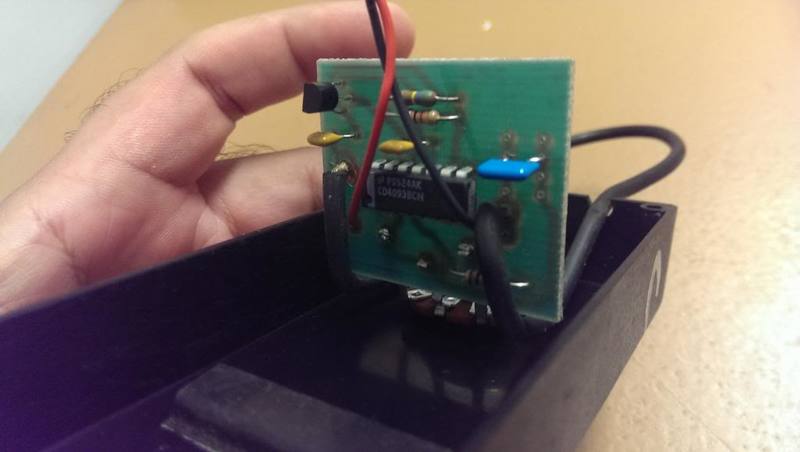
2013-10-19132043_zpsf9388ad0.jpg


2013-10-19132002_zpseb572f14.jpg


2013-10-19131942_zpsa07f096f.jpg
 
Engineering news on Phys.org
The resistors look like regular 1/4 W resistors, the resistance follows from the color code.
The transistor is probably a bipolar transistor (check if there is some description on it, if yes google that).

The PCB looks like a regular PCB.
 
Thanks for the feedback. What are the two yellow and single blue component? Capacitors? Any idea how I can figure out which type or rating i'd need to purchase? There are no markings on the yellow / blue components.
 
They look like capacitors. Without a description... look for a multimeter that can measure capacitances, or find a description of the potentiometer.
 
You can always desolder each component and measure the resistance/capacitance with a good multimeter.

If a component failed it is most likely (in order): chip, transistor, capacitor ... or if something is burnt, check the inductors.
 
Just to add that you can't get any useful information about the transistor without its part number, which should be printed on the flat side, unless somebody with sweaty hands has rubbed off the ink.

Transistors are made in a fairly small number of "package types" (i.e. physical size, shape, and position of the leads) and different types may have the three leads (emitter, base, collector) in different arrangements for the same size and shape of package. Without knowing the part number, or tracing out the circuit diagram and understanding which lead is which, you don't know what types would work as a replacement.
 
The IC looks like a CD4093 quad nand gate. What is the function of the box? Maybe we can help you reverse engineer it if we knew what it did.
 
What some people say look like capacitors could be PTC thermistors. It is unlikely that there are 3 of them with no capacitors on the board. What some people call the transistor could be a 3 terminal voltage regulator.
 
  • #10
Averagesupernova said:
What some people call the transistor could be a 3 terminal voltage regulator.

That was my first impression, then I saw that the CD4093 can accept power up to 15V, so maybe it is a transistor after all.

Anybody notice what the black wire is doing? It looks like it comes off of the board, loops around outside the box (going through holes in the box), then comes right back onto the board. Inductive pickup of some kind?

There is also what looks like a rotary switch on the non-component side which the poster did not show.

Also, the blue device (cap?) has 4 parallel footprints.

@jeiparmar, what is this?
 
  • #11
Crude jammer, the black wire being the antenna? Nand gates wired as ring oscillator?
 
  • #12
Thank you everyone for your feedback.

@the_emi_guy

To answer your questions as to WHAT it is;

It is a device that mimics an electric current as within a spark plug wire. Normally the read probe is connected onto a spark plug wire[around the wire] or ignition wire, but in this case as you said the black wire acts as an "antenna" and the probe gets connected around the antenna. It looks like a giant clamp that you just hold over whatever wire you're taking a reading from and gives you the RPMs digitally. I used to use it for our Dyno at the shop to artificially test different ECU maps and how they would react to different variables. If you can artificially create a[n] mechanical RPM, I can run tests without damaging actual parts by running a computer simulated program.

The dial like object on the other end of the is exactly that. It is a dial [potentiometer?] used to control the RPMs that my dyno will read; in this specific case i was able to simulate from 300ish - 3500ish RPMs.

If you guys need pictures of the other side. I can take some and upload them. Let me know.

Once again. Thanks for the help! Appreciate every bit of it!
 
Last edited:
  • #13
It does look like an oscillator driving a transistor that drives a current spike through the loop to simulate a spark plug wire.

The components that are identifiable from the pics are only the resistors and the IC. The resistors from the top are, I think, 560K, 1K, and 100K. If I'm seeing the colors correctly, the top resistor is green, blue, yellow, the next resistor is brown, black, red, and the bottom one is brown, black, yellow. The gold band is the tolerance rating, 10% for gold and 5% for silver are the most common.

The CD4093 looks like at least one of the gates is unused since both inputs are tied to Vcc. Others may be tied to Vcc like this but I can't tell from the pics. It looks like pins 8 & 9 are tied together and this is often done to create an inverter or to be used as a buffer for the output of the oscillator.

The caps look like they are in the 1nF to .1uF range but this is really just a wild guess since I can't see any numbers at all. Assuming that the pot could be 500K, time constants of approximately the range you suggest are possible with capacitors in that range. It would be helpful if you could read the numbers from the caps and the pot and to see the solder-side of the PCB. I assume the red and black wires are going to power.

Look on the caps for numbers like 103 or 224 or 472. The first two numbers are the value digits and the third is the order of magnitude. The values are in pF so a 103 is 10 x 10^3 pF or 10000pF or 10nF.

Best of luck!
 
  • #14
Oops! The gold and silver are reversed. Gold is 5% and Silver is 10%.
 
  • #15
ScienceGeyser said:
The gold band is the tolerance rating, 10% for gold and 5% for silver are the most common.

Wrong way around.
 
  • #16
Hey all, thanks again for the information. I've been able to find comparable integrated circuits by another brand; thankfully. The capacitors don't have any markings on them, neither does the transistor. Seems to me to be a bipolar NPN type.

Please see the following link for more pictures. It's the best I could do with my phone [sorry]. I'll try to borrow a DSLR from one of my buddies if it's still not enough to get more information out of the pictures.

THANKS AGAIN!

http://s257.photobucket.com/user/jazzzzo/library/Potentiometer
 

Similar threads

Replies
12
Views
2K
  • · Replies 14 ·
Replies
14
Views
2K
Replies
7
Views
3K
Replies
12
Views
3K
Replies
16
Views
3K
  • · Replies 3 ·
Replies
3
Views
3K
Replies
19
Views
4K
  • · Replies 9 ·
Replies
9
Views
18K
  • · Replies 8 ·
Replies
8
Views
3K
  • · Replies 26 ·
Replies
26
Views
4K