Can you please check this (destructive interference).

Click For Summary

Homework Help Overview

The discussion revolves around a problem related to destructive interference in sound waves, specifically involving two speakers and the distances from a listener to each speaker. The original poster presents calculations based on the distances to the speakers and attempts to determine the wavelength and frequency of the sound.

Discussion Character

  • Exploratory, Assumption checking, Conceptual clarification

Approaches and Questions Raised

  • Participants discuss the necessity of considering the distances to both speakers when analyzing destructive interference. The original poster's calculations are questioned, particularly regarding the treatment of distances and the definition of the length difference required for destructive interference.

Discussion Status

There is an ongoing examination of the calculations presented by the original poster, with multiple participants providing feedback and seeking clarification on the correct approach to the problem. Some guidance has been offered regarding the importance of the distance difference between the speakers, but no consensus has been reached on the correctness of the calculations.

Contextual Notes

Participants note that the original poster's calculations may not fully account for the distances to both speakers, which is crucial for determining the conditions for destructive interference. There is also a mention of needing to revisit the problem for further clarification.

Sullo
Messages
15
Reaction score
0
If it is wrong can you please pinpoint where i am going wrong. Thank you.

1. Homework Statement

https://imgur.com/a/0STmmWt
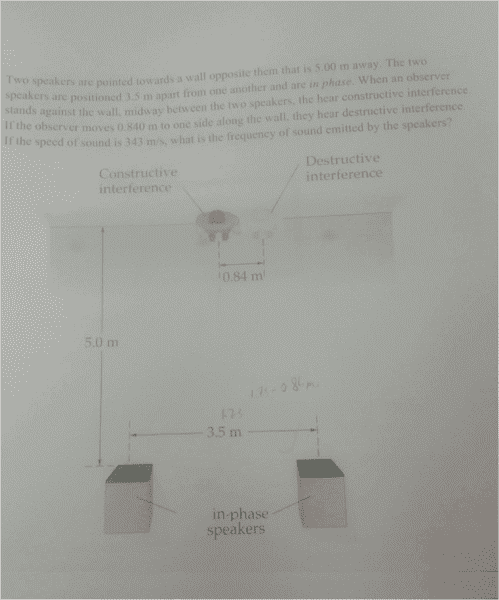
upload_2018-5-19_15-17-56.png

(uploaded picture because it has a diagram)

Homework Equations


To sense destructive interference , the person must be one half wavelength (0.5λ) closer or farther from one speaker than the other.

The Attempt at a Solution


Choosing distance from closer speaker (speaker on the right). So to sense destructive frequency he must be 0.5λ closer to the right speaker than the left.
Distance from right speaker before moving to the right (c^2) = a^2 + b^2
Distance from right speaker before moving to the right (c^2) = 1.75^2 + 5.0^2
Distance from right speaker before moving c = 5.30m

Distance from right speaker after moving to the right (c^2) = a^2 + b^2
Distance from right speaker after moving to the right c^2 = (1.75-0.84)^2 + (5.0)^2
Distance from right speaker after moving to the right c = 5.08m

Therefore; Distance from right speaker before moving - Distance from right speaker after moving
=5.30 - 5.08 = 0.22m

Therefore ; 0.22m = 0.5λ --> λ = 0.44m

v = fλ , f = v/λ = 343/0.44 = 779.5Hz
 

Attachments

  • upload_2018-5-19_15-17-56.png
    upload_2018-5-19_15-17-56.png
    42.6 KB · Views: 764
Last edited by a moderator:
Physics news on Phys.org
The distance to the left speaker changes as well.
 
mfb said:
The distance to the left speaker changes as well.
Can you please elaborate, why include both speakers in this?
 
Sullo said:
To sense destructive interference , the person must be one half wavelength (0.5λ) closer or farther from one speaker than the other.
The length difference between the left and right speaker has to be half the wavelength. What you calculated is something else - you didn't even consider the left speaker.
 
mfb said:
The length difference between the left and right speaker has to be half the wavelength. What you calculated is something else - you didn't even consider the left speaker.

I'll need to go over this again tomorrow then
 
mfb said:
The length difference between the left and right speaker has to be half the wavelength. What you calculated is something else - you didn't even consider the left speaker.
So do you mean distance from left speaker after moving + distance from right speaker after moving = 0.5λ ?
 
The difference, not the sum.
 
mfb said:
The difference, not the sum.
Oh ok. Thank you!

So is this correct?

Distance from left speaker after moving to the right (c^2) = a^2 + b^2
Distance from left speaker after moving to the right (c^2) = (1.75+0.84)^2 + 5.0^2
Distance from left speaker after moving to right c = 5.631

Distance from right speaker after moving to the right (c^2) = a^2 + b^2
Distance from right speaker after moving to the right c^2 = (1.75-0.84)^2 + (5.0)^2
Distance from right speaker after moving to the right c = 5.08m

Therefore; Distance from left speaker after moving - Distance from right speaker after moving
=5.631 - 5.08 = 0.551m

Therefore ; 0.551m = 0.5λ --> λ = 1.102m

v = fλ , f = v/λ = 343/1.102 = 311.26 Hz , 310hz (2 sig figs).
 
That looks good.
 

Similar threads

  • · Replies 3 ·
Replies
3
Views
2K
  • · Replies 7 ·
Replies
7
Views
3K
  • · Replies 3 ·
Replies
3
Views
4K
Replies
3
Views
3K
Replies
3
Views
4K
Replies
7
Views
5K
Replies
20
Views
5K
  • · Replies 1 ·
Replies
1
Views
3K
  • · Replies 6 ·
Replies
6
Views
2K
  • · Replies 19 ·
Replies
19
Views
4K