Can You Prove Equal Proportions in a Liquid Mixture?

  • Context: MHB 
  • Thread starter Thread starter mathmaniac1
  • Start date Start date
  • Tags Tags
    Liquid Mixture
Click For Summary

Discussion Overview

The discussion revolves around a problem involving the mixing of milk and tea, specifically whether the percentage of milk in the tea is greater than, less than, or equal to the percentage of tea in the milk after a series of transfers. Participants explore various mathematical approaches and reasoning related to proportions in liquid mixtures.

Discussion Character

  • Exploratory
  • Mathematical reasoning
  • Debate/contested

Main Points Raised

  • One participant proposes that after mixing, the percentages of milk in tea and tea in milk are equal, based on the assumption that the total amounts in both glasses do not change.
  • Another participant questions the reasoning behind the calculations presented, seeking clarification on how certain ratios were derived.
  • A hypothetical scenario involving a mixture of water and alcohol is introduced to illustrate the concept of maintaining ratios in well-mixed solutions.
  • Concerns are raised about the implications if the amounts of tea or milk are less than three spoonfuls, suggesting potential complications in the problem.
  • A humorous analogy involving sewage and wine is presented to argue that the question may be meaningless under certain interpretations.
  • Some participants express confusion regarding the equality of the amounts after mixing and seek further elaboration on the reasoning behind the claims made.
  • Mathematical expressions are shared to analyze the problem, with one participant suggesting that the results depend on the initial volumes of milk and tea.
  • Another participant proposes modifying the algebraic approach to account for unequal glass sizes, indicating a desire to explore the problem more generally.

Areas of Agreement / Disagreement

Participants do not reach a consensus on the problem. Multiple competing views and interpretations remain, with some asserting equality of proportions while others challenge this conclusion and seek clarification.

Contextual Notes

There are unresolved assumptions regarding the initial volumes of milk and tea, as well as the sizes of the glasses used in the problem. The discussion reflects varying levels of understanding and interpretation of the mathematical reasoning involved.

Who May Find This Useful

Readers interested in mathematical reasoning, liquid mixtures, and proportionality in problem-solving may find this discussion relevant.

mathmaniac1
Messages
158
Reaction score
0
Three tablespoons of milk from a glass of milk are poured into a glass
of tea, and the liquid is thoroughly mixed. Then three tablespoons of this mixture
are poured back into the glass of milk. Which is greater now: the percentage of
milk in the tea or the percentage of tea in the milk?
 
Mathematics news on Phys.org
Re: Answer and explain the answer

Let $S$ be the amount in three spoonfuls and $G$ be the amount in a glass. After stirring in the 3 spoonfuls of milk into the tea, it is

$$\frac{G}{G+S}$$ tea and $$\frac{S}{G+S}$$ milk.

Thus, three spoonfuls of this mixture will be $$\frac{GS}{G+S}$$ tea and $$\frac{S^2}{G+S}$$ milk.

Then, taking three spoonfuls of this mixture and putting it into the milk means:

The tea glass has:

tea: $$G-\frac{GS}{G +S}=\frac{G^2}{G+S}$$
milk: $$S-\frac{S^2}{G + S}=\frac{GS}{G+S}$$

The milk glass has:

tea: $$0+\frac{GS}{G+S}=\frac{GS}{G+S}$$
milk: $$(G-S)+\frac{S^2}{G+S}=\frac{G^2}{G+S}$$

Thus, it is equal.
 
Last edited:
Re: Answer and explain the answer

MarkFL said:
Thus, three spoonfuls of this mixture will be $$\frac{GS}{G+S}$$ tea and $$\frac{S^2}{G+S}$$ milk.

:confused: :confused: :confused: How??

The rest is clear...

Thanks
 
Re: Answer and explain the answer

mathmaniac said:
:confused: :confused: :confused: How??

The rest is clear...

Thanks

I took the product of the ratios and $S$.
 
Re: Answer and explain the answer

MarkFL said:
I took the product of the ratios and $S$.

Explain the reasoning behind it.
 
Re: Answer and explain the answer

Suppose you have a well-mixed solution that is 3/4 water and 1/4 alcohol. If you remove a portion of that, then the ratio of water to alcohol will be the same in the portion you removed, given that it is mixed well. Suppose you removed 100 mL. Then you know:

The amount of water in the removed portion is:

$$\frac{3}{4}\cdot100\text{ mL}=75\text{ mL}$$

The amount of alcohol in the removed portion is:

$$\frac{1}{4}\cdot100\text{ mL}=25\text{ mL}$$

Does this make sense?
 
What if there's less than 3 spoonfuls of tea
in the tea glass? Or 0 spoonfuls? :cool:
 
Wilmer said:
What if there's less than 3 spoonfuls of tea
in the tea glass? Or 0 spoonfuls? :cool:

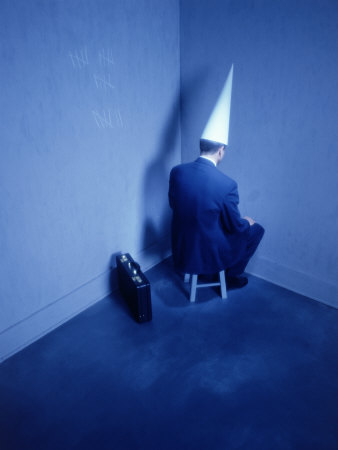
dunce.jpg
 
Who sent you to the corner, Mark?
 
  • #10
(Shake) I see your time in the corner has been insufficient to "correct" your behavioral issue.

More drastic measures may be called for...

images


(Clapping)
 
  • #11

This reminds of an old joke.
Three tablespoons from a glass of sewage are poured into a glass of wine; the liquid is thoroughly mixed.
Then three tablespoons of this mixture are poured back into the glass of sewage.
Which is greater now: the percentage of sewage in the wine or the percentage of wine in the sewage?
The question is meaningless.

Add three tablespoons of sewage to a glass of wine
. . and you will have a glass of sewage.

Return three tablespoons to the glass of sewage
. . and you will have a glass of sewage.

Result: two glasses of sewage.
 
  • #12
Guess I'll be heading along...
 
  • #13
Re: Answer and explain the answer

MarkFL said:
Let $S$ be the amount in three spoonfuls and $G$ be the amount in a glass.

Did I say the amount in two glasses are equal(G)?
 
  • #14
In the absence of anything being said regarding the relative sizes of the two glasses, it is natural to assume they are the same size.

At least Wilmer will no longer be lonely in the corner. (Giggle)
 
  • #15
MarkFL said:
In the absence of anything being said regarding the relative sizes of the two glasses, it is natural to assume they are the same size.

Oh,that was the problem I had in solving this.I never got it equal as in the answer.I will post the original answer now.It made no sense to me...

At least Wilmer will no longer be lonely in the corner. (Giggle)

Who's going to give him a good company?You don't mean me,do you Mark?:)
 
  • #16
I said I found this in an ebook.And here is the ebook answer.It made no sense to me.But I don't know about others.Certainly, the percentage of milk in the tea is the same as the percentage of
tea in the milk, since the total amount of milk (or of tea) in both glasses does not
change.If anybody understood this,please elaborate to me what it means...
 
  • #17
What they are saying is that since both glasses have not changed in the amount of liquid they hold, the amount of tea now in the milk glass must be equal to the amount of milk now in the tea glass.
 
  • #18
Still makes no sense...(Sadface)(Sadface)
 
  • #19
mathmaniac said:
Still makes no sense...
A diagram is worth 10^3 words:

Code:
    MILK       MOVEMENT         TEA
 | 30m     |                | 30t     | : 2 glasses, each with 30 units
 | 15m     |   >> 15m >>    | 30t,15m | : 15 units of milk dumped in tea glass
 | 20m,10t | << 10t,5m <<   | 20t,10m | : 15 units of mix dumped in milk glass
Transfer of mix is in ratio 30:15 of course, so 10:5

In other words, forget the teaspoons (Tauri)
 
Last edited:
  • #20

This is a basis of a stunning card trick.

You and your victim sit on opposite sides of a small table.

You hand him a packet of 20 cards.
Have him deal 10 cards face up on the table.
Then shuffle the two packets together (half face up, half face down).
Have him shuffle a few more times.

Instruct him to hold the deck under the table and give it another shuffle.
Hold out your hand under the table and have him deal 10 cards onto your hand.
Both of you keep your hands under the table.

You remind him:
. . that he doesn't know where the face-up cards were,
. . that he doesn't know which cards he gave you,
. . that he doesn't know how many face-up cards he has now.

You point out:
. . that you are equally ignorant.

Nevertheless, you announce that you will make your number of face-up cards
. match his number of face-up cards.

He will hear the sounds of cards being moved, flipped, etc.
Then you bring up your packet and clearly count out the face-up cards.

Instruct him to do the same. . The numbers will match!The secret: (Drag your cursor between the asterisks.)

** Do nothing to your packet except turn it over.**
 
  • #21
Wilmer said:
A diagram is worth 10^3 words:

Code:
    MILK       MOVEMENT         TEA
 | 30m     |                | 30t     | : 2 glasses, each with 30 units
 | 15m     |   >> 15m >>    | 30t,15m | : 15 units of milk dumped in tea glass
 | 20m,10t | << 10t,5m <<   | 20t,10m | : 15 units of mix dumped in milk glass
Transfer of mix is in ratio 30:15 of course, so 10:5

In other words, forget the teaspoons (Tauri)

Here also both glasses were taken to be equal,right?

So no way of determining if the glasses are unequal,I think.Am I right?
 
  • #22
soroban said:
stunning card trick.
Man,where did you get this from?Amazing!

I always love magic tricks and thank you for teaching me one soro ...
 
  • #23
mathmaniac said:
Here also both glasses were taken to be equal,right?

So no way of determining if the glasses are unequal,I think.Am I right?

Have you tried taking the algebraic approach I posted and modifying it so that the glasses are not necessarily equal in volume?
 
  • #24
MarkFL said:
Have you tried taking the algebraic approach I posted and modifying it so that the glasses are not necessarily equal in volume?

I had tried a similar method before posting it and got insane answers...

Are you saying that it will be equal even when the glasses are unequal...:confused:

Thanks
 
  • #25
Post what you tried...I have not actually worked it out, but let's see what you did, and the "insane" results you obtained.
 
  • #26
Let the volume of milk in teaspoon units be x+3 and volume of tea be y teaspoon units.
Taking 3 from the milk glass gives x remaining in it and y+3 in the tea glass with 3 units of tea.
Now we take 3 units from the tea glass.Let it contain t tea and m milk.
Then 3/(y+3)=m/3
m=9/(y+3)
y/(y+3)=t/3
t=3y/(y+3)
Now the percentage of tea in milk = [3y/(y+3)]/x
Percentage of milk in the tea=[9/(y+3)]/(y+3)=9/[(y+3)^2]
It is obvious that it all depends on x and y...
And putting x+3=y you can get it equal...
 
  • #27
I had something more general in mind, such as using a non-negative constant of proportionality for the volume of one of the glasses relative to the other.
 
  • #28
MarkFL said:
I had something more general in mind, such as using a non-negative constant of proportionality for the volume of one of the glasses relative to the other.

But you can never prove it to be equal to one 1:1,you can do it iff and only if the glasses are equal...
 

Similar threads

  • · Replies 2 ·
Replies
2
Views
1K
  • · Replies 5 ·
Replies
5
Views
5K
  • · Replies 13 ·
Replies
13
Views
3K
  • · Replies 6 ·
Replies
6
Views
5K
  • · Replies 3 ·
Replies
3
Views
2K
  • · Replies 4 ·
Replies
4
Views
8K
  • · Replies 25 ·
Replies
25
Views
6K
  • · Replies 1 ·
Replies
1
Views
2K
  • · Replies 1 ·
Replies
1
Views
3K
  • · Replies 7 ·
Replies
7
Views
3K