Cantilever Pipe Assembly - Statics

Click For Summary
SUMMARY

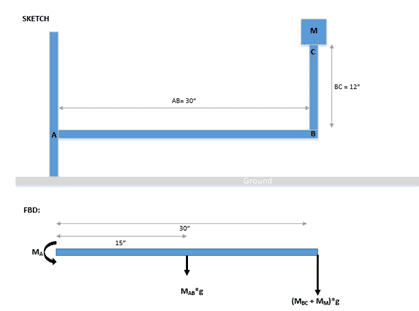
The discussion focuses on the structural integrity of a cantilever pipe assembly, specifically a 30-inch horizontal cantilever pipe with a 3-inch nominal diameter connected to a vertical pipe via a T-connection. The assembly supports a device weighing approximately 10 lbs at the end of the cantilever, leading to a calculated moment of -95.922 lb*ft at point A. Participants analyzed the bending stress using the formula Stress = (F*L)(h/2)/I, with a final calculated bending stress of 401.52 psi, and emphasized the importance of considering deflection and vibration limits, ultimately recommending the installation of a vertical support for safety.

PREREQUISITES
  • Understanding of cantilever beam theory
  • Familiarity with stress and moment calculations
  • Knowledge of pipe specifications, including wall thickness and material properties
  • Ability to interpret Free Body Diagrams (FBD)
NEXT STEPS
  • Research the Euler-Bernoulli beam theory for cantilever beams
  • Learn about calculating deflection in cantilever beams
  • Study the effects of vibration on structural integrity in piping systems
  • Explore the design considerations for vertical supports in cantilevered structures
USEFUL FOR

Mechanical engineers, structural engineers, and anyone involved in the design and analysis of piping systems, particularly those working with cantilevered structures and load-bearing calculations.

NewEngineer
Messages
21
Reaction score
2
To simplify my situation, I am installing a horizontal cantilever pipe (30” length, 3” nominal diameter) which will be connected to a vertical pipe (3” nom diameter, acting as the wall) by a T-connection. See the diagram below. At the end of the cantilever the pipe bends up at 90 degrees for 12”. At the top of the vertical pipe (at the end of the cantilever) will be a device (weight approx. 10 Lb = 4.53592 kg). The cantilever assembly pipe is most likely carbon steel, thickness 0.2159” (based on a 3” nominal diameter steel pipe schedule 40).

What I want to know is given these conditions, do I need to install a vertical support (under point B) for the extended pipe or would the pipe hold fine here? I’ve calculated the moment at point A as -95.922 lb*ft. If you look at the FBD you can see how I modeled the problem. I summed the forces of the Mass (M) and the vertical piece of pipe (MBC).
upload_2017-1-30_7-59-44.png
 
Engineering news on Phys.org
@Mech_Engineer To calculate the stress, could I model it as a cantilever beam with end-loading? is there a different equation that I would have to use to include the pipe's weight and the fact that it's a cylindrical tube?

Stress = (F*L)(h/2)/I
 
Not sure where I'm going wrong I calculated the bending stress (Stress = My/I) and I got 57808.827 lb*ft2.

Note: I changed the weight on the end of the beam, so the moment I calculated is 58.1625 lb*ft
 
I think you just have to be careful about your units, the units of the result should be force/area (psi or equivalent). When I assume 1/4" wall thickness for the pipe, the result would be about 11 ksi (see calculation here).

Another important thing to keep in mind will be max deflection and first vibration mode. Even if the stress seems acceptable, this kind of application usually has limitation on acceptable deflection and vibration as well.
 
Thanks for the tips. My answer above actually was a typo my answer is 401.52 psi. (remember I changed the weight at the end so my moment is only 58.162)

Why does your equation include the pipe's length (30 inch)?
 
NewEngineer said:
Thanks for the tips. My answer above actually was a typo my answer is 401.52 psi. (remember I changed the weight at the end so my moment is only 58.162)
I hadn't seen that you changed your moment load, I updated the calculation here (it turns out there was an order of operations error in the second moment of area as well): calculation link. Is your pipe wall thickness about 0.34"?

NewEngineer said:
Why does your equation include the pipe's length (30 inch)?
Good catch, that was supposed to be 3 inches (the diameter of the pipe). The pipe diameter divided by two (a.k.a. the radius) gives you the neutral axis distance for the stress calculation.

I need to be more rigorous and always be on the look out for a missed factor of 2 and factor of 10!
 
According to engineeringtoolbox.com, a 40 schedule steel pipe with nominal pipe size of 3" has a wall thickness of 0.2159 inch and a weight of 7.58 lb/ft. I should have mentioned this in the original post, sorry bout that.

Anyway, even with my bending stress calculated at below 0.6*yield Stress I think I am still planning to install a support for the structure. I haven't calculated the deflection, but given that the assembly will be outside and have vapor flowing through the pipes I think it may be the safer option.
 
  • Like
Likes   Reactions: Mech_Engineer

Similar threads

  • · Replies 10 ·
Replies
10
Views
2K
Replies
4
Views
2K
Replies
4
Views
4K
Replies
6
Views
4K
  • · Replies 4 ·
Replies
4
Views
4K
Replies
5
Views
2K
  • · Replies 1 ·
Replies
1
Views
3K
  • · Replies 1 ·
Replies
1
Views
4K
  • · Replies 8 ·
Replies
8
Views
5K
  • · Replies 1 ·
Replies
1
Views
2K