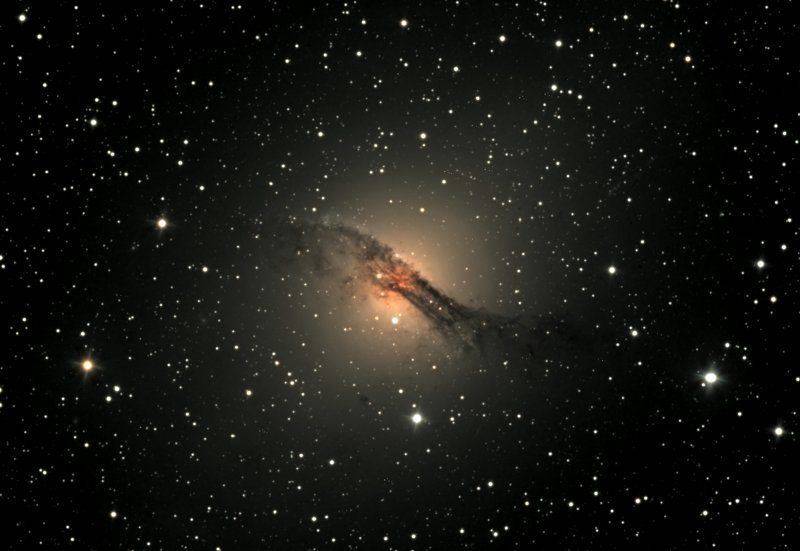
Centaurus A Image Through 27.5" Telescope | iTelescope.net

  • Thread starter Thread starter Drakkith
  • Start date Start date
  • Tags Tags
    Image
Click For Summary

Discussion Overview

The discussion revolves around an image of Centaurus A captured through a 27.5-inch telescope rented via iTelescope.net. Participants explore the image quality, processing challenges, and the identification of bright spots in the image, speculating on their nature and discussing the implications of color in astronomical imaging.

Discussion Character

  • Exploratory
  • Technical explanation
  • Debate/contested
  • Mathematical reasoning

Main Points Raised

  • The original poster shares an image of Centaurus A and mentions difficulties in color processing.
  • Some participants question whether bright spots in the image are quasars or foreground stars, with varying interpretations of their characteristics.
  • One participant expresses uncertainty about differentiating between red supergiants and massive stars based on color, citing challenges in interpretation.
  • Another participant suggests that accurate color reproduction in astronomical imaging is complex and may not provide definitive information about the observed objects.
  • Discussion includes the potential of spectroscopy to provide more detailed information about astronomical sources compared to color images.
  • Participants discuss the costs and logistics of renting telescope time through iTelescope.net, including pricing structures and the benefits of imaging from remote locations.

Areas of Agreement / Disagreement

Participants express differing views on the nature of the bright spots in the image, with no consensus reached on whether they are quasars or foreground stars. The discussion on color interpretation and the effectiveness of imaging techniques also remains unresolved.

Contextual Notes

Participants highlight limitations in color interpretation due to the wide bandpass of color filters and the challenges of accurately reproducing colors in astronomical images.

Who May Find This Useful

Astronomy enthusiasts, astrophotographers, and individuals interested in telescope rental services and imaging techniques may find this discussion relevant.

Drakkith
Mentor
Messages
23,205
Reaction score
7,687
Centaurus A, taken through a 27.5 inch telescope rented through iTelescope.net.
Exposure time: Luminance - 8x900s (120 min) RGB - 2x900s (30 min) each color.

There's some noise I didn't get out of this image prior to color processing, but for some reason I'm having trouble getting a good color picture on my 2nd try at the processing, so I decided to upload this one for now.
Link to full resolution: http://www.astrobin.com/full/172655/0/
C77 Color Cropped 3.jpg
 
  • Like
Likes   Reactions: nitsuj, Greg Bernhardt, marcus and 4 others
Astronomy news on Phys.org
Are those four bright blips in the image - an orange one on the bottom left side and another on the left, along with 2 yellowish one on the bottom and the bottom right side - quasars? They look exceptionally bright and stand out in the background.
 
Sorry, I'm not seeing which blips you're talking about. Can you be more specific?
 
I edited my post to better explain their spatial configuration in the image. By "blips", I mean they are brighter and bigger in radii than other bright spots in the background. They're bright enough that you can see about 4 pointed light ray sections extending out from the center of the spot.
 
They look like foreground stars to me, like the other less bright ones, but I could be missing something.
Nice picture too : )
 
I can't tell if the orange ones are red supergiants or massive stars with their light being redshifted to a high degree (that is, if they're not receding quasars). I've often had this problem of telling the difference when I see something reddish/bluish in these kind of images.
 
They are just bright foreground stars. Don't try to pick up too much info from the color. Reproducing an accurate color with astronomical imaging is not easy and not something I usually try to shoot for. (I'm more concerned with gathering enough exposure time to get a good quality image)
 
Okay, but in general if one is given an accurate color/wavelength picture, is there is no way to differentiate between the two causes for the observed color? I remember I had a very lengthy discussion in class on this when our physics teacher showed us an image of a region where a black hole is believed to be present taken by NASA with the different frequencies of EM radiation emitted labelled. If the answer is not very simple, then I'll make a new thread - I don't want take this one off course.
 
PWiz said:
Okay, but in general if one is given an accurate color/wavelength picture, is there is no way to differentiate between the two causes for the observed color?

Sure, but color filters have such a wide bandpass that they are of little use for this.
 
  • #10
How about labelled wavelengths of EM radiation? "This region of the image emitted radiation of wavelength 600nm because..."?
 
  • #11
Last edited:
  • #12
PWiz said:
How about labelled wavelengths of EM radiation? "This region of the image emitted radiation of wavelength 600nm because..."?

I'm not sure what you're asking. I'd suggest making a new thread and fleshing your questions out there.
 
  • #13
nice one buddy :) what are the online rental charges like ?

Centaurus A is the next one on my list to capture, and with a 400 mm telephoto, it isn't going to look that good, of course.

got Omega Centauri last weekend, will post it in it's own thread in a few minutes ... the 2 objects are not far apart, less than a handspan, I just ran out of time the other nite with the clouds coming in

Dave
 
  • #14
davenn said:
nice one buddy :) what are the online rental charges like ?

For that telescope about 100 USD for an hour of imaging time. But the company had a returning customer special where they'd give you triple points (which are then spent on imaging time on the telescopes) if you came back and signed up for an imaging plan. Ended getting about 800 dollars worth of points for 1/3 the normal price. The price per hour is different for each telescope and is also reduced if the moon is up and over 50% illuminated. Above 75% illumination all the telescopes are at half-price, which makes it prime time for narrowband imaging. I've actually got a narrowband image of the Carina Nebula that just needs some sulfur-II data and it will be done.
 
  • #15
When compared to the cost of a decent EQ mounted scope high quality astro ccd camera etc it's not too bad as long as you use the imaging time wisely :)D
 
Last edited:
  • #16
davenn said:
When compared to the cost of a decent EQ mounted scope high quality astro ccd camera etc it's not too bad as long as you use the imaging wisely :)D

Plus the fact that this telescope is located in Australia, while I'm in North America. I can't even see Centaurus A well enough to image from my location.
 
  • #17
Drakkith said:
Plus the fact that this telescope is located in Australia, while I'm in North America. I can't even see Centaurus A well enough to image from my location.

after that comment, I had to google iTelescope.net ... ahhh its at the Siding Springs Observatory, haven't had a chance to visit there yet ... on the to do list

SSO-Sydney.JPG


Tho its only ~ 340 km crow flies, its over 500km by road and 5 hrs driving
its will happen one day :)cheers
Dave
 
  • #18
Thanks for that information, I didn't know about iTelecope, sounds pretty cool.
 
  • #19
Drakkith said:
Centaurus A, taken through a 27.5 inch telescope rented through iTelescope.net.
<snip>

Hey! That's cheating! :) Nice pic...
 
  • Like
Likes   Reactions: Drakkith

Similar threads

  • · Replies 43 ·
2
Replies
43
Views
12K
  • · Replies 39 ·
2
Replies
39
Views
8K
  • · Replies 1 ·
Replies
1
Views
5K
  • · Replies 4 ·
Replies
4
Views
2K
Replies
1
Views
2K
  • · Replies 152 ·
6
Replies
152
Views
11K
  • · Replies 2 ·
Replies
2
Views
7K
  • · Replies 14 ·
Replies
14
Views
3K
  • · Replies 4 ·
Replies
4
Views
31K
  • · Replies 1 ·
Replies
1
Views
3K