Centre of Mass of a Uniform Cuboid -- Show that it is at the Center

Click For Summary

Homework Help Overview

The discussion revolves around the calculation of the center of mass of a uniform cuboid, specifically addressing common mistakes made by first-year students in their homework. Participants are exploring the integration process and the correct application of variables in this context.

Discussion Character

  • Exploratory, Assumption checking, Mathematical reasoning

Approaches and Questions Raised

  • Participants are questioning the use of volume in integration limits and the distinction between volume as a constant and as an integration variable. There are discussions about the correct approach to integrating with respect to specific variables and the implications of incorrect assumptions in the setup.

Discussion Status

Some participants are providing guidance on the standard approach to the problem, emphasizing the need to integrate with respect to the correct variable. There is recognition of multiple interpretations of the problem, and participants are actively engaging in clarifying the reasoning behind their approaches.

Contextual Notes

There are indications of confusion regarding the definitions and roles of variables in the integration process, as well as the potential for misunderstanding due to the overlap of terms used in the problem. Participants are reflecting on the fundamental reasons for distinguishing between different variables in the context of the problem.

patrykh18
Messages
32
Reaction score
2
Homework Statement
Starting from a definition of Centre of Mass, show explicitly that for a uniform cuboid the centre of mass is at the centre.
Relevant Equations
Provided below.
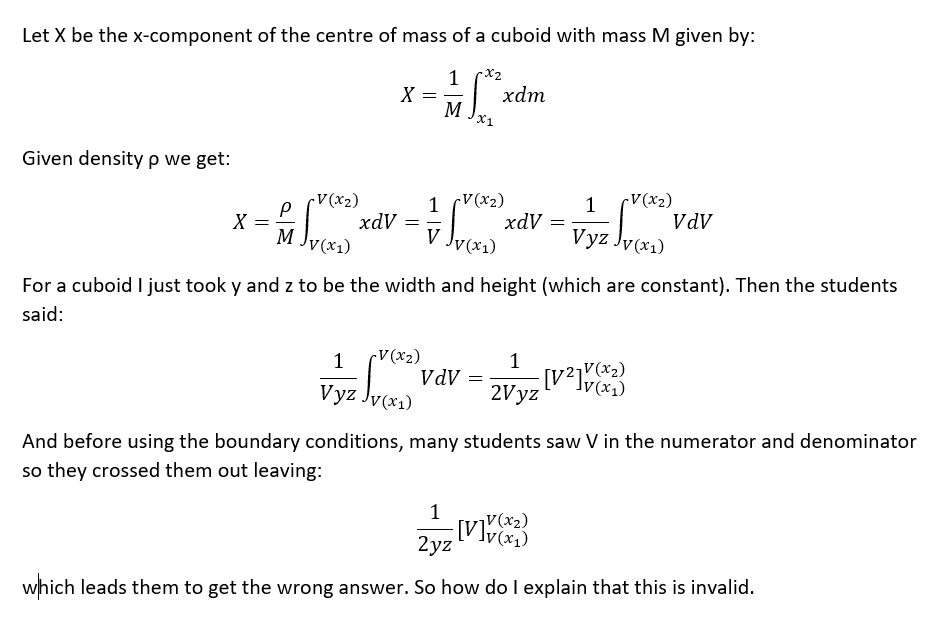
So, I volunteered to run a seminar to first year students in my college. They got a question like this for homework recently and a lot of them made a mistake in the calculation. I am not asking for help with the question itself because I know how to do it. However, a lot of students made a mistake that I shown in the image below. I'm curious about what would be the best way to explain to them why that is a wrong approach (without going into too much details about mathematics).
1605044028976.png
 
Physics news on Phys.org
Woahhhhhh, why you putting volumes in the limits?
 
etotheipi said:
Woahhhhhh, why you putting volumes in the limits?
Well I am going from x1 to x2 but it's all multiplied by yz
 
patrykh18 said:
Well I am going from x1 to x2 but it's all multiplied by yz
It should be multiplied by the constant cross sectional area, surely?
 
  • Like
Likes   Reactions: etotheipi
PeroK said:
It should be multiplied by the constant cross sectional area, surely?

Yeah yz is the constant cross area
 
I was trying to figure out how to answer this but there's too much wrong at the moment to make a start. You have ##x##'s in the limits for your integration with respect to ##m##, you use ##V## both as the volume of the cuboid and as an integration variable, you set ##V=xyz## at one point, when this is clearly incorrect [##x##, ##y## and ##z## are coordinates..., and I don't even know which ##V## you're trying to refer to], you have some weird limits. Too much to untangle for me, sorry.
 
patrykh18 said:
Yeah yz is the constant cross area
The standard approach should integrate with respect to ##x##, and not ##V##. In any case, you cannot have ##V## as the fixed volume of the cube and an integration variable. That's a problem that encourages the invalid cancellation.
 
etotheipi said:
I was trying to figure out how to answer this but there's too much wrong at the moment to make a start. You have ##x##'s in the limits for your integration with respect to ##m##, you use ##V## both as the volume of the cuboid and as an integration variable, you set ##V=xyz## at one point, when this is clearly incorrect [##x##, ##y## and ##z## are coordinates..., and I don't even know which ##V## you're trying to refer to], you have some weird limits. Too much to untangle for me, sorry.

Yeah. I solved a lot of integrals. I know I need to distinguish between ##V## the volume and ##V## the integration parameter. I just never asked myself why you fundamentally have to do it.
 
PeroK said:
The standard approach should integrate with respect to ##x##, and not ##V##. In any case, you cannot have ##V## as the fixed volume of the cube and an integration variable. That's a problem that encourages the invalid cancellation.

Yeah, if I did this question I would naturally distinguish between those two but I never asked myself why that is fundamentally the case.
 

Similar threads

  • · Replies 13 ·
Replies
13
Views
3K
  • · Replies 10 ·
Replies
10
Views
2K
Replies
25
Views
2K
  • · Replies 25 ·
Replies
25
Views
2K
Replies
5
Views
2K
  • · Replies 3 ·
Replies
3
Views
2K
  • · Replies 13 ·
Replies
13
Views
3K
  • · Replies 9 ·
Replies
9
Views
3K
  • · Replies 2 ·
Replies
2
Views
4K
  • · Replies 7 ·
Replies
7
Views
5K