Centripitalforce problem (hard)

  • Thread starter Thread starter trondern
  • Start date Start date
  • Tags Tags
    Hard
Click For Summary

Homework Help Overview

The problem involves a half-cylinder pipe with an object sliding on its surface. The question focuses on determining the angle at which the object loses contact with the cylinder after being given a small push. The subject area includes concepts of centripetal force, dynamics, and energy conservation.

Discussion Character

  • Exploratory, Assumption checking, Conceptual clarification

Approaches and Questions Raised

  • Participants discuss the conditions under which the object loses contact with the surface, including the role of normal force and centripetal force. There are attempts to derive expressions related to the angle and forces acting on the object.

Discussion Status

Some participants have offered hints regarding the forces involved and suggested using conservation of energy or resolving forces. There is an ongoing exploration of the relationships between forces and angles, but no consensus has been reached on a specific approach or solution.

Contextual Notes

Participants express confusion regarding the application of relevant equations and the lack of examples in their resources. The discussion reflects a need for clarification on the fundamental principles involved in the problem.

trondern
Messages
7
Reaction score
0
Ok, I've been looking around for a answer for this , but haven't found one. So in hope for some help, ill post the problem here:


A pipe has the form as a half cylinder. On the top of the cylinder its placed a item that can slide frictionfree on the cylinder. The cylinder gets a microsmal puff, so the system starts. What angel does the radius make with the horizontal axis in the moment the item loses its contact with the cylindersurface?
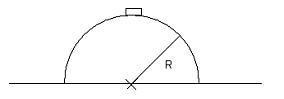
illustration.JPG


Any help solving this would be of great appreciaton from me :shy:

I've tried attacking this with finding an expression for the angle, but it failed. I am having problems really understanding what's causing the item to lose the surfacecontact with the cylinder. I am sure it has something to do with the speed of the item , combined with the angle for the position... I am really drawing a blank here.
 
Last edited:
Physics news on Phys.org
This is a classic problem that is in nearly every textbook I've looked through. I'll give you the standard hints:

You must assume that the object leaves the surface at an angle "theta."

What will the normal force on the object be at that moment?

What force (or componant thereof) provides the centripetal force at that moment?

In what way could you determine the speed of the object at that moment?
 
:bugeye:
Chi Meson said:
This is a classic problem that is in nearly every textbook I've looked through. I'll give you the standard hints:

You must assume that the object leaves the surface at an angle "theta."

What will the normal force on the object be at that moment?

What force (or componant thereof) provides the centripetal force at that moment?

In what way could you determine the speed of the object at that moment?


Thats what I've been trying to figgur out. There's no examples on it in my book, so its kinda hard to just see it happening.

I was thinking something like this, but unsure what to do with it.. hehe

mg cos(thetta+phi/2)..

seriously ..im drawing a blank here
 
Last edited:
if the object has just left the surface, can there be a normal force on it?
 
no, ok. Fn = 0. But I am still confused about what equations to use..
 
You could use the conservation of energy theorem, or resolve forces radially giving you the normal reaction force. The choice is yours...
 
Those ..never used them before i think..
 
How have you solved questions like this in the past?
 
I haven't solved any questions like this in the past. Thats why its kinda hard for me to get the picture here:)
 
  • #10
Here:

Up until the point "theta" the centripetal force is some force component minus the normal force. At "theta" cnetriipetal force is...
 
  • #11
Up to thetta it is : sin (thetta) * mg - m*(v^2/R)

at thetta its : sin(thetta)*mg - 0 ?

This is hard:( What do i do with it afterwards?
 
Last edited:
  • #12
trondern said:
Up to thetta it is : sin (thetta) * mg - m*(v^2/R)

at thetta its : sin(thetta)*mg - 0 ?

This is hard:( What do i do with it afterwards?
This is the centripetal force at this point so it is equal to what other formula?
 
  • #13
I have no clue...
 
  • #14
I know that I'm just repeating, in slightly different words, what Chi Meson has already explained. Nonetheless...

There are only two forces acting on the object: its weight and the normal force of the surface. At the moment in question, when the object is just about to leave the surface, the normal force goes to zero: so the only force acting on the object (and the only force available to provide the centripetal force) is the weight.

You need to do two things:

(1) Apply Newton's 2nd law to forces in the radial direction, remembering that the object has a radial (centripetal) acceleration.

(2) Combine that with an expression relating angle with speed; you can derive one using conservation of energy.
 

Similar threads

Replies
22
Views
2K
Replies
5
Views
1K
  • · Replies 5 ·
Replies
5
Views
2K
  • · Replies 14 ·
Replies
14
Views
3K
  • · Replies 6 ·
Replies
6
Views
3K
  • · Replies 26 ·
Replies
26
Views
9K
  • · Replies 3 ·
Replies
3
Views
3K
  • · Replies 18 ·
Replies
18
Views
2K
  • · Replies 21 ·
Replies
21
Views
7K
  • · Replies 2 ·
Replies
2
Views
3K