Checking if a Graph is Planar - v, e & f

  • Context: Undergrad 
  • Thread starter Thread starter kljoki
  • Start date Start date
  • Tags Tags
    Graph
Click For Summary
SUMMARY

This discussion focuses on determining the planarity of a graph using the formula v - e + f = 2, where v represents the number of vertices, e the number of edges, and f the number of faces. The user calculates f as 8 based on their graph with 9 vertices and 15 edges. To count the faces of the graph, they are advised to trace connections starting from a vertex and ensuring not to count the same loop multiple times. Additionally, the discussion suggests checking for the presence of K3,3 or K5 subgraphs to further confirm planarity.

PREREQUISITES
  • Understanding of graph theory concepts such as vertices, edges, and faces.
  • Familiarity with the Euler's formula for planar graphs.
  • Knowledge of K3,3 and K5 graphs as non-planar indicators.
  • Ability to trace paths and loops in a graph structure.
NEXT STEPS
  • Study Euler's formula in-depth for planar graphs.
  • Learn about graph traversal techniques, such as Depth-First Search (DFS).
  • Explore algorithms for detecting K3,3 and K5 subgraphs in a graph.
  • Investigate software tools for visualizing and analyzing graph structures.
USEFUL FOR

Mathematicians, computer scientists, and students studying graph theory, particularly those interested in planar graph analysis and algorithms for graph traversal.

kljoki
Messages
5
Reaction score
0
Hi
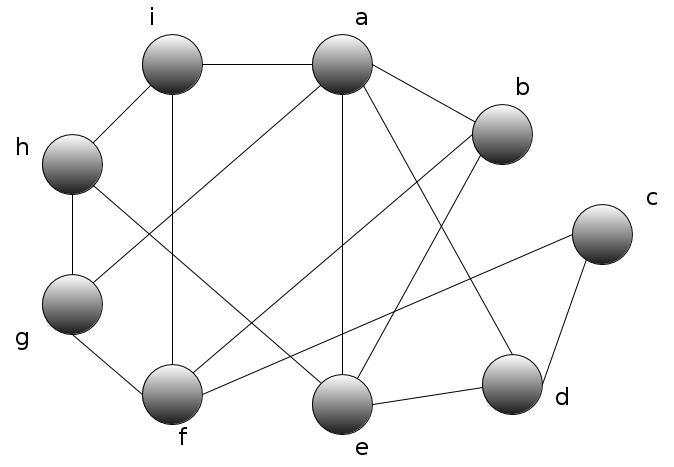
I have this graph
Drawing1 (2).jpg


now i should check if this graph can be planar.

v - number of vertices
e - number of edges
f - number of faces

to be planar it should hold v - e + f = 2 from here f = 2 - v + e = 2 - 9 + 15 = 8
so f = 8 now my question is how to easily count faces (regions bounded by edges, including the outer, infinitely large region) of the graph??
thanks
 
Physics news on Phys.org
couldnt you start with point a and then compile a list of connections that come back to a

a-b-e

a-b-f-i

and continue to point b, c, d ... making sure not to count the same loop again

as an example b-e-a is the same as a-b-e
 
kljoki said:
Hi
I have this graph
View attachment 50059

now i should check if this graph can be planar.

v - number of vertices
e - number of edges
f - number of faces

to be planar it should hold v - e + f = 2 from here f = 2 - v + e = 2 - 9 + 15 = 8
so f = 8 now my question is how to easily count faces (regions bounded by edges, including the outer, infinitely large region) of the graph??
thanks

How about arguing that your graph contains neither a K3,3 nor a K5

as a subgraph? it seems there are not that many cases to consider...
 

Similar threads

  • · Replies 1 ·
Replies
1
Views
2K
  • · Replies 2 ·
Replies
2
Views
1K
  • · Replies 4 ·
Replies
4
Views
2K
  • · Replies 4 ·
Replies
4
Views
2K
  • · Replies 4 ·
Replies
4
Views
2K
Replies
1
Views
2K
  • · Replies 5 ·
Replies
5
Views
4K
  • · Replies 7 ·
Replies
7
Views
3K
Replies
8
Views
5K
  • · Replies 6 ·
Replies
6
Views
3K