Checking if velocity and position graphs are consistent

  • Thread starter Thread starter Differentiate it
  • Start date Start date
  • Tags Tags
    Graphs
Join the discussion
Registration is free. Start your own thread to ask a follow-up.
11 replies · 2K views · last reply
Differentiate it
Messages
63
Reaction score
2
Homework Statement
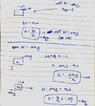
Acceleration of Blocks Due to a Time Varying Force: A block m, is placed on smooth ground over which another mass m, is placed. Friction coefficient between m, and m₂ is u. Now a time varying horizontal external force F = bt is applied on m2. Find acceleration of block with time and plot acceleration v/s time graph of both blocks.
Relevant Equations
F = ma
Two handwritten acceleration versus time graphs stacked vertically. Top graph labelled m1: a rises linearly from the origin to a time of μm2g/b, then stays constant. Bottom graph labelled m2: a rises linearly from the origin to a peak at μm2g/b, then drops to a lower value and rises linearly again.

I have attempted this question - Are the graphs correct?
 
Attachments

  • Problem statement with a diagram: block m1 on smooth ground, block m2 on top with friction coefficient mu between them, horizontal force F = bt applied to m2.
    Screenshot_20221013-224546~2.jpg
    17.3 KB · Views: 156
Last edited:
Physics news on Phys.org
Is ##m_2## sitting on top of ##m_1##? It isn't clear in the problem statement.
 
  • Like
Likes   Reactions: berkeman
erobz said:
Is ##m_2## sitting on top of ##m_1##? It isn't clear in the problem statement.
Yes, it is. Sorry for not mentioning it earlier
 
Attachments
  • Diagram of two stacked blocks on a hatched floor: block m2 on top with force F = bt pointing right, block m1 below, with the problem text about a time-varying force on m2 and friction coefficient mu.
    Screenshot_20221013-224546~2.jpg
    17.5 KB · Views: 164
1) What is the reasoning that you expect a drop in acceleration for ##m_2## once the force ##F## exceeds the static friction between the masses (think about the change in force acting on each of the masses from static to kinetic friction)?

2) The slope of the acceleration vs time before and after the discontinuity appear parallel to me, is that drawn to scale (they won't be parallel)?

3) For the same reason in (1), how does that effect the graph for ##m_1## (there is a missing discontinuity there)?
 
Last edited:
  • Like
Likes   Reactions: hutchphd
erobz said:
1) What is the reasoning that you expect a drop in acceleration for ##m_2## once the force ##F## exceeds the static friction between the masses?

2) The slope of the acceleration vs time before and after the discontinuity appear parallel to me, is that drawn to scale?
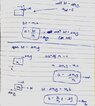
Yes, it is supposed to be parallel Here is my working if you want to take a look
 
Attachments
  • Handwritten derivation of accelerations for two blocks: m1 with a = bt/m1 until bt = μm2g, then a = μm2g/m1 constant; m2 with b = (b/m2)t - μg, linear, after the threshold.
    wor.jpg
    47.6 KB · Views: 151
erobz said:
1) What is the reasoning that you expect a drop in acceleration for ##m_2## once the force ##F## exceeds the static friction between the masses?

2) The slope of the acceleration vs time before and after the discontinuity appear parallel to me, is that drawn to scale?
 
Attachments
  • Handwritten derivation of accelerations for two stacked blocks m1 and m2 under a time-varying force bt, with friction coefficient μ: a = bt/m1 before slipping, then a = μm2g/m1 constant, and b = (b/m2)t - μg for m2 after slipping.
    wor.jpg
    47.6 KB · Views: 157
So, you think the slope of ##a_2(t)## before and after ##t = \frac{\mu m_2g}{b}## are equal. Hmmm.

Before the force of static friction is exceeded what is the acceleration ##a_2(t)## of ##m_2##? What is the acceleration ##a_1(t)## of ##m_1##?
 
erobz said:
So, you think the slope of ##a_2(t)## before and after ##t = \frac{\mu m_2g}{b}## are equal. Hmmm.

Before the force of static friction is exceeded what is the acceleration ##a_2(t)## of ##m_2##? What is the acceleration ##a_1(t)## of ##m_1##?
Both are the same: bt/m1
 
Differentiate it said:
Both are the same:
The first part is correct. They are both the same.
Differentiate it said:
bt/m1
The second part is not.
 
  • Like
Likes   Reactions: hutchphd
erobz said:
The first part is correct. They are both the same.

The second part is not.
Could you please explain why?
 
Differentiate it said:
Could you please explain why?
How much mass is being accelerated by the applied force ##F## on ##m_2##?

Remember, we are talking about a time before they (##m_1## & ##m_2##) "unstick" at this point.
 
Last edited:
  • Like
Likes   Reactions: hutchphd