Chemical Engineering Questions: Basic Sterilisation and Heat Transfer

  • Thread starter Thread starter Dave_
  • Start date Start date
Click For Summary
SUMMARY

This discussion centers on fundamental concepts in chemical engineering, specifically focusing on sterilization and heat transfer calculations. Key calculations include mass flow rates, where the total flow rate is determined as 37,000 kg/hr, and a specific heat transfer calculation yielding a value of 1.55 MPa. The discussion also references the application of the formula Q = mc(ΔT) for heat transfer, indicating the importance of understanding temperature differentials in thermal processes. Participants seek clarification on flow rates and heat exchanger types, emphasizing the need for foundational knowledge in these areas.

PREREQUISITES
  • Basic understanding of mass flow rate calculations
  • Familiarity with the heat transfer equation Q = mc(ΔT)
  • Knowledge of shell and tube heat exchangers
  • Experience with pressure calculations in fluid systems
NEXT STEPS
  • Study the principles of mass and energy balance in chemical processes
  • Learn about the design and operation of shell and tube heat exchangers
  • Explore advanced heat transfer methods and their applications
  • Investigate online calculators and software for chemical engineering calculations
USEFUL FOR

This discussion is beneficial for undergraduate chemical engineering students, educators, and professionals seeking to reinforce their understanding of basic sterilization processes and heat transfer principles.

Dave_
Messages
7
Reaction score
0
I'm currently in my first week of undergrad chemical engineering and was set these questions to answer, so any help or any pointers will be greatly appreciated. Thanks.

a) 32000 kg/hr + 5000 kg/hr = 37000 kg/hr

b ) (The question is meant to be 0.05kg) 37000 * 0.05 = 1850 kg/hr

c) I'm not entirely sure what to do on this question, I'm assuming it has something to do with Q = mc(DeltaT) but I'm not 100% sure how I would apply this.

d) I used a online calculator for this and obtained a value of 1.55 Mpa.

e) I'm unsure on how to answer this question.

f) I answered a shell and tube heat exchanger.
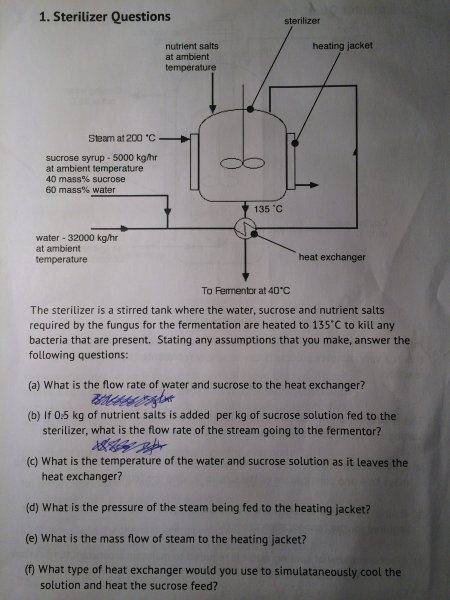
image.jpeg
 
Physics news on Phys.org
Thanks for the post! Sorry you aren't generating responses at the moment. Do you have any further information, come to any new conclusions or is it possible to reword the post?
 
In (c) you can determine the flow rate vertically, and you are told it cools from 135° to 40°. The heat it loses goes into warming the horizontal flow from ambient to ?

Determine ? stating any assumptions you make.
 

Similar threads

  • · Replies 1 ·
Replies
1
Views
2K
  • · Replies 45 ·
2
Replies
45
Views
8K
Replies
1
Views
3K
  • · Replies 10 ·
Replies
10
Views
2K
Replies
9
Views
3K
  • · Replies 9 ·
Replies
9
Views
12K
  • · Replies 11 ·
Replies
11
Views
3K
  • · Replies 10 ·
Replies
10
Views
4K
Replies
2
Views
2K
Replies
1
Views
2K