Inelastic Collision of an object Problem

Click For Summary

Homework Help Overview

The discussion revolves around an inelastic collision problem involving two objects, one moving and one stationary, and their subsequent motion along an inclined plane. The context includes concepts from mechanics, specifically conservation of momentum and energy transformations.

Discussion Character

  • Exploratory, Conceptual clarification, Mathematical reasoning

Approaches and Questions Raised

  • Participants explore the calculation of the velocity of the combined mass system post-collision and discuss the forces acting on the system as it moves up the incline. There are inquiries about the relationship between kinetic energy and potential energy in this context.

Discussion Status

The discussion includes various approaches to understanding the problem, with some participants suggesting the use of conservation laws and free-body diagrams. There is acknowledgment of similar problems among participants, indicating a shared learning experience. One participant mentions having resolved their understanding, but no consensus on the approach has been reached among all contributors.

Contextual Notes

Participants note that the problem is part of a group assignment on a homework platform, and there are references to study materials, suggesting a common educational context. Some participants express uncertainty about the details of the problem setup.
fire765
Messages
4
Reaction score
0
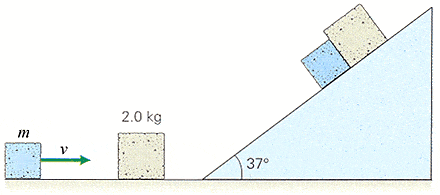
A m=1.5 kg object moving at 14 m/s collides with a stationary 2.0 kg object. If the collision is perfectly inelastic, how far along the inclined plane will the combined system travel? Neglect Friction.
6-38alt.gif


Any help would be appreciated
 
Physics news on Phys.org
This is a three part question. First you need to calculate the velocity of the combined mass system before it begins up the incline. Second, you need to determine what will slow the combined mass system down, and to what magnitude (free-body diagram). Then, it's simple kinematics to see how far up the slope the system will go.
 
I have the same exact problem with the incline...I think we have the same prof. Is it from the study guide on webassign?
 
Using conservation momentum find the velocity of the combined mass before it starts climbing the inclined plane. After moving certain distance along inclined plane combined blocks stop. So loss of KE = gain in PE. From this you can get the height of the combind blocks from the ground. Using the angle of inclination you can find the distance moved by the blocks.
 
complexc25 said:
I have the same exact problem with the incline...I think we have the same prof. Is it from the study guide on webassign?

yea its a group problem on webassign for my class

edit: I figured it out, thanks for the the help. find the KE (1/2mv^2) then set it equal to PE (mgh) and solve for h. then use trig to find the distance traveled. Again, thanks for the help, and there's one other problem ill be posting in a bit.
 
Last edited:

Similar threads

  • · Replies 7 ·
Replies
7
Views
4K
Replies
9
Views
3K
  • · Replies 2 ·
Replies
2
Views
3K
  • · Replies 21 ·
Replies
21
Views
3K
  • · Replies 4 ·
Replies
4
Views
2K
  • · Replies 2 ·
Replies
2
Views
2K
  • · Replies 13 ·
Replies
13
Views
1K
  • · Replies 9 ·
Replies
9
Views
4K
  • · Replies 6 ·
Replies
6
Views
3K
Replies
3
Views
7K