Power of ten and math power notation

  • Context: High School 
  • Thread starter Thread starter KingGambit
  • Start date Start date
  • Tags Tags
    Notation Power
Click For Summary

Discussion Overview

The discussion revolves around the interpretation of power notation, specifically in the context of extremely large numbers such as \(10^{10^{10^{5600}}}\) and the Penrose number \(10^{101123}\). Participants explore different interpretations of exponentiation and how they relate to mathematical conventions.

Discussion Character

  • Debate/contested
  • Mathematical reasoning

Main Points Raised

  • One participant questions whether \(10^{10^{10^{5600}}}\) should be interpreted as \(10^{(10^{(10^{56})})}\) or \(((10^{10})^{10})^{56}\).
  • Another participant suggests that the standard interpretation for nested exponentiation is to evaluate from the top down, supporting choice A for the interpretation of the large number.
  • A participant provides an example using the number 3 to illustrate the difference between the two interpretations, showing that \(3^{(3^3)}\) yields a significantly larger result than \((3^3)^3\).
  • There is a humorous acknowledgment of the narrator's lack of precision regarding numbers.
  • The Penrose number is also discussed, with participants questioning whether it represents \(1\) followed by \(246\) zeros or a much larger quantity, leading to confusion about the correct interpretation.

Areas of Agreement / Disagreement

Participants do not reach a consensus on the correct interpretation of the power notation, with multiple competing views remaining on how to evaluate the expressions presented.

Contextual Notes

Participants express uncertainty regarding the conventions of exponentiation and how they apply to both finite and infinite cases, indicating a potential lack of clarity in definitions and assumptions.

KingGambit
Messages
54
Reaction score
46
TL;DR
Power of ten
Dear PF Forum,

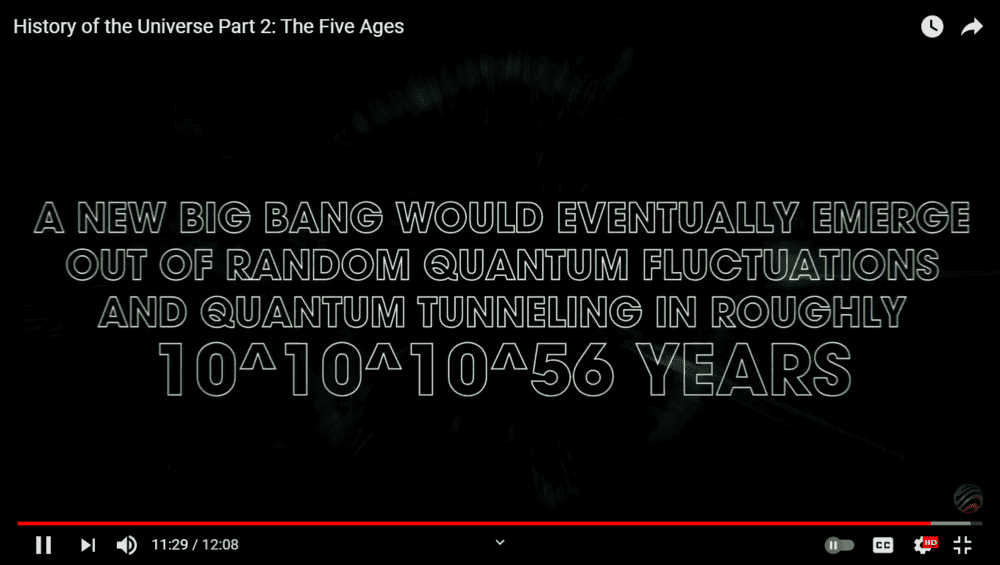
I watched this video
10 ^ 10 ^ 10 ^ 5600
1618949641347.png


The narative says,
It is 1 followed by 5600 zeros

But that's not what I think,
I think it is 1 followed by I don't know.
What does this number means?

Is it
A: 10 ^ (10 ^ (10 ^ 56)))
or
B: ((10 ^ 10) ^ 10) ^ 56?

It says that
"As another possibility, during the dark era, the extreme low energy states might cause the localized quantum events to become major microscopic phenomena. At that point the smallest pertubation might lead to enormouse changes. In their paper spontaneus inflation and the origin of arrow of time, Sean Caroll and Jennifer Chan have calculated that the new Big Bang would eventually emerge out of random quantum fluctuations and quantum tunneling in roughly in ten to the power of ten to the power of ten to the power of 56 years.
That's one followed by 5600 zeros"

Well, is it 1 followed by 5600 zeros or (10 ^ (10 ^ 56))) zeros?
And judging from the physics involved, which one is true?

I mean 2 * (3 * (4 * 5 )) is the same as ((2 * 3) * 4) * 5 right. Or
2 + (3 + (4 + 5 )) = ((2 + 3) + 4) + 5 right.

And what about Penrose Number?
1010123
Is it
A: 1 followed by 246 zeros
or
B: 1 followed by... you know.Here is the link:


Thank you very much for your help.
 
Mathematics news on Phys.org
My guess is A ##10^{10^{10^{5600}}}##
 
  • Like
Likes   Reactions: KingGambit and PeroK
Clearly, the narrator is not a numbers kind of guy.
 
  • Like
Likes   Reactions: KingGambit
KingGambit said:
Is it
A: 10 ^ (10 ^ (10 ^ 56)))
or
B: ((10 ^ 10) ^ 10) ^ 56?

So when we write something like:
##\omega##^##\omega##^##\omega##^##\omega##
by default (if nothing else is mentioned) it usually is taken to mean:
##\omega##^(##\omega##^(##\omega##^##\omega##))=##\omega^{\omega^{\omega^{\omega}}}##
and not:
((##\omega##^##\omega##)^##\omega##)^##\omega##=##\omega^{\omega^3}##

One would guess that it should be similar for finite numbers too.
 
  • Like
Likes   Reactions: KingGambit
It's taken to mean choice A.

As an example, if three is used instead of ten:

3^(3^3) = 3^27 = 7.62559748499e+12

-vs-

(3^3)^3 = 27^3 = 19683
 
jedishrfu said:
Clearly, the narrator is not a numbers kind of guy.
I see you are practicing your use of understatement today :smile:
 
KingGambit said:
Summary:: Power of ten
And what about Penrose Number?
1010123
Is it
A: 1 followed by 246 zeros
or
B: 1 followed by... you know.

I'm sorry.
Penrose number (1010123) question should be
Is it
A: 1 followed by 246 1230 zeros
or
B: 1 followed by... you know.


I think there's a bug in my ALU or typo (if you call it a typo) in option A, but considering option B, my ALU just simply crashes.
 
SSequence said:
So when we write something like:
##\omega##^##\omega##^##\omega##^##\omega##
by default (if nothing else is mentioned) it usually is taken to mean:
##\omega##^(##\omega##^(##\omega##^##\omega##))=##\omega^{\omega^{\omega^{\omega}}}##
and not:
((##\omega##^##\omega##)^##\omega##)^##\omega##=##\omega^{\omega^3}##

One would guess that it should be similar for finite numbers too.
Ow, thanks SSequence.
 

Similar threads

  • · Replies 6 ·
Replies
6
Views
861
  • · Replies 5 ·
Replies
5
Views
1K
  • · Replies 24 ·
Replies
24
Views
3K
  • · Replies 1 ·
Replies
1
Views
2K
  • · Replies 10 ·
Replies
10
Views
2K
  • · Replies 5 ·
Replies
5
Views
2K
  • · Replies 51 ·
2
Replies
51
Views
4K
Replies
3
Views
2K
  • · Replies 2 ·
Replies
2
Views
2K
  • · Replies 9 ·
Replies
9
Views
3K