Is Bulb A Brighter in a Parallel Circuit Due to Potential Difference?

  • Thread starter Thread starter rokunanto
  • Start date Start date
  • Tags Tags
    Circuits
AI Thread Summary
In a parallel circuit with identical bulbs and batteries, the brightness of each bulb is determined by the potential difference across them. If bulb A is less bright than bulb B, it suggests a difference in potential generated by the batteries, which contradicts the assumption of identical batteries. The discussion emphasizes the application of Ohm's law and Kirchhoff's Voltage Law to understand current flow and potential differences. The absence of resistances in this scenario indicates that the brightness is solely dependent on the potential differences created by the batteries. Understanding these principles is crucial for accurately analyzing the circuit's behavior.
rokunanto
Messages
1
Reaction score
0
Homework Statement
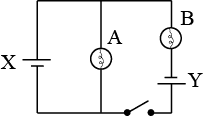
When the switch is closed, is the brightness of bulb A greater than, less than, or equal to the brightness of bulb B? Why?

When the switch is closed, is the current through battery X greater than, less than, or equal to the current through battery Y? Why?
Relevant Equations
I do not know the equations.
As demonstrated by the figure, bulb A and bulb are in a parallel circuit whose batteries are ideal and identical. I am asking for assistance to see where I am going wrong in my approach and how to better understand and figure out the question!

1. If the switch was closed, the brightness of bulb A would be less than the brightness of bulb B due to the potential difference as a result of the pathway. However, I do not know if this is correct or if there was another reason. I was thinking that because A does not have a resistor that it would have potential flowing more freely.

2. I am not sure about this question, but I am assuming that it bulb A is less bright than bulb b, that would mean that battery X is generating a greater than battery Y. THIS IS THE FIGURE FOR THE PROBLEM. (The lightbulbs are identical, and the batteries are ideal and identical.)
1646599631882.png
 
Physics news on Phys.org
The bulb with the highest potential difference will be the brightest. Can you identify the potential differences between each component?

Once you found the potential differences, what does Ohm's law say about the current going through the resistances?
 
Resistances ? Don't see no resistances ... :smile:
 
Not needed. Identical batteries, identical bulbs. Throw switch.
 
Have you been taught Kirchhoff's Voltage Law? If so what does it say?
 
Kindly see the attached pdf. My attempt to solve it, is in it. I'm wondering if my solution is right. My idea is this: At any point of time, the ball may be assumed to be at an incline which is at an angle of θ(kindly see both the pics in the pdf file). The value of θ will continuously change and so will the value of friction. I'm not able to figure out, why my solution is wrong, if it is wrong .
TL;DR Summary: I came across this question from a Sri Lankan A-level textbook. Question - An ice cube with a length of 10 cm is immersed in water at 0 °C. An observer observes the ice cube from the water, and it seems to be 7.75 cm long. If the refractive index of water is 4/3, find the height of the ice cube immersed in the water. I could not understand how the apparent height of the ice cube in the water depends on the height of the ice cube immersed in the water. Does anyone have an...
Thread 'A bead-mass oscillatory system problem'
I can't figure out how to find the velocity of the particle at 37 degrees. Basically the bead moves with velocity towards right let's call it v1. The particle moves with some velocity v2. In frame of the bead, the particle is performing circular motion. So v of particle wrt bead would be perpendicular to the string. But how would I find the velocity of particle in ground frame? I tried using vectors to figure it out and the angle is coming out to be extremely long. One equation is by work...
Back
Top