Classify the given second-order linear PDE

  • Thread starter Thread starter chwala
  • Start date Start date
  • Tags Tags
    Linear Pde
Join the discussion
Registration is free. Ask a follow-up in this thread, or start your own.
2 replies · 1K views · last reply
chwala
Gold Member
Messages
2,854
Reaction score
436
Homework Statement
Classify the second order linear pde, given by;

##U_t +2U_{tt}+3U_{xx}=0##
Relevant Equations
use of discriminant
Now i learned how to use discriminant i.e ##b^2-4ac## and in using this we have;
##b^2-4ac##=##0-(4×3×2)##=##-24<0,## therefore elliptic.

The textbook has a slight different approach, which i am not familiar with as i was trained to use the discriminant at my undergraduate studies...
see textbook approach here;
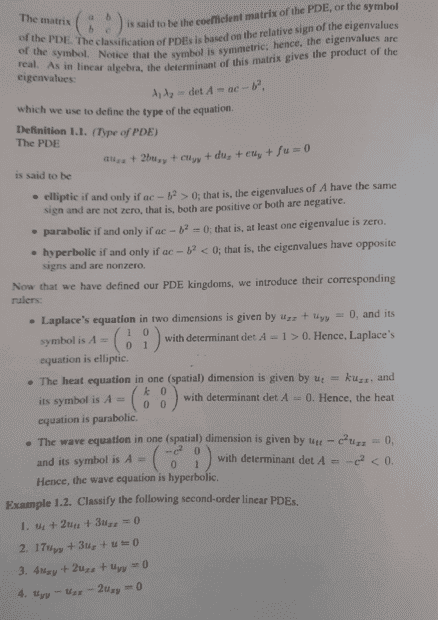
Textbook page on classifying second-order linear PDEs: definition of the coefficient matrix A = [a b; b c], eigenvalue test for elliptic, parabolic and hyperbolic types, and Example 1.2 with PDEs listed for classification.


and the textbook solution is here;
Handwritten solution listing four symbol matrices A with determinants and classifications: [[2,0],[0,3]] det 6 elliptic; [[0,0],[0,17]] det 0 parabolic; [[2,2],[2,1]] det -2 hyperbolic; [[-1,-1],[-1,1]] det -2 hyperbolic.
and i also checked wikipedia on this and they have used the discriminant approach. See the approach here; ( i am comfortable with this approach)
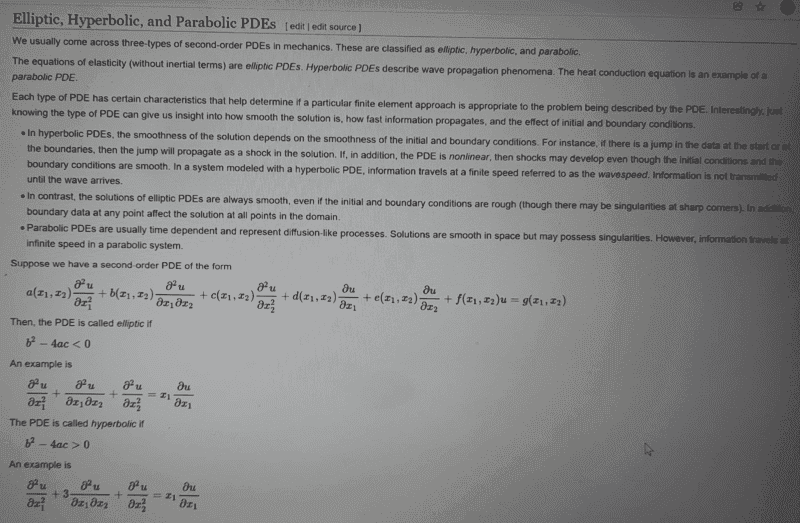
Text page titled Elliptic, Hyperbolic, and Parabolic PDEs, with the general second-order PDE form and the discriminant test b^2 - 4ac for elliptic, hyperbolic and parabolic cases, plus example equations.


Both approaches should be fine, one can use either approach...correct?
 
Physics news on Phys.org
The textbook is the same thing with some math modifications

1.) Instead of ##b^2-4ac## they have ##4ac-b^2## so the sign is flipped

2.) They write ##2b## as the coefficient instead of ##b##. So given that the coefficient of the cross term is called ##2b##, their discriminant becomes
##4ac-(2b)^2=4(ac-b^2)##. Since 4 is positive, the sign of the discriminant is determined by ##ac-b^2##.
 
Office_Shredder said:
The textbook is the same thing with some math modifications

1.) Instead of ##b^2-4ac## they have ##4ac-b^2## so the sign is flipped

2.) They write ##2b## as the coefficient instead of ##b##. So given that the coefficient of the cross term is called ##2b##, their discriminant becomes
##4ac-(2b)^2=4(ac-b^2)##. Since 4 is positive, the sign of the discriminant is determined by ##ac-b^2##.
ooooh, Thanks am trying to refresh on pde's cheers mate...:cool: