Clebsch–Gordan coefficients: An Identity

Click For Summary
SUMMARY

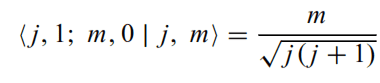
The discussion centers on deriving a specific Clebsch–Gordan (CG) identity, particularly in the format . Participants reference the general expression for CG coefficients, which involves Wigner 3j-symbols and angular momentum coupling. The key formula provided includes factorial expressions and conditions for summation over n, specifically for the case where j1 = j3 = j, j2 = 1, m1 = m3 = m, and m2 = 0. This identity is crucial for understanding the addition of angular momenta in quantum mechanics.

PREREQUISITES
  • Understanding of Clebsch–Gordan coefficients
  • Familiarity with Wigner 3j-symbols
  • Knowledge of angular momentum coupling in quantum mechanics
  • Basic proficiency in mathematical expressions involving factorials
NEXT STEPS
  • Study the derivation of Clebsch–Gordan coefficients in detail
  • Explore the properties and applications of Wigner 3j-symbols
  • Learn about angular momentum coupling techniques in quantum mechanics
  • Investigate advanced topics in quantum mechanics related to angular momentum
USEFUL FOR

Quantum physicists, students of quantum mechanics, and researchers focusing on angular momentum theory will benefit from this discussion.
victor01
Messages
2
Reaction score
0
TL;DR
I have a problem getting a Clebsch–Gordan Identity
Hi, everyone. I'm trying to get the next identity

Anotación 2020-05-25 222341.png


It is in the format <j1, j2; m1, m2 |j, m>. I hope you can help me
 
Physics news on Phys.org
What is your starting point? Wigner 3j-symbols?
 
DrClaude said:
What is your starting point? Wigner 3j-symbols?
Hi, DrClaude.
I start with Clebsch–Gordan coefficients to arise angular momentum coupling i.e. express the addition of two angular momenta in terms of a third.
 
victor01 said:
Summary:: I have a problem getting a Clebsch–Gordan Identity

Hi, everyone. I'm trying to get the next identity

View attachment 263536

It is in the format <j1, j2; m1, m2 |j, m>. I hope you can help me
The general expression for the CG coefficients is \begin{align*}C_{j_{3}m_{3}}(j_{1}j_{2};m_{1}m_{2}) &amp;= \delta_{m_{3},m_{1}+m_{2}} \left( \frac{(2j_{3}+1) (j_{1} + j_{2} -j_{3})!(j_{1} + j_{3} - j_{2})!(j_{2} + j_{3} - j_{1})!}{(j_{1}+j_{2}+j_{3}+1)!}\right)^{1/2} \\ &amp; \times \left( \prod_{i = 1}^{3}[(j_{i} - m_{i})!] \prod_{i = 1}^{3}[(j_{i} + m_{i})!]\right)^{1/2} \\ &amp; \times \sum_{n} \frac{(-1)^{n}}{n! (j_{1} + j_{2} - j_{3} - n)!(j_{1} - m_{1} - n)!(j_{2} - m_{2} - n)!(j_{3} - j_{1} - m_{2} + n)!(j_{3} - j_{2} + m_{1} + n)!} , \end{align*} where we take the sum over n when non-of the arguments of factorials are negative. The case you are considering: j_{1} = j_{3} \equiv j, \ j_{2} = 1, \ m_{1} = m_{3} \equiv m, \ m_{2} = 0, you sum over n = 0 , 1.
 
  • Like
Likes   Reactions: DrClaude

Similar threads

  • · Replies 1 ·
Replies
1
Views
2K
  • · Replies 1 ·
Replies
1
Views
1K
  • · Replies 4 ·
Replies
4
Views
1K
  • · Replies 1 ·
Replies
1
Views
2K
  • · Replies 7 ·
Replies
7
Views
2K
  • · Replies 3 ·
Replies
3
Views
4K
  • · Replies 2 ·
Replies
2
Views
3K
  • · Replies 7 ·
Replies
7
Views
3K
Replies
0
Views
1K
  • · Replies 1 ·
Replies
1
Views
2K