Clebsch–Gordan coefficients: An Identity

Click For Summary

Discussion Overview

The discussion revolves around deriving a specific identity related to Clebsch–Gordan coefficients, particularly in the context of angular momentum coupling. Participants are exploring the mathematical formulation and implications of these coefficients.

Discussion Character

  • Technical explanation
  • Mathematical reasoning
  • Debate/contested

Main Points Raised

  • One participant seeks assistance in deriving an identity in the format using Clebsch–Gordan coefficients.
  • Another participant inquires about the starting point, suggesting the use of Wigner 3j-symbols.
  • The original poster clarifies that they are beginning with Clebsch–Gordan coefficients to express the addition of two angular momenta in terms of a third.
  • A later post provides a detailed expression for the Clebsch–Gordan coefficients, including conditions for the arguments of factorials and specific values for j and m.

Areas of Agreement / Disagreement

Participants have not reached a consensus on the identity being derived, and multiple approaches or starting points are suggested without resolution.

Contextual Notes

The discussion includes complex mathematical expressions and conditions that may not be fully resolved, such as the dependence on the non-negativity of factorial arguments and the specific cases being considered.

victor01
Messages
2
Reaction score
0
TL;DR
I have a problem getting a Clebsch–Gordan Identity
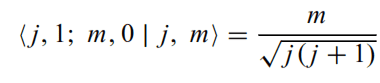
Hi, everyone. I'm trying to get the next identity
Anotación 2020-05-25 222341.png


It is in the format <j1, j2; m1, m2 |j, m>. I hope you can help me
 
Physics news on Phys.org
What is your starting point? Wigner 3j-symbols?
 
DrClaude said:
What is your starting point? Wigner 3j-symbols?
Hi, DrClaude.
I start with Clebsch–Gordan coefficients to arise angular momentum coupling i.e. express the addition of two angular momenta in terms of a third.
 
victor01 said:
Summary:: I have a problem getting a Clebsch–Gordan Identity

Hi, everyone. I'm trying to get the next identity

View attachment 263536

It is in the format <j1, j2; m1, m2 |j, m>. I hope you can help me
The general expression for the CG coefficients is \begin{align*}C_{j_{3}m_{3}}(j_{1}j_{2};m_{1}m_{2}) &amp;= \delta_{m_{3},m_{1}+m_{2}} \left( \frac{(2j_{3}+1) (j_{1} + j_{2} -j_{3})!(j_{1} + j_{3} - j_{2})!(j_{2} + j_{3} - j_{1})!}{(j_{1}+j_{2}+j_{3}+1)!}\right)^{1/2} \\ &amp; \times \left( \prod_{i = 1}^{3}[(j_{i} - m_{i})!] \prod_{i = 1}^{3}[(j_{i} + m_{i})!]\right)^{1/2} \\ &amp; \times \sum_{n} \frac{(-1)^{n}}{n! (j_{1} + j_{2} - j_{3} - n)!(j_{1} - m_{1} - n)!(j_{2} - m_{2} - n)!(j_{3} - j_{1} - m_{2} + n)!(j_{3} - j_{2} + m_{1} + n)!} , \end{align*} where we take the sum over n when non-of the arguments of factorials are negative. The case you are considering: j_{1} = j_{3} \equiv j, \ j_{2} = 1, \ m_{1} = m_{3} \equiv m, \ m_{2} = 0, you sum over n = 0 , 1.
 
  • Like
Likes   Reactions: DrClaude

Similar threads

  • · Replies 1 ·
Replies
1
Views
3K
  • · Replies 1 ·
Replies
1
Views
1K
  • · Replies 4 ·
Replies
4
Views
2K
  • · Replies 1 ·
Replies
1
Views
2K
  • · Replies 7 ·
Replies
7
Views
2K
  • · Replies 3 ·
Replies
3
Views
5K
  • · Replies 2 ·
Replies
2
Views
3K
  • · Replies 7 ·
Replies
7
Views
3K
Replies
0
Views
1K
  • · Replies 1 ·
Replies
1
Views
2K