CNO Fusion Cross-sections for proton nitrogen-15

  • Context: Graduate 
  • Thread starter Thread starter cmb
  • Start date Start date
  • Tags Tags
    Fusion Proton
Click For Summary
SUMMARY

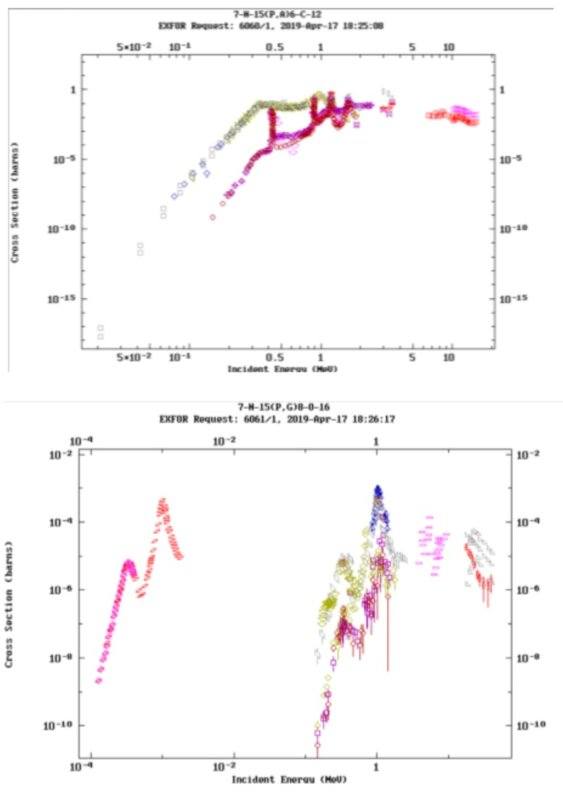
The discussion centers on the CNO-II cycle in stellar nucleosynthesis, specifically the reaction involving nitrogen-15 (15N). It highlights that at temperatures around 1-2 keV, the cross-section for the proton-gamma (p,g) reaction is significantly higher than that for the proton-alpha (p,a) reaction, which occurs only 0.04% of the time in the Sun's core. The participant questions the rationale behind the occurrence of the p,a reaction despite its lower likelihood, suggesting a potential misrepresentation of data in the EXFOR database.

PREREQUISITES
  • Understanding of the CNO cycle in stellar nucleosynthesis
  • Familiarity with nuclear reaction cross-sections
  • Knowledge of the EXFOR database for nuclear reaction data
  • Basic concepts of stellar core temperatures and their effects on reactions
NEXT STEPS
  • Research the CNO-II cycle and its implications for stellar evolution
  • Examine the EXFOR database for detailed cross-section data on nuclear reactions
  • Study the factors influencing reaction probabilities in stellar environments
  • Explore the significance of minor reactions in nuclear astrophysics
USEFUL FOR

Astronomers, nuclear physicists, and astrophysicists interested in stellar nucleosynthesis and the behavior of nuclear reactions in stellar cores.

cmb
Messages
1,128
Reaction score
128
I was reading the wiki page on CNO [https://en.wikipedia.org/wiki/CNO_cycle ] which says; for CNO-II;
"In a minor branch of the above reaction, occurring in the Sun's core 0.04% of the time, the final reaction involving 15N...does not produce carbon-12 and an alpha particle, but instead produces oxygen-16 "

Looking at the data on EXFOR the cross section for p,g is several orders of magnitude above p,a at Sun-ish 1~2 keV temperatures.

So my question is: Why does p,a even get a look-in on that reaction when p,g seems so much more likely based on EXFOR cross-section, yet is described as a minor side reaction?
p_15N_cs.jpg

Has EXFOR misplotted the p,g data?
 
Last edited:
Physics news on Phys.org
I am not sure why my original post title has been changed, as it doesn't seem to have any relation on the question I am asking.
 

Similar threads

  • · Replies 3 ·
Replies
3
Views
2K
  • · Replies 7 ·
Replies
7
Views
3K
  • · Replies 5 ·
Replies
5
Views
2K
  • · Replies 1 ·
Replies
1
Views
5K
Replies
5
Views
5K
  • · Replies 4 ·
Replies
4
Views
6K
  • · Replies 1 ·
Replies
1
Views
3K
  • · Replies 50 ·
2
Replies
50
Views
10K
  • · Replies 6 ·
Replies
6
Views
4K
Replies
4
Views
4K