Discussion Overview
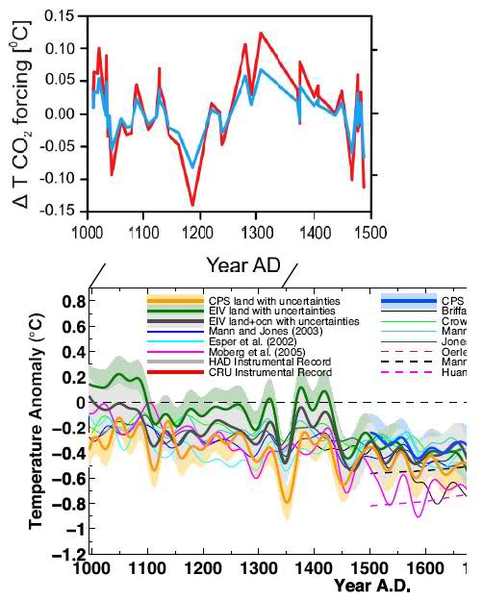
The discussion revolves around the correlation between CO2 levels and temperature in historical climate reconstructions, particularly focusing on data from the past 1000 to 1500 AD. Participants explore the implications of various studies and data sources, including ice core and plant stomata data, and their reliability in assessing the role of CO2 in climate change.
Discussion Character
- Debate/contested
- Technical explanation
- Exploratory
Main Points Raised
- Some participants highlight that both CO2 and temperature exhibited independent variations, suggesting that CO2 concentration may not solely control temperature.
- Others argue that CO2 forcing should not be overlooked, especially during the period between 1000 to 1500 AD, and that different data sources yield varying conclusions about the significance of CO2.
- There is a discussion about the reliability of ice core data versus plant stomata data for measuring historical CO2 levels, with some suggesting that ice core data may underestimate CO2 fluctuations.
- Concerns are raised about the interpretation of data, including the potential issues with gas age and ice age differences in ice core samples.
- Participants express uncertainty about the impact of CO2 in an open-ended climate system, with references to historical climate conditions and potential cataclysmic events.
- Some contributions emphasize the importance of confronting different data sets to draw personal observations rather than relying solely on authors' opinions.
Areas of Agreement / Disagreement
Participants do not reach a consensus; multiple competing views remain regarding the role of CO2 in historical climate change and the reliability of different data sources.
Contextual Notes
Limitations include unresolved questions about the reliability of various data sources, the assumptions underlying the interpretations of CO2 forcing, and the complexities of the carbon cycle.