Is the Integral Zero for Closed Paths in Complex Analysis?

Click For Summary
The discussion centers on the question of whether the integral of a function over closed paths in complex analysis is zero. Participants express confusion about how to demonstrate that the integral is zero, particularly in relation to the conditions on the function's magnitude. It is clarified that if the magnitude of the function is less than or equal to zero, it must be zero since it cannot be negative. The concept of closed paths is linked to the integral being zero, reinforcing the importance of understanding the properties of complex functions in this context. Ultimately, the integral's value is affirmed to be zero due to the nature of closed paths in complex analysis.
Gwinterz
Messages
27
Reaction score
0
Hey, I have been stuck on this question for a while:
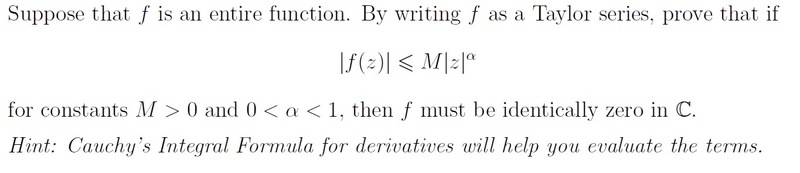
WClcaAN.jpg

I have tried to follow the hint, but I am not sure where to go next to get the result.


Have I started correctly? I am not sure how to show that the integral is zero.

If I can show it is less than zero, I also don't see how that shows it is always zero.

Thanks in advance for any help.
 

Attachments

  • WClcaAN.jpg
    WClcaAN.jpg
    17.6 KB · Views: 666
Physics news on Phys.org
The condition in the premise is on ##\left|f(z)\right|##, not ##f(z)##. If you have in fact shown that ##\left|f(z)\right| \leq 0##, then it must be equal to 0 since it can't be negative.
 
Gwinterz said:
Hey, I have been stuck on this question for a while:

View attachment 232707
I have tried to follow the hint, but I am not sure where to go next to get the result.


Have I started correctly? I am not sure how to show that the integral is zero.

If I can show it is less than zero, I also don't see how that shows it is always zero.

Thanks in advance for any help.

Something cannot be less than zero and equal to zero at the same time. However, since you have non-strict inequalities "##\leq##" there is a chance you can show the thing is ##\leq 0##. Then (being a norm in the complex plane) it must also be ##\geq 0##, hence must ##= 0.##
 
Thanks guys that makes sense.

Is the integral equal to zero because its a closed path?
 
Question: A clock's minute hand has length 4 and its hour hand has length 3. What is the distance between the tips at the moment when it is increasing most rapidly?(Putnam Exam Question) Answer: Making assumption that both the hands moves at constant angular velocities, the answer is ## \sqrt{7} .## But don't you think this assumption is somewhat doubtful and wrong?

Similar threads

  • · Replies 2 ·
Replies
2
Views
2K
  • · Replies 2 ·
Replies
2
Views
2K
  • · Replies 2 ·
Replies
2
Views
2K
  • · Replies 3 ·
Replies
3
Views
2K
Replies
3
Views
1K
  • · Replies 2 ·
Replies
2
Views
3K
  • · Replies 14 ·
Replies
14
Views
2K
  • · Replies 17 ·
Replies
17
Views
3K
Replies
8
Views
3K
Replies
7
Views
2K