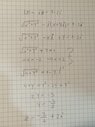
Complex numbers problem |z| - iz = 1-2i

Join the discussion
Ask a follow-up here, or get your own question answered by working scientists, mathematicians and engineers — people, not an autocomplete.
Real named experts · corrections over time · the nuance an AI answer skips
20 replies · 3K views
Callmelucky
Messages
144
Reaction score
30
Homework Statement
Photo of procedure below.
Relevant Equations
z= x+yi, |z|=sqrt(x^2 + y^2), i^2=-1
Here is my attempt(photo below), but somehow the solution in the textbook is z= 2 - (3/2)i, and mine is z=(-3/2) +2i.

Can someone please tell me where I am making a mistake? I suppose it's something with x being part of the real part of the 1st complex number and x being part of an imaginary number of the 1st complex number. But I don't know how to make it right.

Thank you.
 

Attachments
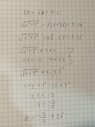
  • WhatsApp Image 2022-12-16 at 20.34.35.jpeg
    WhatsApp Image 2022-12-16 at 20.34.35.jpeg
    32.8 KB · Views: 196
Last edited:
Physics news on Phys.org
Callmelucky said:
Homework Statement:: Photo of procedure below.
Relevant Equations:: z= x+yi, |z|=sqrt(x^2 + y^2), i^2=-1

Here is my attempt(photo below), but somehow the solution in the textbook is z= 2 - (3/2)i, and mine is z=(-2/3) +2i.

Can someone please tell me where I am making a mistake? I suppose it's something with x being part of the real part of the 1st complex number and x being part of an imaginary number of the 1st complex number. But I don't know how to make it right.

Thank you.
Please include the statement of the problem in the text of your post, not merely in the Title.

Also, the image you posted is unreadable or nearly so.

Please learn to use the typing helps at the top of the editing screen, at the very least. Better yet, learn to use LaTeX.
 
Reply
  • Like
Likes   Reactions: jim mcnamara
SammyS said:
Please include the statement of the problem in the text of your post, not merely in the Title.

Also, the image you posted is unreadable or nearly so.

Please learn to use the typing helps at the top of the editing screen, at the very least. Better yet, learn to use LaTeX.
I want to learn latex but I don't have time right now. Here is another pic
Here is the new pic(below). I want to learn Latex, but I don't have time rn.
Problem: Solve in the set of complex numbers. |z| -iz = 1-2i
 

Attachments

  • WhatsApp Image 2022-12-16 at 20.34.35.jpeg
    WhatsApp Image 2022-12-16 at 20.34.35.jpeg
    32.8 KB · Views: 173
SammyS said:
Please include the statement of the problem in the text of your post, not merely in the Title.

Also, the image you posted is unreadable or nearly so.

Please learn to use the typing helps at the top of the editing screen, at the very least. Better yet, learn to use LaTeX.
Amen to all of these. As @SammyS noted, the image is pretty much unreadable. However, I was able to work the problem and get the same solution as shown in the book.

Callmelucky said:
I suppose it's something with x being part of the real part of the 1st complex number and x being part of an imaginary number of the 1st complex number.
This is very unclear.
The equation you're working with is ##|z| - iz = 1 - 2i##
Replace z with x + iy and substitute into the given equation. Note that in the complex number x + iy, y is the coefficient of the imaginary part, but both x and y are real numbers.
 
The new image is slightly more readable, and it looks like you were able to correct your mistake.
Edit: I didn't notice that the real and imaginary parts were reversed.
 
Last edited:
Reply
  • Like
Likes   Reactions: ohwilleke
Yeah but I don't understand how is y imaginary part if i is next to x(xi). Shouldn't x be imaginary part?
 
I know that z= x+yi, but I have xi after multiplying i(x+yi). That is what bothers me.
 
OK, so; you said:
1) ##z=x + iy##
2) ## x=2 ##
3) ## y=-\frac{3}{2}##
and (drum roll, please)...
4) ## z=-\frac{3}{2} + 2i ##

Your only problem is your last line.
 
Reply
  • Like
Likes   Reactions: ohwilleke, FactChecker and PeroK
DaveE said:
OK, so; you said:
1) ##z=x + iy##
2) ## x=2 ##
3) ## y=-\frac{3}{2}##
and (drum roll, please)...
4) ## z=-\frac{3}{2} + 2i ##

Your only problem is the last line.
But that is not the solution. Solution is z= 2 - (3/2)i
 
Callmelucky said:
But that is not the solution. Solution is z= 2 - (3/2)i
Reread my post slowly. Do the substitutions in step 4 carefully.
 
DaveE said:
Reread my post slowly. Do the substitutions in step 4 carefully.
I don't get how did x became y and vice versa
 
Callmelucky said:
But that is not the solution. Solution is z= 2 - (3/2)i
Let's assume your solution is correct:
$$z = -\frac 3 2 + 2i$$$$\Rightarrow \ |z| = \frac 5 2, iz = -2 - \frac 3 2i$$$$\Rightarrow \ |z| - iz = \frac 9 2 + \frac 3 2 i$$
 
Last edited:
Callmelucky said:
I don't get how did x became y and vice versa
Me either.
37c0a70ddb78d0a9b40e33f42faf34b6.jpg
 
Reply
  • Haha
  • Like
Likes   Reactions: pinball1970, malawi_glenn and jim mcnamara
PeroK said:
Do you recognise that ##z## and ##iz## are different complex numbers? In the sense that ##z \ne iz##?
I didn't recognize that. What does that mean, that I have 3 complex numbers in that equation?
 
PeroK said:
It means that if ##z = x + iy## then ##iz \ne x + iy##.
I got the right solution. I think I get it now. For some reason I thought that I am not allowed to move stuff from right side to the left. Thank you.
 
Last edited:
Callmelucky said:
Yeah but I don't understand how is y imaginary part if i is next to x(xi). Shouldn't x be imaginary part?
If z = x + iy, then the Re(z) = x and Im(z) = y.
Callmelucky said:
I know that z= x+yi, but I have xi after multiplying i(x+yi).
##iz = i(x + iy) = i^2y + ix = -y + ix##
Re(iz) = -y and Im(iz) = x
The real part is the part that isn't multiplied by i. The imaginary part is the coefficient of i.
Callmelucky said:
I don't get how did x became y and vice versa
It didn't. What you missed is that the Re(al) and Im(aginary) parts got changed after multiplication by i.
 
Last edited:
Reply
  • Like
Likes   Reactions: berkeman, DaveE and PeroK