Complex & Real Differentiability ... Remmert, Section 2, Ch 1

Click For Summary

Discussion Overview

The discussion centers on the relationship between complex and real differentiability as presented in Reinhold Remmert's "Theory of Complex Functions," specifically in Chapter 1, Section 2. Participants seek to understand how complex differentiability implies real differentiability and the nature of complex-linear differentials.

Discussion Character

  • Technical explanation
  • Conceptual clarification
  • Debate/contested

Main Points Raised

  • Some participants argue that complex differentiability implies real differentiability because one can restrict to real paths approaching zero, which still satisfies the condition for differentiability.
  • Others propose that the limit defining complex differentiability is similar in form to that of real differentiability, suggesting a connection between the two concepts.
  • It is noted that the differential \( f'(c) \) acts via multiplication on the direction \( h \), indicating that this multiplication is \( \mathbb{C} \)-linear in its variable \( h \).
  • Some participants emphasize that real differentiability is a subcase of complex differentiability, highlighting the additional structure provided by complex numbers.
  • Concerns are raised about the necessity of considering all paths to zero, with a request for clarification on why restricting to real paths is permissible.
  • One participant asserts that the complex derivative is inherently complex linear by definition, which also satisfies the conditions for real linearity.

Areas of Agreement / Disagreement

Participants express various viewpoints on the implications of complex differentiability for real differentiability, with some agreeing on the connection while others question the assumptions involved. The discussion remains unresolved regarding the justification for restricting to real paths.

Contextual Notes

Participants highlight the importance of understanding the nature of paths approaching zero in the context of differentiability, noting that the converse of the implications discussed may not hold.

Math Amateur
Gold Member
MHB
Messages
3,920
Reaction score
48
I am reading Reinhold Remmert's book "Theory of Complex Functions" ...

I am focused on Chapter 1: Complex-Differential Calculus ... and in particular on Section 2: Complex and Real Differentiability ... ... ...

I need help in order to fully understand the relationship between complex and real differentiability ... ...

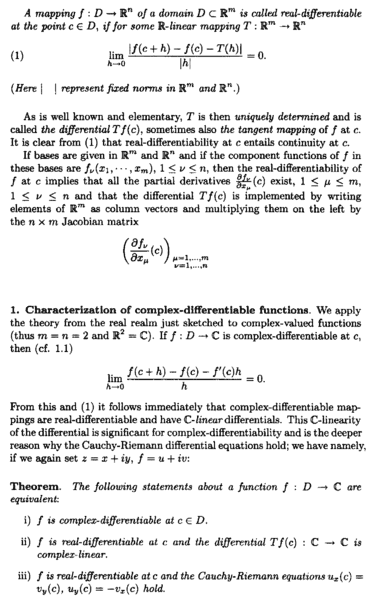
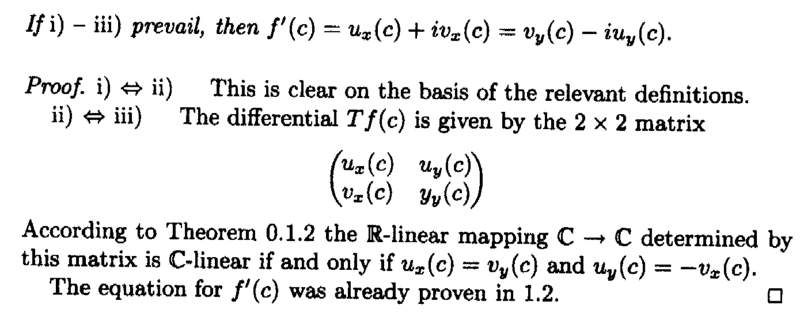
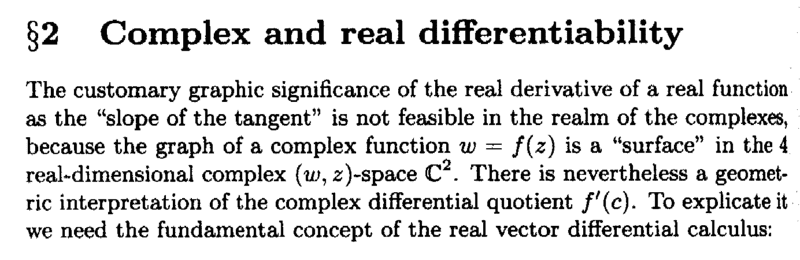
Remmert's section on complex and real differentiability reads as follows:
?temp_hash=f9a2d1d32bc609fb064aff024fb25eab.png

?temp_hash=f9a2d1d32bc609fb064aff024fb25eab.png

?temp_hash=f9a2d1d32bc609fb064aff024fb25eab.png

In the above text from Remmert, we read the following ... ... just below 1. Characterization of complex-differentiable functions ... ...

" ... ... If ##f : D \to C## is complex-differentiable at ##c## then ...##\displaystyle \lim_{ h \to 0 } \frac{ f(c + h ) - f(c) - f\, ' (c) h }{ h} = 0##From this and (1) it follows immediately that complex-differentiable mappings are real differentiable and have ##\mathbb{C}##-linear differentials ... ...

... ... ... "
Can someone please explain (formally and rigorously) how/why

(i) it follows from the limit immediately above and (1) that complex-differentiable mappings are real differentiable ... ...

(ii) it follows from the limit immediately above and (1) that complex-differentiable mappings have ##\mathbb{C}##-linear differentials ... ...(***NOTE: I suspect the answer to (i) is that the form of the two limits is essentially the same ... although I'm concerned about the presence of norms in one and not the other ... and also that we can identify ##\mathbb{C}## with ##\mathbb{R}^2## as a vector space ... is that correct?)Help will be appreciated ...

Peter

=======================================================================================
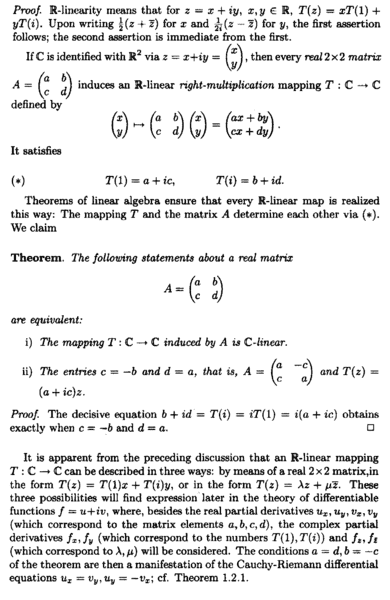
Physics Forum readers of the above post may benefit from access to Remmert's section defining R-linear and C-linear mappings ... so I am providing access to that text ... as follows:
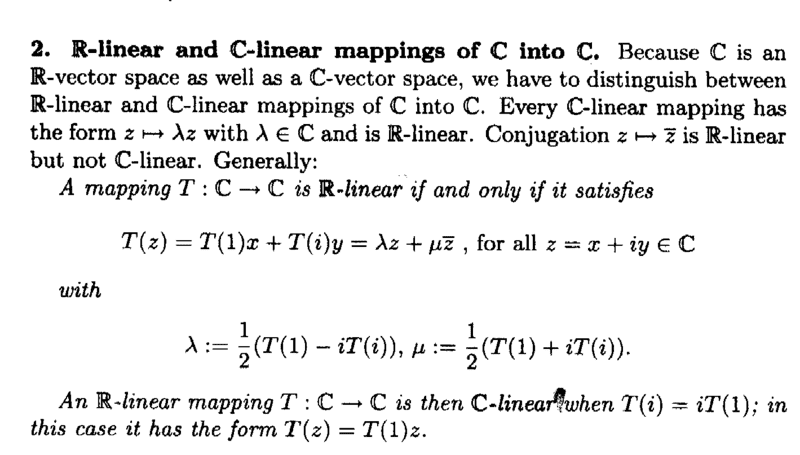
?temp_hash=f9a2d1d32bc609fb064aff024fb25eab.png

?temp_hash=f9a2d1d32bc609fb064aff024fb25eab.png
Hope that helps ...

Peter
 

Attachments

  • Remmert - 1 - Complex and Real Differentiability - Section 2, Ch. 1  - PART 1 ... .png
    Remmert - 1 - Complex and Real Differentiability - Section 2, Ch. 1 - PART 1 ... .png
    27.9 KB · Views: 451
  • Remmert - 2 - Complex and Real Differentiability - Section 2, Ch. 1  - PART 2 ... .png
    Remmert - 2 - Complex and Real Differentiability - Section 2, Ch. 1 - PART 2 ... .png
    32 KB · Views: 510
  • Remmert - 3 - Complex and Real Differentiability - Section 2, Ch. 1  - PART 3 ... .png
    Remmert - 3 - Complex and Real Differentiability - Section 2, Ch. 1 - PART 3 ... .png
    23.9 KB · Views: 469
  • Remmert - 1 - R-linear and C-linear Mappings, Ch. 0, Section 1.2 ... PART 1 .png
    Remmert - 1 - R-linear and C-linear Mappings, Ch. 0, Section 1.2 ... PART 1 .png
    32.2 KB · Views: 426
  • Remmert - 2 - R-linear and C-linear Mappings, Ch. 0, Section 1.2 ... PART 2 .png
    Remmert - 2 - R-linear and C-linear Mappings, Ch. 0, Section 1.2 ... PART 2 .png
    32.7 KB · Views: 460
  • ?temp_hash=f9a2d1d32bc609fb064aff024fb25eab.png
    ?temp_hash=f9a2d1d32bc609fb064aff024fb25eab.png
    27.9 KB · Views: 692
  • ?temp_hash=f9a2d1d32bc609fb064aff024fb25eab.png
    ?temp_hash=f9a2d1d32bc609fb064aff024fb25eab.png
    32 KB · Views: 1,008
  • ?temp_hash=f9a2d1d32bc609fb064aff024fb25eab.png
    ?temp_hash=f9a2d1d32bc609fb064aff024fb25eab.png
    23.9 KB · Views: 733
  • ?temp_hash=f9a2d1d32bc609fb064aff024fb25eab.png
    ?temp_hash=f9a2d1d32bc609fb064aff024fb25eab.png
    32.2 KB · Views: 651
  • ?temp_hash=f9a2d1d32bc609fb064aff024fb25eab.png
    ?temp_hash=f9a2d1d32bc609fb064aff024fb25eab.png
    32.7 KB · Views: 618
Physics news on Phys.org
Math Amateur said:
" ... ... If ##f : D \to C## is complex-differentiable at ##c## then ...##\displaystyle \lim_{ h \to 0 } \frac{ f(c + h ) - f(c) - f\, ' (c) h }{ h} = 0##From this and (1) it follows immediately that complex-differentiable mappings are real differentiable and have ##\mathbb{C}##-linear differentials ... ...

... ... ... "
Can someone please explain (formally and rigorously) how/why

(i) it follows from the limit immediately above and (1) that complex-differentiable mappings are real differentiable ... ...
It follows, because we have any complex ##h## approaching zero, and we are thus allowed to restrict ourselves to real paths to zero, which still gives the same condition, so complex differentiability implies real differentialbility.
(ii) it follows from the limit immediately above and (1) that complex-differentiable mappings have ##\mathbb{C}##-linear differentials ... ...
We have the differential ##f\,'(c)## which acts via multiplication on the direction ##h##, and multiplication ##h \longmapsto f\,'(c)\cdot h## is ##\mathbb{C}-##linear in its variable ##h##. (Remember my comment about the Jacobi matrix in the previous thread.)
(***NOTE: I suspect the answer to (i) is that the form of the two limits is essentially the same ...
Yes. Real is a subcase of complex.
... although I'm concerned about the presence of norms in one and not the other ...
This doesn't make a difference.
$$
\lim_{ h \to 0 } \frac{ f(c + h ) - f(c) - f\, ' (c) h }{ h} = 0 \Longleftrightarrow \lim_{ h \to 0 } \frac{ f(c + h ) - f(c) - f\, ' (c) h }{ ||h||} \cdot \frac{||h||}{h}= \lim_{ h \to 0 } \frac{ f(c + h ) - f(c) - f\, ' (c) h }{ ||h||} \cdot z = 0 \Longleftrightarrow \lim_{ h \to 0 } \frac{ f(c + h ) - f(c) - f\, ' (c) h }{ ||h||} =0
$$ with a complex number ##z \in \mathbb{C}## of norm ##1##.
... and also that we can identify ##\mathbb{C}## with ##\mathbb{R}^2## as a [real] vector space ... is that correct?)
Yes, with the strong and loud emphasis on "as a real vector space". However, we have the complex numbers here as a field and a complex vector space, which are more than just a real plane, which is why complex differentiation is more - in the sense of stronger, resp. stricter - than real differentiation. With ##(\alpha\cdot i) \cdot (\beta \cdot i) = -\alpha \beta## we get a possibility to change between the dimensions: imaginary ##\to ## real. A rule which we do not have in real vector spaces, where we cannot just switch from one dimension (##x-##axis) to the other (##y-##axis) by some scalar multiplication.
 
  • Like
Likes   Reactions: BvU and Math Amateur
fresh_42 said:
It follows, because we have any complex ##h## approaching zero, and we are thus allowed to restrict ourselves to real paths to zero, which still gives the same condition, so complex differentiability implies real differentialbility.

We have the differential ##f\,'(c)## which acts via multiplication on the direction ##h##, and multiplication ##h \longmapsto f\,'(c)\cdot h## is ##\mathbb{C}-##linear in its variable ##h##. (Remember my comment about the Jacobi matrix in the previous thread.)

Yes. Real is a subcase of complex.

This doesn't make a difference.
$$
\lim_{ h \to 0 } \frac{ f(c + h ) - f(c) - f\, ' (c) h }{ h} = 0 \Longleftrightarrow \lim_{ h \to 0 } \frac{ f(c + h ) - f(c) - f\, ' (c) h }{ ||h||} \cdot \frac{||h||}{h}= \lim_{ h \to 0 } \frac{ f(c + h ) - f(c) - f\, ' (c) h }{ ||h||} \cdot z = 0 \Longleftrightarrow \lim_{ h \to 0 } \frac{ f(c + h ) - f(c) - f\, ' (c) h }{ ||h||} =0
$$ with a complex number ##z \in \mathbb{C}## of norm ##1##.

Yes, with the strong and loud emphasis on "as a real vector space". However, we have the complex numbers here as a field and a complex vector space, which are more than just a real plane, which is why complex differentiation is more - in the sense of stronger, resp. stricter - than real differentiation. With ##(\alpha\cdot i) \cdot (\beta \cdot i) = -\alpha \beta## we get a possibility to change between the dimensions: imaginary ##\to ## real. A rule which we do not have in real vector spaces, where we cannot just switch from one dimension (##x-##axis) to the other (##y-##axis) by some scalar multiplication.
Thanks fresh_42 ...

Reflecting on what you have written ...

But ... just a clarification ...

You write:

" ... ... It follows, because we have any complex ##h## approaching zero, and we are thus allowed to restrict ourselves to real paths to zero, which still gives the same condition, so complex differentiability implies real differentiability. ... ... "

Can you please justify why we are allowed to restrict ourselves to real paths to zero ... I thought we had to be able to approach zero along all paths ... can you please clarify ...Thanks again for your help ...

Peter
 
We want to show that ##f(c+h)-f(c) = f\,'(c)\cdot h + ||h||\cdot E_c(h)## holds for the real variable ##h## approaching zero. (I've used your previous notation as it is within one line.) What we have is, that ##f(c+h)-f(c) = f\,'(c)\cdot h + ||h||\cdot E_c(h)## holds for the complex variable ##h## approaching zero; that means, for all complex paths ##p: [0,1] \longrightarrow \mathbb{C}## approaching zero, e.g. ##p(t)=h \cdot (1-t)## or ##p(t) = \sin((1-t) \cdot |h|)## or whatever. Now if we only consider those paths among all allowed, which are real, i.e. ##p([0,1])\subseteq \mathbb{R}## we still have ##f(c+h)-f(c) = f\,'(c)\cdot h + ||h||\cdot E_c(h)## which is real differentiabilty. It also shows, that the converse direction does not hold: If we had real differentiability, we wouldn't have any knowledge yet about what's going on along complex paths to zero.
 
  • Like
Likes   Reactions: Math Amateur
The complex derivative is complex linear by definition since it is defined to be multiplication by the complex number ##f'(c)##.

As Fresh_42 explained, a complex linear function is real linear since real numbers are complex numbers.

Given that it is real linear, your definition of real differentiable is immediately satisfied by taking the limit of the norm of

##\displaystyle \frac{ f(c + h ) - f(c) - f\, ' (c) h }{ h}## since if this goes to zero its norm must as well.
 
Last edited:
  • Like
Likes   Reactions: Math Amateur

Similar threads

Replies
1
Views
2K
  • · Replies 1 ·
Replies
1
Views
1K
  • · Replies 1 ·
Replies
1
Views
1K
  • · Replies 4 ·
Replies
4
Views
3K
  • · Replies 3 ·
Replies
3
Views
2K
Replies
4
Views
2K
  • · Replies 0 ·
Replies
0
Views
2K
  • · Replies 7 ·
Replies
7
Views
3K
Replies
2
Views
2K
Replies
7
Views
2K