Composition of Jupiter: Ices, Cores & Outer Gas Layers

  • Context: Undergrad 
  • Thread starter Thread starter curious_ocean
  • Start date Start date
  • Tags Tags
    Composition Jupiter
Click For Summary

Discussion Overview

The discussion centers around the composition of Jupiter and Saturn, particularly in relation to the presence of ices such as water, carbon dioxide, ammonia, and methane. Participants explore the implications of these compounds for the formation and structure of the gas giants, comparing them to Uranus and Neptune, and questioning the representation of these ices in diagrams of planetary composition.

Discussion Character

  • Exploratory
  • Technical explanation
  • Debate/contested

Main Points Raised

  • Some participants question where the ices mentioned in textbooks are represented in the composition diagrams of Jupiter and Saturn, suggesting they may be included in the core or transformed under high pressure and temperature.
  • It is proposed that the amount of ices in Jupiter and Saturn is significantly less than in Uranus and Neptune, with estimates suggesting about 5 Earth masses of ices in Jupiter.
  • One participant argues that the thick hydrogen atmospheres of Jupiter and Saturn differentiate them from the ice giants, implying that their cores may resemble large Neptunes surrounded by hydrogen.
  • There is speculation about the state of materials in the interiors of these planets, with some suggesting that ice, rock, and iron could be dissolved or mixed in hot hydrogen, while others emphasize the lack of experimental data to confirm these ideas.
  • Participants discuss the nature of clouds on gas giants, questioning their composition and the dynamics that keep them suspended in the atmosphere, drawing parallels to cloud formation on Earth.
  • Some express uncertainty about the stratification of atmospheres and the behavior of different gases and clouds under varying conditions.

Areas of Agreement / Disagreement

Participants express differing views on the composition and structure of Jupiter and Saturn, with no consensus reached regarding the presence and role of ices in these planets. The discussion remains unresolved, particularly concerning the dynamics of their atmospheres and the state of materials in their interiors.

Contextual Notes

Limitations include the lack of direct observational data regarding the interiors of gas giants and the complexities of atmospheric dynamics that may not be fully represented in diagrams.

curious_ocean
Messages
36
Reaction score
7
TL;DR
Where are the ices in Jupiter and Saturn?
Hello PF,

I am teaching a general education college-level introduction to "Planet Earth" class that covers a bit of astronomy. This question is in regards to our unit on the formation of the Solar System. Specifically I am confused about the composition of Jupiter and Saturn. This is a figure from our textbook:
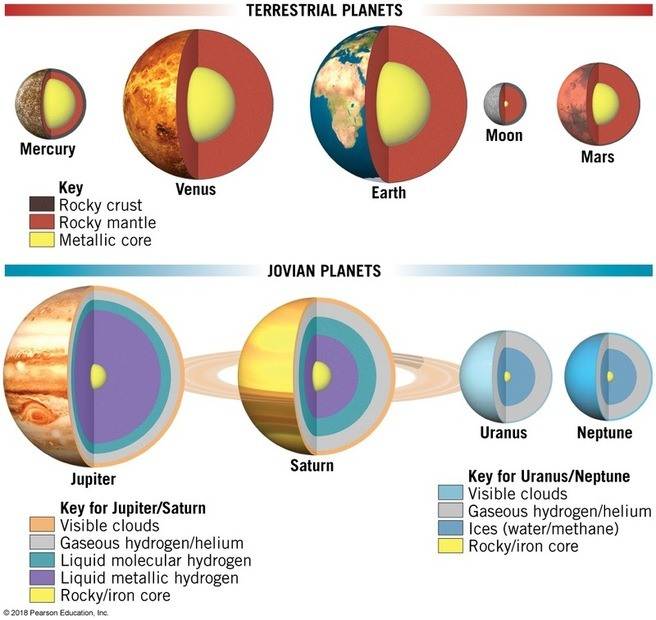
-Exr2X8oIKjTd1O1hIk-MTXWvP39fAlc_mZmO_6q15tWllc=s0.jpg

The textbook says:
"[The Jovian] planets accreted from planetesimals that originated beyond the orbit of Mars (beyond the frost line), where temperatures were low enough so compounds that remained gases in the inner solar system condensed to form ices. As a result, these planetesimals contained high percentages of ices -- mainly ices of water, carbon dioxide, ammonia, and methane -- as well as smaller amounts of rocky and metallic debris. The fact that the outer reaches of the solar system contained much larger quantities of ices than metallic and rocky material accounts in part for the large sizes and low density of the outer planets. The two most massive planets, Jupiter and Saturn, also had surface gravities sufficient to attract and retain even large quantities of hydrogen and helium gas, the lightest elements."

My question is: Where are the ices of water, carbon dioxide, ammonia and methane in the composition diagram of Jupiter and Saturn? Are those included in the core? Or did those compounds get broken up and turned into something else? In the diagram, Uranus and Neptune have a layer called "ices" but Jupiter and Saturn do not. Still, the textbook claims these ices are what allowed Jupiter and Saturn to become "giants".

I posted a related question years ago and appreciated the help I got here:
https://www.physicsforums.com/threa...stem-gas-giants-in-outer.747964/#post-4715415

Thanks in advance for your help!
 
  • Like
Likes   Reactions: Delta2
Astronomy news on Phys.org
Thanks Russ - those both seem like reasonable guesses.
This site suggests that the percentages are small:
https://www.spaceexploration92.com/2019/02/planet-jupiter.html
It seems there is ammonia in the atmosphere:
https://www.nasaspaceflight.com/2020/09/case-of-jupiters-missing-ammonia/
and the schematic at the bottom of this page seems to suggest that there might be "ices" in the core:
https://www.space.com/18388-what-is-jupiter-made-of.html
Not sure how that works with the heat and pressure of the core- perhaps the term ice is used differently here.
I suppose the "ices" could still be the reason they became giants even though it only accounts for a tiny fraction of their mass.
 
It's simple. Neptune and Uranus weigh about 15 Earth masses, of which say 3/4 are ices - so maybe 10 or 12 Earth masses. Their upper atmospheres are still mostly hydrogen.

This is only 10% of Saturn's mass and 3% of Jupiter's. The best estimates are that Jupiter has about 5 Earth masses of ices - less than Neptune, but not crazy less. What's different about Jupiter and Saturn is that their upper hydrogen atmospheres are much thicker.

You would not be far wrong to imagine Jupiter and Saturn as having large Neptunes at their cores, surrounded by a very, very thick hydrogen layer.
 
  • Like
Likes   Reactions: phinds and curious_ocean
Thank you Vanadium 50!
 
Vanadium 50 said:
It's simple. Neptune and Uranus weigh about 15 Earth masses, of which say 3/4 are ices - so maybe 10 or 12 Earth masses. Their upper atmospheres are still mostly hydrogen.

This is only 10% of Saturn's mass and 3% of Jupiter's. The best estimates are that Jupiter has about 5 Earth masses of ices - less than Neptune, but not crazy less. What's different about Jupiter and Saturn is that their upper hydrogen atmospheres are much thicker.

You would not be far wrong to imagine Jupiter and Saturn as having large Neptunes at their cores, surrounded by a very, very thick hydrogen layer.
You may or may not be seriously wrong.
What is certain is that there is little ice, and less rock or iron, in upper atmosphere of Jupiter, Saturn, Uranus or Neptune. At the low pressure and low temperature, all of them would promptly snow out.

What is NOT certain is where they are. The interior of Jupiter, Saturn, Uranus and Neptune is hot and under high pressure. The properties of hydrogen, ice, rock and iron under those conditions are not experimentally accessible.

It is possible that in hot hydrogen, ice, rock and/or iron are dissolved/evaporated, and mixed. It is also possible that they stay separated.

No possibility of experiment, and also no observations. Comet Shoemaker Levy emitted a bunch of shockwaves in Jupiter´s atmosphere, but no one seems to know precisely what routes those waves took through Jupiter´s interior, at which depth they met acoustic impedance discontinuities if any, etc.
 
Sure, evidence is indirect. Nobody has seen even the Earth's core.
 
snorkack said:
...

No possibility of experiment, and also no observations. ..

Juno probe took gravity measurements.
 
The visible clouds are ammonia ice, probably water ice clouds lower down. Pretty sure that's where most of the ice is. Density with Jupiter is extreme, there may even be electron degenerate matter at the core, similar to that in White Dwarfs. Can't imagine much 'ice' there, mainly iron I would have thought, but I guess nobody knows for sure. Similar for Saturn.

This, plus the metallic hydrogen makes them very different to Uranus and Neptune. They are just planets with a thick atmosphere. Jupiter and Saturn are more like 'failed' stars.
 
Last edited:
  • #10
Clouds floating on H and He? Why don't they sink? This is disturbing me. Light gases in the Earth's atmosphere extend further than anything else so why not on the Gas Giants?
What do the 'clouds' consist of, to keep them up there?
 
  • Like
Likes   Reactions: symbolipoint
  • #11
Why would clouds be in equilibrium? They aren't on earth.
 
  • #12
Vanadium 50 said:
Why would clouds be in equilibrium? They aren't on earth.
But water molecules are lighter than air. What do the clouds consist of? Condensed H?
You are implying it must be convection then? I’M prepared to be surprised at a reason I think you owe me more than just a question. 🤔
 
  • #13
sophiecentaur said:
But water molecules are lighter than air.
And sometimes they come down. We call it rain.
And we don't asphyxiate on the pool of argon that should end up at the bottom of the atmosphere.

We don't see this extreme stratification on Earth. Why do you expect it on Jupiter.
 
  • #14
Vanadium 50 said:
And sometimes they come down. We call it rain.
And we don't asphyxiate on the pool of argon that should end up at the bottom of the atmosphere.

We don't see this extreme stratification on Earth. Why do you expect it on Jupiter.
Ok. What do the clouds consist of on J? Perhaps the density of the liquid H (surely not liquid He?) is high enough to support a mixture of H gas and H droplets. I was hoping for some sort of help along those lines. Is that the sort of thing you had in mind?
(Or we’re you trying to make the student ‘think’ a bit? )
 
  • #15
I'm not being coy. I am just saying that the fully-stratified model doesn't work even on Earth. Atmospheres are complicated and dynamic things.
 
  • #16
Oh yes. But there are only a few possibilities for their content. Perhaps someone else would enlighten us.
 
  • #17
sophiecentaur said:
But water molecules are lighter than air. What do the clouds consist of? Condensed H?
Clouds on Earth are composed of liquid droplets or solid crystals of water, which are both much denser than air. These remain airborne only while they are small enough that their terminal velocity is smaller than the air circulation velocities. I expect the same is true on Jupiter with its clouds.
 
  • Like
Likes   Reactions: symbolipoint, russ_watters and sophiecentaur
  • #18
Drakkith said:
I expect the same is true on Jupiter with its clouds.
I guess so. My problem could be with the way those diagrams are drawn. Why would the clouds only be on the upper level? Do the lower levels, as drawn, consist of liquid or gas? Is the only gaseous region where the clouds are? That would make sense (to me). Would the Helium just be mixed in with the H molecules as a sort of solution? There would not be much of it.
 
  • #19
sophiecentaur said:
Why would the clouds only be on the upper level?
Well, that is all we can see. On Earth cloud height varies from 50 miles (above 99.9% of the atmosphere) to I guess 0 with fog. The oceans have clouds of sorts as well - regions of varying salinity.
 
Last edited:
  • Like
Likes   Reactions: stefan r
  • #20
sophiecentaur said:
Why would the clouds only be on the upper level?
Well, that's where the right chemicals, in the right ratios, at the right pressures and temperatures are.
More about this general topic can be found in this paper: https://web.archive.org/web/2019012...altech.edu/~ulyana/www_papers/west_Ch5_us.pdf
This, of course, doesn't guarantee that other types of clouds don't form lower down. We just can't see further down.
 
  • Like
Likes   Reactions: russ_watters
  • #21
Erik 05 said:
The visible clouds are ammonia ice, probably water ice clouds lower down. Pretty sure that's where most of the ice is. Density with Jupiter is extreme, there may even be electron degenerate matter at the core, similar to that in White Dwarfs. Can't imagine much 'ice' there, mainly iron I would have thought, but I guess nobody knows for sure. Similar for Saturn.
Most of the water on Earth is not in clouds. Most of water in Earth atmosphere is not in clouds either. Clouds are visible, but there is actually a lot of water vapour in clear gaseous state in clear air. There also is a lot of water vapour in gas state in clouds between the water or ice particles.

Indeed, clouds necessarily contain less water in total than clear air beneath. The reason is that clouds form when clear humid air rises and cools and some water condenses. All of the water in clouds was in the clear air before it cooled and condensed, so the cloud cannot contain more water, but some water has rained or snowed out, so the cloud must have less water left than before it formed.

The reason Earth has clouds and that they have not all rained out yet is that humid air has risen from beneath and formed new clouds. However, the reason humid air rises on Earth is that sunlight can reach the bottom of atmosphere, ground or sea surface, and warm it while top of the atmosphere cools. Jupiter´s atmosphere is too dense for sunlight to warm its bottom, so why does air rise on Jupiter?
 
  • Like
Likes   Reactions: russ_watters
  • #22
snorkack said:
However, the reason humid air rises on Earth is that sunlight can reach the bottom of atmosphere, ground or sea surface, and warm it while top of the atmosphere cools. Jupiter´s atmosphere is too dense for sunlight to warm its bottom, so why does air rise on Jupiter?
Because Jupiter's atmosphere (troposphere) gets warmer as you go lower. This is probably due to internal heat, not warming by the Sun. See the following graph from the galileo probe data.

1920px-Structure_of_Jovian_atmosphere.png
 
  • #23
I am still confused when the situation on Earth is compared with that on Jupiter to 'explain' the Methane clouds. The proportions of elements in the atmosphere (according to that Wiki article) is largely the same as in a star - mostly H and He. Everything else has much heavier molecules. H2O clouds in Earth's atmosphere seem quite reasonable as H2O vapour is less dense than our main atmospheric constituents. So water vapour can easily find itself high up in the Earth's atmosphere; it would just float up.

Is there some other mechanism - perhaps a lot of turbulence - that can cause molecules of methane to be present, right at the top the H layer? Methane molecules are 7.5 times the mass of H2 molecules. How can they 'float' up in any proportion? And what is it that keeps them up there in a layer with pretty stable looking forms (red spot etc.)?

I'v no doubt it's pretty complicated but it must be worth while resolving where intuition is going wrong. (I do believe the observations.)
 
  • #24
sophiecentaur said:
I am still confused when the situation on Earth is compared with that on Jupiter to 'explain' the Methane clouds. The proportions of elements in the atmosphere (according to that Wiki article) is largely the same as in a star - mostly H and He. Everything else has much heavier molecules. H2O clouds in Earth's atmosphere seem quite reasonable as H2O vapour is less dense than our main atmospheric constituents. So water vapour can easily find itself high up in the Earth's atmosphere; it would just float up.
No. Because it is molecules.
sophiecentaur said:
Is there some other mechanism - perhaps a lot of turbulence - that can cause molecules of methane to be present, right at the top the H layer? Methane molecules are 7.5 times the mass of H2 molecules. How can they 'float' up in any proportion? And what is it that keeps them up there in a layer with pretty stable looking forms (red spot etc.)?

I'v no doubt it's pretty complicated but it must be worth while resolving where intuition is going wrong. (I do believe the observations.)
Molecules are extremely tiny. Which is why they do not settle, down or up, the way liquid or solid suspensions do. Very weak turbulence is enough to mix molecules and atoms. Whereas cloud droplets and snowflakes settle fast, and strong turbulence is needed to lift or produce them faster than they rain out.
 
  • Like
Likes   Reactions: sophiecentaur
  • #25
snorkack said:
Very weak turbulence is enough to mix molecules and atoms
I found a term "turbopause" which it the height above which simple diffusion governs the proportions of the gases. On Earth, it's at around 100km altitude and (of course) that's well above the clouds.

I think that has sorted my problem - thanks.
 

Similar threads

  • · Replies 16 ·
Replies
16
Views
5K
  • · Replies 4 ·
Replies
4
Views
2K
  • · Replies 2 ·
Replies
2
Views
3K
  • · Replies 3 ·
Replies
3
Views
5K
  • · Replies 9 ·
Replies
9
Views
6K
Replies
17
Views
4K
  • · Replies 21 ·
Replies
21
Views
5K
  • · Replies 1 ·
Replies
1
Views
3K
  • · Replies 1 ·
Replies
1
Views
2K
  • · Replies 1 ·
Replies
1
Views
9K