Computing the Legendre Symbol (2/p) for Odd Primes: A Proof and Explanation

  • Context: Graduate 
  • Thread starter Thread starter kingwinner
  • Start date Start date
  • Tags Tags
    Legendre Symbol
Click For Summary

Discussion Overview

The discussion revolves around the computation of the Legendre symbol (2/p) for odd primes, specifically focusing on the conditions under which it can be simplified using modular arithmetic, particularly modulo 8. Participants explore the implications of reducing primes modulo 8 and the parity of certain expressions related to the Legendre symbol.

Discussion Character

  • Exploratory
  • Technical explanation
  • Mathematical reasoning
  • Debate/contested

Main Points Raised

  • Some participants question why the Legendre symbol can be computed using primes reduced modulo 8, specifically regarding the parity of (p^2-1)/8 for different values of p.
  • There is a discussion about the validity of manipulating expressions involving division by 8, with some participants noting that this is not straightforward since 1/8 is not an integer.
  • One participant suggests considering two cases for (p^2-1)/8 being even or odd, leading to a search for congruences modulo 8.
  • Another participant proposes checking all cases for odd primes to derive the conditions for (2/p) being equal to 1.
  • There is a mention of using the formula related to (-1/p) to derive conditions for (2/p), but uncertainty remains about how to systematically approach this derivation.
  • Some participants express confusion about the transition from modulo 8 to modulo 16 and the implications of such a transition on the results.
  • One participant provides a breakdown of cases for odd primes and discusses the introduction of the factor 8 in the context of a product series of powers of -1.

Areas of Agreement / Disagreement

Participants do not reach a consensus on the conditions for the Legendre symbol (2/p) and the appropriate modular arithmetic to apply. Multiple competing views and uncertainties remain throughout the discussion.

Contextual Notes

Limitations include the unclear assumptions regarding the manipulation of expressions involving division by 8, the lack of resolution on the transition between different moduli, and the dependence on the definitions of parity and congruences in the context of the Legendre symbol.

kingwinner
Messages
1,266
Reaction score
0
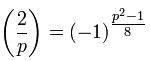
"Let p be an odd prime, then we proved that the Legendre symbol
nt9.JPG


Note that this can be easily computed if p is reduced modulo 8.
For example, if p=59, then p≡3 (mod 8) and [tex](-1)^{(p^2-1)/8}[/tex] = [tex](-1)^{(3^2-1)/8}[/tex]" (quote from my textbook)
====================================

Now I don't exactly see WHY p can be reduced modulo 8 without changing the answer.
Why can we be so sure that [tex](59^2-1)/8[/tex] and [tex](3^2-1)/8[/tex] will have the same parity? How can we prove this?

Thanks for explaining!
 
Physics news on Phys.org
kingwinner said:
Why can we be so sure that [tex](59^2-1)/8[/tex] and [tex](3^2-1)/8[/tex] will have the same parity? How can we prove this?
Isn't parity just another word for looking at the number modulo 2?
 
Yes, but my textbook says modulo 8 which I don't understand.

59≡3 (mod 2)
=> 592≡32 (mod 2)
=> 592-1 ≡ 32-1 (mod 2)
But the trouble here is that there is no rule saying that I can multiply both sides by 1/8 (since 1/8 is not an integer)
 
kingwinner said:
But the trouble here is that there is no rule saying that I can multiply both sides by 1/8 (since 1/8 is not an integer)
That's right. But, still, there is a rule that deals with division...

By the way, it's the parity of (p2-1)/8, not the parity of p, so maybe you should start with that?
 
Or, I suppose, you could start with p=q mod 8 and work from there.
 
Sorry, I don't get it...

How should I begin?
 
I guess I should look at two cases...(p2-1)/8 is even and the other case (p2-1)/8 is odd.

(2/p)=1
<=> (p2-1)/8 is even
<=> (p2-1)/8 = 2k
<=> p2= 16k + 1
<=> p2 ≡ 1 (mod 16)

<=> p ≡ ? (mod 8) <-----------this is the step I'm stuck...

Can someone help me, please?
Thank you!
 
Can't you just try everything?
 
How? Can someone show me an example?

How do you go from mod 8 to mod 16??
 
  • #10
17eb39e435290b52c08e30078f40942d.png

To get the conrguence on the right hand side (i.e. precisely when (-1/p)=1), I will use the formula in the middle
(-1/p)=1 <=> (p-1)/2 is even <=> (p-1)/2 = 2k <=> p=1+4k <=> p≡1 (mod 4)

b84e4e92a3b8ac098c587cf814810b00.png

Following the same trick as above, to determine when (2/p)=1,
set [tex][(p^2 -1)/8][/tex] =2k
<=> [tex]p^2[/tex] = 16k +1
<=> [tex]p^2[/tex] ≡ 1 (mod 16)

<=> p ≡ ? (mod 8)[/color] <-----I'm stuck on this step. Can someone explain how to go from the previous step to this step?

Thanks for any help!
 
Last edited:
  • #11
If we somehow already HAVE the answer on the right hand side, then it's easy to check that [tex]\frac{p^2-1}{8}[/tex] is odd for p = 3, 5 and it's even for p = 1, 7. But to do this, we actually need to know the correct answers in the first place.

b84e4e92a3b8ac098c587cf814810b00.png

But like in my textbook, it only proved the formula in the middle, without showing the conditions on the right, and I'm looking for a way to systematically derive the conditions on the right using the formula in the middle.

Also, why should the conditions be p≡ (mod 8)? Why not p≡ (mod 16)?? (as analogy, for (-1/p), the formula has 2 in the denominator of the exponent, and we get mod 4 on the right)
Having ONLY the formula in the middle, how to figure out what "modulus" to work with when we're trying to derive the conditions on the right?


Can someone explain this, please?
Thank you!
 
  • #12
Why not p≡ (mod 16)?
Do it for that then. What do you get?
 
  • #13
We know p is an odd prime so there are only four cases which can be placed in two catagories: [tex]\pm1+8k; \pm3+8k[/tex] Of course, in some cases k could be even and represent things like 1+32k, etc.

In the first case, squaring, subtracting off 1, and dividing by 8: [tex]\frac{\pm16k +64k^2}{8}}[/tex]

This gives an even result which goes for 8k+1 and 8k +7. The second situation is negative.

The factor 8 is introduced by use of a way to get the result. It comes from the sum formula for a product series of powers of -1: 1+2++++(p-1)/2 =(p-1)/2*(p+1)/2*1/2 =(p^2-1)/8. http://www.mathreference.com/num-mod,qr12.html

_In that case we arrive at 2^(p-1)/2 = (-1)^(p^2-1)/8. Since 2^(p-1)/2 can be only +/1, and all squares are +1--which is half the cases, we have our result.
 
Last edited:

Similar threads

  • · Replies 21 ·
Replies
21
Views
2K
  • · Replies 31 ·
2
Replies
31
Views
3K
Replies
16
Views
3K
  • · Replies 17 ·
Replies
17
Views
2K
  • · Replies 3 ·
Replies
3
Views
4K
  • · Replies 14 ·
Replies
14
Views
2K
  • · Replies 2 ·
Replies
2
Views
2K
  • · Replies 1 ·
Replies
1
Views
2K
Replies
15
Views
4K
  • · Replies 1 ·
Replies
1
Views
3K