Cone‑like layered structure in 2D FFT

Click For Summary

SUMMARY

The discussion centers on a cone-like, layered pattern observed in a 2D Fourier transform (2D FFT) of an image, hypothesized to result from interference between a sharp signal and a temporally smeared component. Contributors clarify that 2D DFTs of images do not inherently involve temporal aspects, emphasizing the importance of the original image encoding and transmission characteristics if the image was raster scanned. The pattern may be influenced by JPEG compression artifacts or image rotation, but no definitive cause is established due to insufficient data. The thread was closed due to lack of detailed information and its nature as a personal debugging issue.

PREREQUISITES

  • 2D Discrete Fourier Transform (2D DFT) and Fast Fourier Transform (FFT) principles
  • Signal interference and spectral leakage in Fourier analysis
  • Image encoding formats and compression artifacts, specifically JPEG
  • Raster scanning and image transmission concepts

NEXT STEPS

  • Investigate spectral leakage effects in 2D FFT using MATLAB documentation and examples
  • Analyze the impact of JPEG compression on Fourier transform patterns
  • Explore interference patterns in astrophysical signal processing, including broadened pulses and chirps
  • Study image preprocessing techniques such as rotation and cropping on FFT results

USEFUL FOR

Researchers and practitioners in signal processing, astrophysics data analysis, and image processing who encounter unexpected patterns in 2D Fourier transforms and seek to understand the influence of encoding, transmission, and preprocessing artifacts on spectral representations.

jbackk
Messages
1
Reaction score
0
TL;DR
A 2D FFT of an image produced a cone‑like, layered pattern. Asking if this can result from temporal smearing or interference effects.
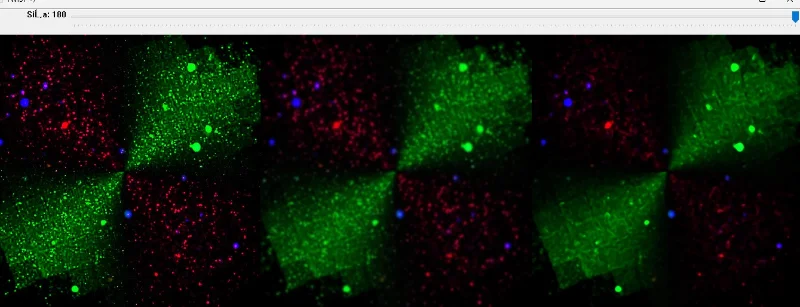
While experimenting with a 2D Fourier transform of an image, I obtained a cone‑like, layered pattern that resembles interference between a sharp signal and a temporally smeared component.

The structure looks like a central cone with repeating “shells” or “scales”, similar to what one might expect from interference between a real and a damped component of a signal.

My question is: Can such cone‑layered patterns arise purely from temporal smearing, phase interference, or spectral leakage in Fourier space?

I am not proposing a model, I’m only trying to understand whether this type of structure is known in signal analysis or astrophysical data processing (e.g., broadened pulses, chirps, or interference patterns).

Here is the image and the transform result:
nasaTIMDR.webp
 
Last edited by a moderator:
Physics news on Phys.org
I do not understand what you are doing.
I have taken many 2D DFT of images - there is nothing inherently "temporal" about the process.

I take it that the image you are working from has been transmitted with a signal that performs a raster scan of the image. If that is the case, then not only are the transmission characteristics of the signal channel important, the original encoding of the image is also critical.

You say "Here is the image and the transform result", followed by three similar images. All three images look like a telescopic picture of the night sky with an FFT super-imposed. Exactly what are those three images?

I am wondering if what I see is, in part, effects of jpg encoding along with image rotation.
Does that seem likely?

In any case, we will need more detail before we can guess what you are looking at.
Also, I would expect this post to be moved from "Special Relativity" to Astronomy or Math.
 
It might be worthwhile to look up Fourier transform side effect on the matlab site.

It you're using Matlab with a valid license you might be able to post a question on their website along with the image, your code, and anything done to the image like cropping it.

Closing this thread because we don't have enough to go on and it's more about debugging a personal program.
 

Similar threads

  • · Replies 27 ·
Replies
27
Views
6K
  • · Replies 2 ·
Replies
2
Views
3K
  • · Replies 17 ·
Replies
17
Views
5K
  • · Replies 4 ·
Replies
4
Views
2K
Replies
4
Views
5K
  • · Replies 8 ·
Replies
8
Views
6K
  • · Replies 13 ·
Replies
13
Views
4K