How Do I Calculate Confidence Intervals for Two Means?

Click For Summary
SUMMARY

This discussion focuses on calculating confidence intervals for the difference between two means, specifically using the formula for the normal distribution. The key components include the means (barX1 and barX2), standard deviations (sd1 and sd2), and sample sizes (n1 and n2). The Z value for a 95% confidence level is established as ±1.96. The formula provided is (barX1 - barX2) ± z * sqrt(sd1²/n1 + sd2²/n2), which defines the confidence interval for the difference between the two means.

PREREQUISITES
  • Understanding of basic statistics, including means and standard deviations.
  • Familiarity with the normal distribution and Z-scores.
  • Knowledge of confidence intervals and their significance in hypothesis testing.
  • Ability to perform calculations involving sample sizes and variances.
NEXT STEPS
  • Study the derivation and application of the confidence interval formula for two means.
  • Learn about hypothesis testing and its relationship with confidence intervals.
  • Explore the use of statistical software like R or Python for calculating confidence intervals.
  • Investigate graphical representations of confidence intervals to enhance understanding.
USEFUL FOR

Statisticians, data analysts, researchers, and students who need to calculate and interpret confidence intervals for comparing two means.

girlwhoneedsmathhelp
Messages
7
Reaction score
3
Here is the question I'm struggling with (Q1) :
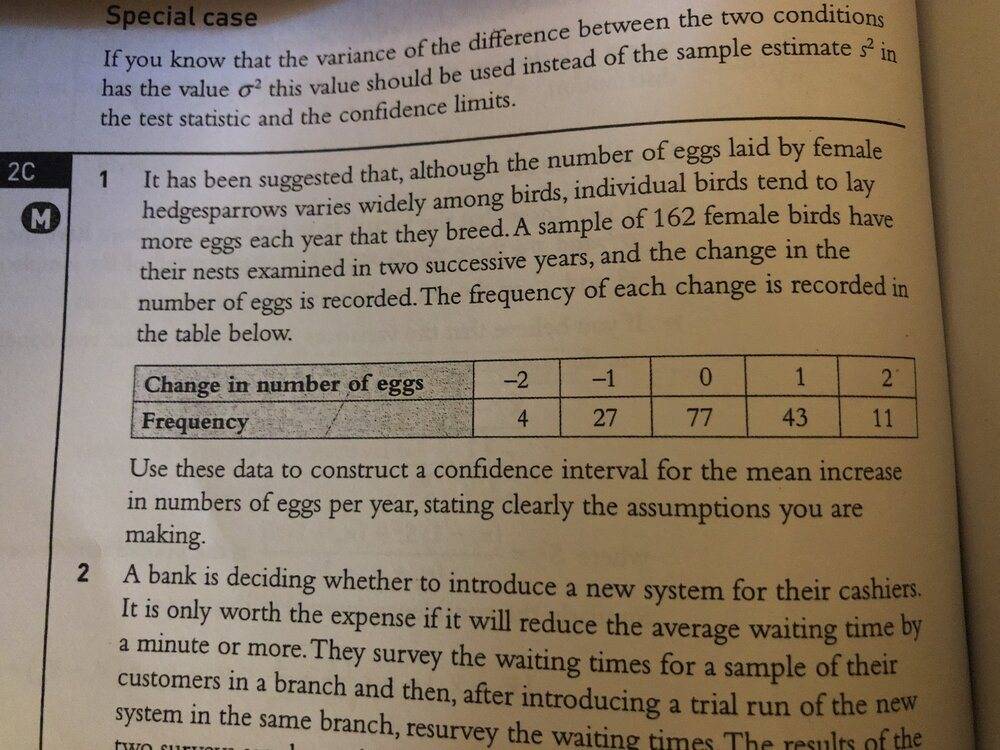
image_123927839.JPG

I just... I just don't understand what my first step is.
Whats my barx1 and barx2? (bar x = mean, x1 = subscript 1)

My thoughts on approaching this question :
barX1 - barX2 `~ N(u1-u2, sd1^2/n1 + sd2^2/n2)
Find Z value when p = 0.975, z = + or - 1.96
Formula : (barx1-barx2)-z(root (sd1^2/n1 + sd2^2/n2) < (u1-u2) < (barx1-barx2)-z(root (sd1^2/n1 + sd2^2/n2)

Please help me! Thank you :)
 
Physics news on Phys.org
In this case I believe the author wants you to look at the differences directly...the random variable is ##(x_2-x_1)## and the table provides the data. Maybe draw a graph.
 

Similar threads

  • · Replies 3 ·
Replies
3
Views
3K
Replies
6
Views
3K
Replies
6
Views
3K
  • · Replies 21 ·
Replies
21
Views
3K
Replies
5
Views
2K
  • · Replies 1 ·
Replies
1
Views
14K
  • · Replies 10 ·
Replies
10
Views
2K
  • · Replies 4 ·
Replies
4
Views
5K
  • · Replies 7 ·
Replies
7
Views
2K
Replies
2
Views
2K