Conformal Mapping for Transforming Regions: Finding a Function

Click For Summary
A conformal mapping transform function is sought to map a specific region in the z-plane into the interior of a unit circle in the w-plane. The Schwarz-Christoffel mapping is identified as a general approach, though it often lacks analytical solutions. The discussion suggests splitting the domain along the imaginary axis to simplify the mapping process, potentially using ζ=z^2 for a semi-circle transformation. A method proposed involves transforming a half-disk to a half-plane and then applying a Schwarz-Christoffel mapping to achieve a square. This process, while complex, is a feasible approach to solving the conformal mapping problem.
MaxJasper
Messages
1
Reaction score
0
Hello folks,

I am trying to find a conformal mapping transform function that maps the following region in z-plane into interior of a unit circle in w-plane:

|z-i|<\sqrt{2}\text{ ...AND... }|z+i|<\sqrt{2}
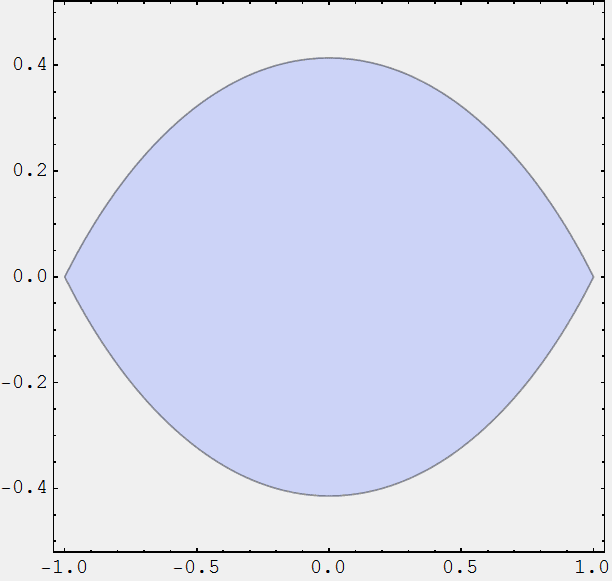
attachment.php?attachmentid=52520&stc=1&d=1351728946.png


Many thanks in advance for help & clues.
Max.
 

Attachments

  • Region.png
    Region.png
    5.5 KB · Views: 628
Last edited:
Physics news on Phys.org
The most general way to calculate a conformal mapping is a Schwarz-Christoffel mapping. This integral however can't be solved analytically in most cases.

You can split the domain in two along the imaginary axis and try to map the semi circle into one half, and then mirror it to get the other half. I know that you can get that half-shape through ζ=z^2 if you original domain is a square. You can see it here (p. 246):

http://www.math.umn.edu/~olver/pd_/cm.pdf

All you need then is a mapping from unit disk to unit square. One way you could (maybe) do this is by starting with the half-disk, tranform it to a half-plane, and then fold it to a square using a Schwarz-Christoffel mapping. I think that this case can be solved analytically. You then mirror your domain along the imaginary axis and you're done. This is easier said than done of course, but that is the nature of conformal mappings :biggrin:
 
Last edited by a moderator:
We all know the definition of n-dimensional topological manifold uses open sets and homeomorphisms onto the image as open set in ##\mathbb R^n##. It should be possible to reformulate the definition of n-dimensional topological manifold using closed sets on the manifold's topology and on ##\mathbb R^n## ? I'm positive for this. Perhaps the definition of smooth manifold would be problematic, though.

Similar threads

Replies
2
Views
2K
  • · Replies 3 ·
Replies
3
Views
2K
  • · Replies 3 ·
Replies
3
Views
3K
  • · Replies 5 ·
Replies
5
Views
981
  • · Replies 5 ·
Replies
5
Views
2K
  • · Replies 4 ·
Replies
4
Views
3K
  • · Replies 4 ·
Replies
4
Views
8K
  • · Replies 15 ·
Replies
15
Views
2K
  • · Replies 7 ·
Replies
7
Views
2K
  • · Replies 1 ·
Replies
1
Views
3K