Confusion about a capacitor with 2 different dielectrics

Click For Summary
SUMMARY

The discussion focuses on calculating the capacitance of a parallel-plate capacitor filled with two different dielectric slabs, each with constants K1 and K2, and thickness d/2. The incorrect application of the voltage equation V = Q/(4πε0r) was identified, as it is not suitable for parallel plates. Instead, the voltage should be expressed as a line integral over the electric field, leading to the correct formulation of capacitance. Additionally, understanding the geometric arrangement of the dielectric slabs is crucial for solving the problem accurately.

PREREQUISITES
  • Understanding of parallel-plate capacitors
  • Knowledge of dielectric materials and their properties
  • Familiarity with electric field calculations
  • Ability to perform line integrals in physics
NEXT STEPS
  • Learn how to calculate equivalent capacitance for capacitors in series and parallel
  • Study the effects of different dielectric materials on capacitance
  • Explore the concept of electric field strength in dielectric-filled capacitors
  • Review line integral techniques in electromagnetism
USEFUL FOR

Students studying electromagnetism, electrical engineers, and anyone seeking to understand capacitor behavior with multiple dielectrics.

Hieu
Messages
2
Reaction score
0
1. The problem statement, all variables, and given/known data
A parallel-plate capacitor has the space between the plates filled with to slabs of dielectric, one with constant K1, & one constant K2. each slab has thickness d⁄2, where d is plate separation, show the capacitance is?
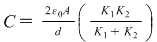
cramster-equation-2012241714286346397246825332121459.gif

Homework Equations


C=Q/V
E=Q/(ε0.A)
mrqBvc

V=Q/(4πε0.r)

The Attempt at a Solution


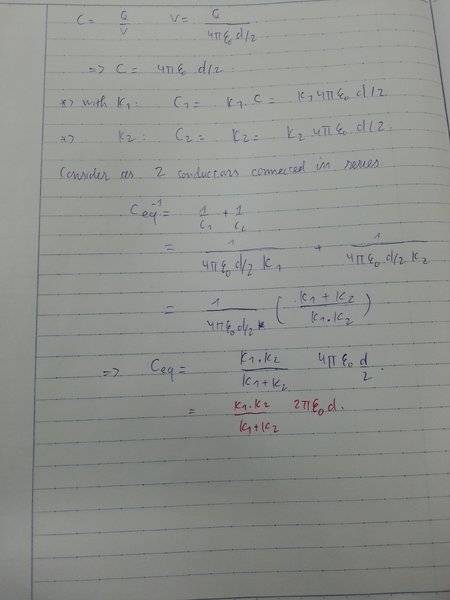
I consider the conductor as 2 different conductors with different slabs of the dielectric. I think that is not a bad idea to find the answer, but my result is different from the answer, maybe it is wrong somewhere. Can you guys help me? Here is my solution.
27901128_940949156060953_1878984400_o.jpg
 

Attachments

  • cramster-equation-2012241714286346397246825332121459.gif
    cramster-equation-2012241714286346397246825332121459.gif
    774 bytes · Views: 1,261
  • 27901128_940949156060953_1878984400_o.jpg
    27901128_940949156060953_1878984400_o.jpg
    22.9 KB · Views: 1,354
Physics news on Phys.org
Hello. Welcome to PF!

The mistake is using the equation ##V = \large \frac{Q}{4\pi\epsilon_0 r}##. This is not applicable to parallel plates.
 
  • Like
Likes   Reactions: Hieu and Vriska
You can express V as a line integral over the E field. Try using: $$V=\int_0^d E(z)dz=\int_0^{\frac {d} {2}} E_1(z)dz +\int_{\frac {d} {2}}^{d} E_2(z)dz $$where ##E=\frac {\sigma} {K\epsilon_0}##, d is plate separation and ##\sigma## is the charge density.

Peace
Fred
 
  • Like
Likes   Reactions: Hieu
Hi Hieu,

Your problem statement should be more specific about the geometric arrangement of the dielectric slabs between the plates. Do they divide the space horizontally or vertically? Given the expected answer we can deduce that the arrangement is two horizontal slabs dividing the space vertically (case B below), but it might be not so obvious to a new student approaching this type of problem for the first time.
upload_2018-2-9_11-11-18.png
 

Attachments

  • upload_2018-2-9_11-11-18.png
    upload_2018-2-9_11-11-18.png
    2.6 KB · Views: 1,250
  • Like
Likes   Reactions: Hieu
Fred Wright said:
You can express V as a line integral...

There is a much easier way for an old duffer like me that involves knowing how to calculate the equivalent capacitance for two capacitors in series or parallel.
 
  • Like
Likes   Reactions: Hieu

Similar threads

Replies
5
Views
726
  • · Replies 7 ·
Replies
7
Views
2K
  • · Replies 6 ·
Replies
6
Views
2K
Replies
4
Views
2K
Replies
3
Views
2K
Replies
9
Views
3K
Replies
10
Views
4K
  • · Replies 4 ·
Replies
4
Views
2K
  • · Replies 17 ·
Replies
17
Views
3K
  • · Replies 8 ·
Replies
8
Views
2K