Confusion about friction in rotating ring

Join the discussion
Ask a follow-up here, or get your own question answered by working scientists, mathematicians and engineers — people, not an autocomplete.
Real named experts · corrections over time · the nuance an AI answer skips
12 replies · 1K views
palaphys
Messages
269
Reaction score
19
Homework Statement
A ring of mass m and radius r is rotating on a horizontal rough table with coefficient of friction. how long does the ring take to stop rotating? What is the frictional force from the ground?
Relevant Equations
Torque=r×F
So to begin with, I did this:

$$


\begin{align*}
dm &= \frac{M}{2\pi} d\theta \\
dN &= dm \cdot g = \frac{M}{2\pi} g \, d\theta \\
df &= \mu_k \, dN = \mu_k \frac{M}{2\pi} g \, d\theta \\
f &= \int df = \int_0^{2\pi} \mu_k \frac{M}{2\pi} g \, d\theta \\
f &= \mu_k \frac{M}{2\pi} g \int_0^{2\pi} d\theta \\
f &= \mu_k \frac{M}{2\pi} g \cdot 2\pi \\
f &= \mu_k M g
\end{align*}


$$

However, I had a thought- what if I could simply super impose all the frictional force vectors on every small element? Wouldnt that add up to 0?As there are vectors of equal magnitude in every direction.. Then why do I end up with some other answer?
 

Attachments
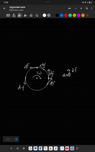
  • Screenshot_20250216-155034.png
    Screenshot_20250216-155034.png
    10.5 KB · Views: 78
Physics news on Phys.org
palaphys said:
However, I had a thought- what if I could simply super impose all the frictional force vectors on every small element? Wouldnt that add up to 0?As there are vectors of equal magnitude in every direction..
Yes. That's right. The net friction force is zero.

palaphys said:
Then why do I end up with some other answer?
Your integration is adding up the magnitudes of the infinitesimal friction force elements. But, forces add as vectors, as you noted. So, your integration does not take into account the different directions of the infinitesimal forces.

This problem deals with rotation. What is the rotational analog of force?
 
Reply
  • Like
Likes   Reactions: Lnewqban
So you say that due to the fact that vectorially the force is 0, the center of mass of the ring does not undergo any acceleration?
 
Reply
  • Like
Likes   Reactions: jbriggs444
palaphys said:
So you say that due to the fact that vectorially the force is 0, the center of mass of the ring does not undergo any acceleration?
Yes. I'm assuming the ring is lying "flat" on the table. The axis of the ring is vertical. Is this right?
 
Yeah got it just gotta use tau is moment of inertia times alpha and then simple angular kinematics. Thanks
 
Can I briefly add to what @TSny has said?

Writing ##f =\int {d\!f}## is wrong and leads to an incorrect answer,

It should be ##\vec f = \int \vec {d\!f} ##. When we integrate a vector, the different directions of the elements must be taken into account.
 
Reply
  • Like
Likes   Reactions: Orodruin and TSny
TSny said:
OK. Can you summarize how you found tau?
I used tau=I(alpha) =r×F
 
Steve4Physics said:
Can I briefly add to what @TSny has said?

Writing ##f =\int {d\!f}## is wrong and leads to an incorrect answer,

It should be ##\vec f = \int \vec {d\!f} ##. When we integrate a vector, the different directions of the elements must be taken into account
If I did that would I get 0?