Confusion about the Heaviside method

Click For Summary
SUMMARY

The discussion centers on the Heaviside method for partial fraction decomposition, specifically addressing the confusion surrounding the cancellation of terms when evaluating limits. Participants clarify that while one cannot cancel zeros, one can cancel expressions that behave similarly near specific points. The limit as x approaches a root does not imply that the function is defined at that root, as demonstrated through the example of the limit of x/x as x approaches 0. The conversation emphasizes the importance of understanding removable discontinuities and the proper application of limits in polynomial equations.

PREREQUISITES
  • Understanding of limits in calculus, specifically limit evaluation techniques.
  • Familiarity with polynomial functions and their properties.
  • Knowledge of partial fraction decomposition and the Heaviside method.
  • Concept of removable discontinuities in mathematical functions.
NEXT STEPS
  • Study the application of the Heaviside method in partial fraction decomposition for higher-degree polynomials.
  • Learn about removable discontinuities and their implications in calculus.
  • Explore limit evaluation techniques, including L'Hôpital's Rule and epsilon-delta definitions.
  • Practice solving polynomial equations and their behavior at roots using various methods.
USEFUL FOR

Students of calculus, mathematics educators, and anyone interested in mastering the concepts of limits and polynomial functions, particularly in the context of partial fraction decomposition.

ali PMPAINT
Messages
44
Reaction score
8
Homework Statement
described on picture
Relevant Equations
described on picture
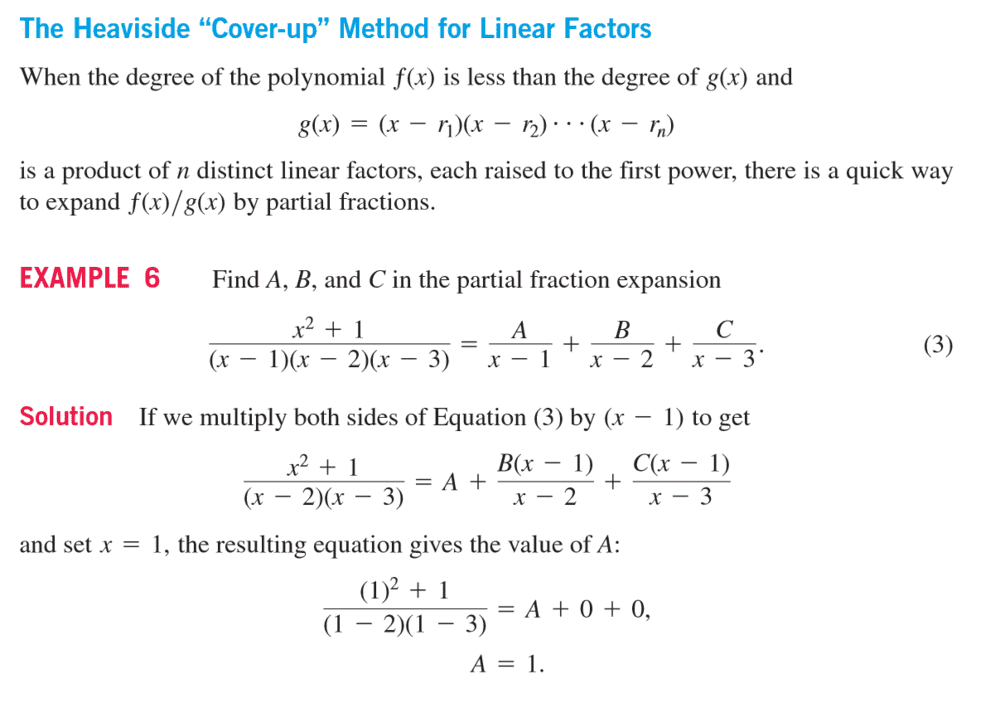
So, Heavside's method confused me, I mean, but we can't divide by zero, can we?
Capture.PNG

So, my mind sees it as cheating, and to multiply both sides by zero to cancel zeros, and for the example above(from Thomas Calulus), when x = 1, before you multiply by x-1(=0), you get: 2/0=A/0+B/-1+c/-2, and I think you get the point where I am confused, where am I misunderstanding Heavside's method?
 
Physics news on Phys.org
But it is not multiplied by zero. It is multiplied by the variable ##x-1##.
Either case, before or after canceling ##x-1##. The equality holds for the limit ##x=1##.

You cannot cancel zeros, but you can cancel expressions, because same expressions have the same behavior (Same value at any chosen point). Take the following:

$$\lim_{x\rightarrow 0} \frac{x}{x}=1$$

Even without cancelling the terms ##x##, the limit is ##1##. Although, approaching the function ##x## itself is zero. Cancelling expressions is not the same as cancelling numbers.

You can check the previous with a simple table, approaching zero from the left and the right of ##x##.

**Not an expert, but this is what I think.
 
  • Like
Likes   Reactions: ali PMPAINT
Phylosopher said:
You cannot cancel zeros, but you can cancel expressions, because same expressions have the same behavior (Same value at any chosen point). Take the following:

$$\lim_{x\rightarrow 0} \frac{x}{x}=1$$
Well, you're kind of right, but $$\lim_{x\rightarrow 0} \frac{x}{x}=1$$ doesn't imply x/x = 1 when x = 0, does it?
So, if you're saying that we should take the limit as x is approaching to a specific number, like 1 on the first post example, it doesn't mean that the value EQUALS the number it approaches, so, although I liked your reasoning, I'm still not convinced.
 
ali PMPAINT said:
\lim_{x\rightarrow 0} \frac{x}{x}=1 doesn't imply x/x = 1 when x = 0, does it?

The limit is 1 for ##x\rightarrow 0##.

Well, it is more like a removable discontinuity. Sadly, this is my best explanation, maybe others can help us understand.
 
  • Like
Likes   Reactions: ali PMPAINT
ali PMPAINT said:
Well, you're kind of right, but $$\lim_{x\rightarrow 0} \frac{x}{x}=1$$ doesn't imply x/x = 1 when x = 0, does it?
No, it doesn't. There's a big difference between ##\lim_{x \to 0}\frac x x## on the one hand, and ##\frac x x## when x = 0, on the other hand. In the first expression, x is not allowed to be equal to 0, but merely close to zero. The actual definition of the limit doesn't involve "merely close," but instead involves open neighborhoods around 0, but not including 0.

ali PMPAINT said:
So, if you're saying that we should take the limit as x is approaching to a specific number, like 1 on the first post example, it doesn't mean that the value EQUALS the number it approaches, so, although I liked your reasoning, I'm still not convinced.
No one is saying that if x = 0, the expression ##\frac x x## has any meaning. What is being said is that the expression ##\frac x x## can be made as near to 1 as anyone specifies, by taking values of x that are within a specified interval.
 
  • Like
Likes   Reactions: ali PMPAINT
The original polynomial fraction is well define everywhere except at it's roots. The partial fraction expansion is also well defined everywhere except at those same roots. So I don't see any problem with this. Nothing makes sense at the roots, everything agrees away from the roots. In what sense is the expansion not equivalent to the original function?
 
  • Like
Likes   Reactions: ali PMPAINT
Here's the original problem:
$$\frac {x^2 + 1}{(x - 1)(x - 2)(x - 3)} = \frac A{x - 1} + \frac B{x - 2} + \frac C{x - 3}$$
Obviously this equation is not defined at x = 1, x = 2, and x = 3.
A different approach than is shown in post #1 is to multiply both sides by ##(x - 1)(x - 2)(x - 3)## assuming that x is not any of 1, 2, or 3.
The resulting equation is $$x^2 + 1 = A(x - 2)(x - 3) + B(x - 1)(x - 3) + C(x - 1)(x - 2)$$
Unlike the first equation above, this equation is a polynomial, and is defined for all real numbers, including 1, 2, and 3.
If we set x = 1, we get ##2 = 2A##, so A = 1.
Setting x to 2 and 3, respectively, we get values for B and C.

Alternatively, we can expand the right side of the polynomial, and then rearrange and group the terms on the right by powers of x, noting that the coefficient of the ##x^2## term has to be 1, the coefficient of the ##x## term has to be 0, and the constant term has to be 1. We could then find the values of A, B, and C.
 
  • Like
Likes   Reactions: ali PMPAINT
Mark44 said:
Here's the original problem:
$$\frac {x^2 + 1}{(x - 1)(x - 2)(x - 3)} = \frac A{x - 1} + \frac B{x - 2} + \frac C{x - 3}$$
Obviously this equation is not defined at x = 1, x = 2, and x = 3.
A different approach than is shown in post #1 is to multiply both sides by ##(x - 1)(x - 2)(x - 3)## assuming that x is not any of 1, 2, or 3.
The resulting equation is $$x^2 + 1 = A(x - 2)(x - 3) + B(x - 1)(x - 3) + C(x - 1)(x - 2)$$
Unlike the first equation above, this equation is a polynomial, and is defined for all real numbers, including 1, 2, and 3.
If we set x = 1, we get ##2 = 2A##, so A = 1.
Setting x to 2 and 3, respectively, we get values for B and C.

Alternatively, we can expand the right side of the polynomial, and then rearrange and group the terms on the right by powers of x, noting that the coefficient of the ##x^2## term has to be 1, the coefficient of the ##x## term has to be 0, and the constant term has to be 1. We could then find the values of A, B, and C.

Nice approach, though it might not look like a limit has been used, it has been used for the numerator equation at the beginning. I find it hilarious that we cannot talk about a simple manipulation without introducing limits.

I think the following is quite satisfying:

The misleading part in the solution obtained, is actually ##A=1##. The limit must be used to find this result! Because, the equation as @DaveE suggested is not defined at the roots. We are basically forcing ##A## to be defined on the roots. So, a better solution (or statement) would be the following in my opinion:

$$\frac {x^2 + 1}{(x - 1)(x - 2)(x - 3)} = \frac A{x - 1} + \frac B{x - 2} + \frac C{x - 3};\ \forall x\in [-\infty,1)\cup(1,2)\cup(2,3)\cup(3,\infty]$$

In which, if we equate the denominators of both sides, the following equation is found:

$$x^2 + 1= A(x-2)(x-3)+B(x-1)(x-3)+C(x-1)(x-2);\ \forall x\in [-\infty,1)\cup(1,2)\cup(2,3)\cup(3,\infty]$$

We do not set ##x=1## because it is not allowed. Instead, we reformulate the equation:

$$x^2 + 1= x^{2}(A+B+C)+x(-5A-4B-3C)+(6A+3B+2C);\ \forall x\in [-\infty,1)\cup(1,2)\cup(2,3)\cup(3,\infty]$$

From this, a set of three solvable equations is obtained:

$$A+B+C=1$$
$$-5A-4B-3C=0$$
$$6A+3B+2C=1$$

Solving this with whatever method:

$$A=1,B=-5,C=5;\ \forall x\in [-\infty,1)\cup(1,2)\cup(2,3)\cup(3,\infty]$$We basically shouldn't have forced the result to be defined on the real numbers.
 
  • Like
Likes   Reactions: ali PMPAINT
Phylosopher said:
Nice approach, though it might not look like a limit has been used, it has been used for the numerator equation at the beginning. I find it hilarious that we cannot talk about a simple manipulation without introducing limits.

I think the following is quite satisfying:

The misleading part in the solution obtained, is actually ##A=1##. The limit must be used to find this result! Because, the equation as @DaveE suggested is not defined at the roots. We are basically forcing ##A## to be defined on the roots. So, a better solution (or statement) would be the following in my opinion:

$$\frac {x^2 + 1}{(x - 1)(x - 2)(x - 3)} = \frac A{x - 1} + \frac B{x - 2} + \frac C{x - 3};\ \forall x\in [-\infty,1)\cup(1,2)\cup(2,3)\cup(3,\infty]$$

In which, if we equate the denominators of both sides, the following equation is found:

$$x^2 + 1= A(x-2)(x-3)+B(x-1)(x-3)+C(x-1)(x-2);\ \forall x\in [-\infty,1)\cup(1,2)\cup(2,3)\cup(3,\infty]$$

We do not set ##x=1## because it is not allowed. Instead, we reformulate the equation:

$$x^2 + 1= x^{2}(A+B+C)+x(-5A-4B-3C)+(6A+3B+2C);\ \forall x\in [-\infty,1)\cup(1,2)\cup(2,3)\cup(3,\infty]$$

From this, a set of three solvable equations is obtained:

$$A+B+C=1$$
$$-5A-4B-3C=0$$
$$6A+3B+2C=1$$

Solving this with whatever method:

$$A=1,B=-5,C=5;\ \forall x\in [-\infty,1)\cup(1,2)\cup(2,3)\cup(3,\infty]$$We basically shouldn't have forced the result to be defined on the real numbers.
Thanks, but that wasn't what I was looking for. For longer polynomial degrees, this method will get harder and harder, so we use Heaviside's method. However, I found a way to use this method without setting x to equal 1 (or the root). For 2 degree polynomial, we have:
3.png

Which I think we can generalize it for higher degrees. Here is the general solution:
Capture.PNG

(From Thomas Calculus)
 
Last edited:
  • #10
Mark44 said:
A different approach than is shown in post #1 is to multiply both sides by ##(x - 1)(x - 2)(x - 3)## assuming that x is not any of 1, 2, or 3.
The resulting equation is $$x^2 + 1 = A(x - 2)(x - 3) + B(x - 1)(x - 3) + C(x - 1)(x - 2)$$
So here, you assumed x isn't 1, 2 and 3,
Mark44 said:
Unlike the first equation above, this equation is a polynomial, and is defined for all real numbers, including 1, 2, and 3.
If we set x = 1, we get ##2 = 2A##, so A = 1.
Setting x to 2 and 3, respectively, we get values for B and C.
But after multiplying, you said it is?
Now it is getting more confusing...
 
  • #11
ali PMPAINT said:
Thanks, but that wasn't what I was looking for. For longer polynomial degrees, this method will get harder and harder, so we use Heaviside's method.

This is not the point of your thread. The question you asked was about setting ##x## to the root values, and whether it is even a liable action. Thus, my answer was evolving around this, not about the method in which we solve the problem.

Putting that aside, assuming my answer is mathematically satisfying, it follows that you only need to restrict the domain of the solutions ##A_{i}## while using the book method. No need to use a different method to begin with.
 
  • Like
Likes   Reactions: ali PMPAINT
  • #12
Phylosopher said:
This is not the point of your thread. The question you asked was about setting ##x## to the root values, and whether it is even a liable action. Thus, my answer was evolving around this, not about the method in which we solve the problem.

Putting that aside, assuming my answer is mathematically satisfying, it follows that you only need to restrict the domain of the solutions ##A_{i}## while using the book method. No need to use a different method to begin with.
Well, yeah, but my goal was to prove this method(Heaviside's method) without having zero in dinomerater, sorry if I didn't mention this.
 
  • #13
Mark44 said:
A different approach than is shown in post #1 is to multiply both sides by ##(x - 1)(x - 2)(x - 3)## assuming that x is not any of 1, 2, or 3.
The resulting equation is $$x^2 + 1 = A(x - 2)(x - 3) + B(x - 1)(x - 3) + C(x - 1)(x - 2)$$
ali PMPAINT said:
So here, you assumed x isn't 1, 2 and 3,
Mark44 said:
Unlike the first equation above, this equation is a polynomial, and is defined for all real numbers, including 1, 2, and 3.
If we set x = 1, we get ##2 = 2A##, so A = 1.
Setting x to 2 and 3, respectively, we get values for B and C.
ali PMPAINT said:
But after multiplying, you said it is?
Now it is getting more confusing...
I thought I was clear on what I was doing. The original equation is not defined for x = 1, x = 2, and x = 3. When we multiply both sides by (x - 1)(x - 2)(x - 3), we get a new equation that is defined for all real numbers. If for some reason it bothers you to set x to 1, 2, and 3, respectively, you can set x to any other three values to get three equations in the unknowns A, B, and C. It's just more convenient to work with x = 1, 2, and 3.

Why is this confusing? We have two different equations, with different domains.
 

Similar threads

  • · Replies 11 ·
Replies
11
Views
2K
Replies
9
Views
1K
  • · Replies 1 ·
Replies
1
Views
3K
  • · Replies 25 ·
Replies
25
Views
1K
  • · Replies 14 ·
Replies
14
Views
2K
  • · Replies 1 ·
Replies
1
Views
3K
  • · Replies 1 ·
Replies
1
Views
2K
  • · Replies 20 ·
Replies
20
Views
2K
  • · Replies 8 ·
Replies
8
Views
2K
  • · Replies 4 ·
Replies
4
Views
1K